What it actually looks like.
Real screens from the running app — not mockups.
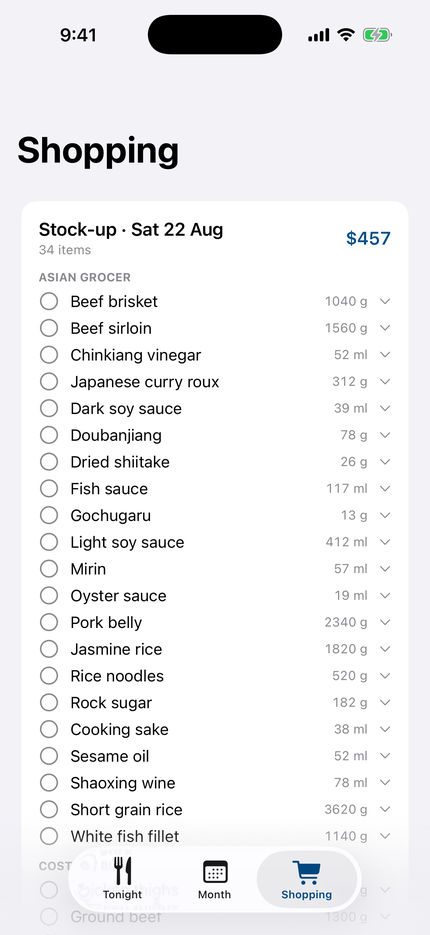
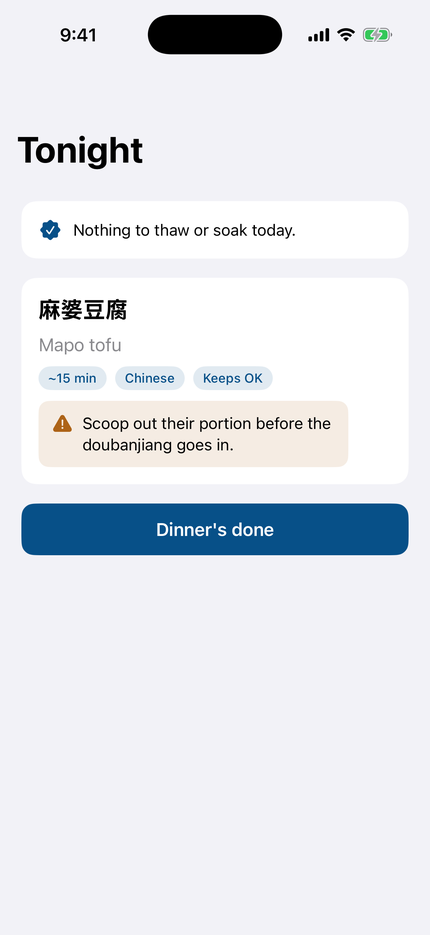
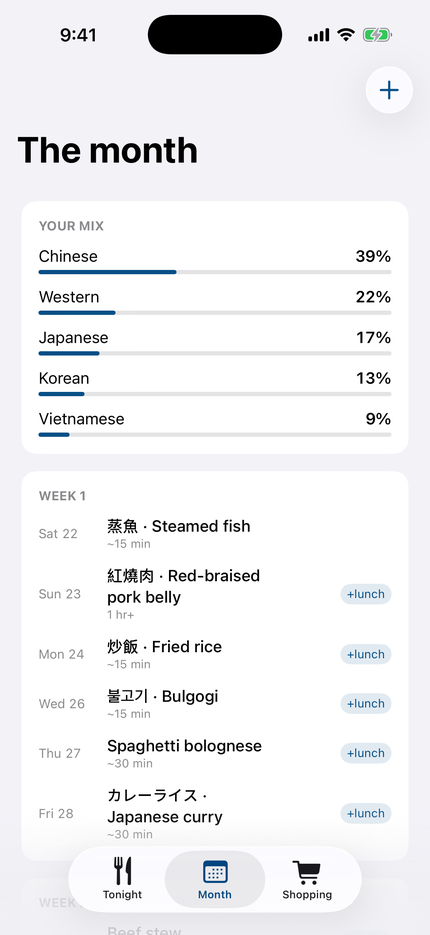
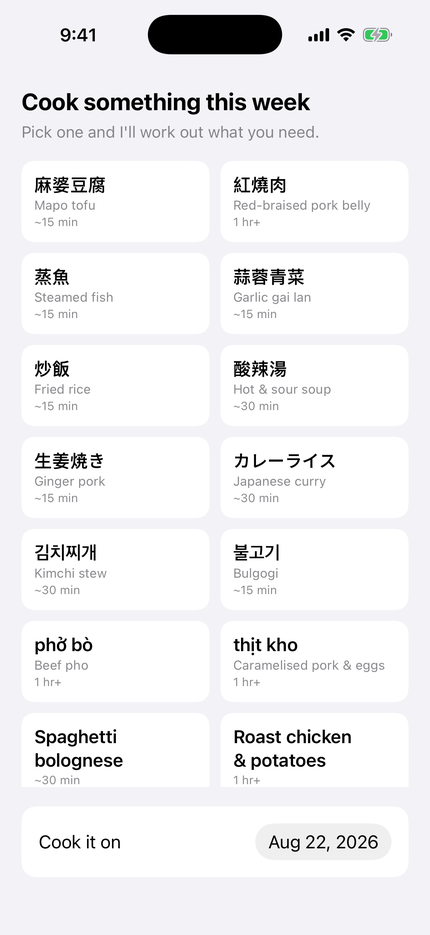
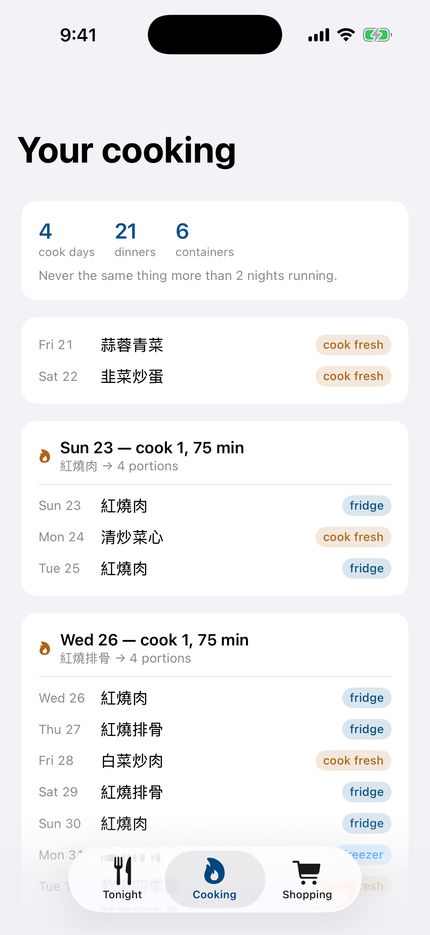
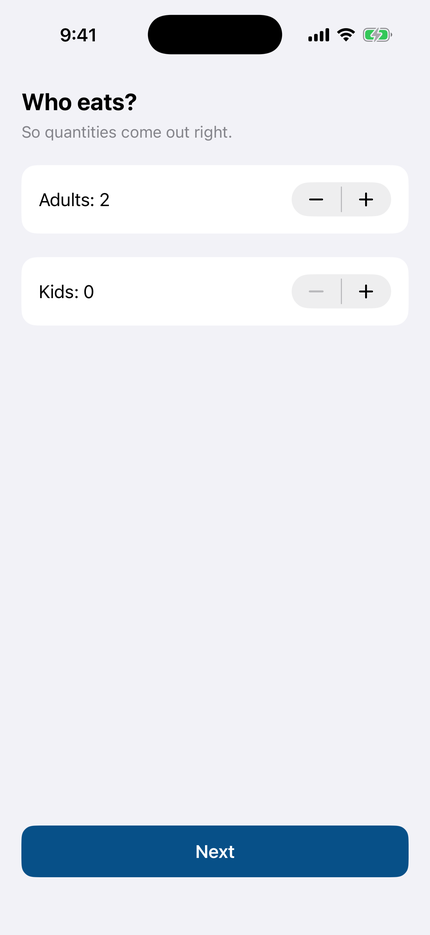
Every meal app helps you decide what to cook. Mise works out what to buy — how much, from which shop, and on which day — then keeps being right after Tuesday goes sideways.
In development. This page will link the App Store listing when it ships.
The painful, expensive, weekly decision isn't what shall we eat — it's what to put in the trolley. Buy for a month and you're doing quantity maths for thirty dinners in the car park. Buy weekly and you pay for it in trips.
So Mise isn't a recipe app with a planner bolted on. You tell it the twenty-odd dishes you already cook — the ones you actually make on a Tuesday, not ones you saved and never touched — and it runs the supply chain behind them.
A monthly stock-up carries the shelf-stable and freezer items. Short top-up runs carry the fresh. Each line traces back to the dinners that need it — tap the ground beef and you'll see which three nights it's spoken for.
And the lists split by where you actually shop. A household cooking mostly Chinese food does two different runs; no other planner writes the list that way.
Real screens from the running app — not mockups.
Every meal app's ingredient list is Anglo-American, which is why a family eating mostly Chinese food has no good option. Mise ships Chinese, Japanese, Korean, Vietnamese and Western dishes in one rotation, and carries cross-language ingredient names — gai lan is also 芽蘭 and Chinese broccoli — so a shopping list works whichever name is on the label.
Every dish shows both scripts. Plenty of the people this is for grew up eating 麻婆豆腐 without ever learning to read it — and the other adult in the house often reads neither — so the plan is legible to everyone who has to shop from it.
It also knows which dishes survive being cooked ahead. Braises and soups batch beautifully; stir-fried greens on day three are a tragedy. That distinction is the difference between a plan you follow and one you abandon by Wednesday.
Every planner is brittle. You order takeout on Tuesday, the model is now wrong about what's in your fridge, and the app quietly starts lying to you.
Mise expects it. One tap — ate out — and the rest of the month re-solves. Tuesday's pork doesn't evaporate; the dish slides to a later night, anything perishable gets pulled forward so it's cooked before it spoils, and the next shopping list shrinks because you already own the food.
Every app that tried barcode scanning or a pantry checklist is dead, and better software doesn't change the fact that nobody will do the typing. Mise works it out instead: it knows what you bought and what you cooked, so it knows roughly what's left.
Where it's unsure, it says so and errs toward putting the item on the list — being wrong about “you've got soy sauce” ruins a dinner, while being wrong the other way costs four dollars.
No. You tell it the dishes you already cook, and it handles the scheduling and the shopping. There's no feed to scroll and nothing to browse.
That's what it was built for. Chinese, Japanese, Korean, Vietnamese and Western dishes sit in one rotation, ingredients carry cross-language names, and the shopping list splits the Asian grocer run from the supermarket run.
One tap, and the rest of the month re-solves. The food you already bought doesn't vanish from the plan — the dish moves and anything perishable gets pulled forward.
Most cases where kids can't eat what the adults are eating are a fork in the method, not a second meal — and Mise knows where that fork is. It also budgets how many genuinely separate cooks land in a week.
Yes, and the plan changes shape entirely. For one person every recipe is a batch, so it schedules a couple of cook sessions and interleaves the portions so you're never eating the same thing more than two nights running.
Not yet — it's in development. This page will link the App Store listing when it ships.
We build software that removes a specific piece of friction rather than adding another thing to check. If you've got a job that looks like this one, tell us about it.