 Feng Shui Scan
The four pillars
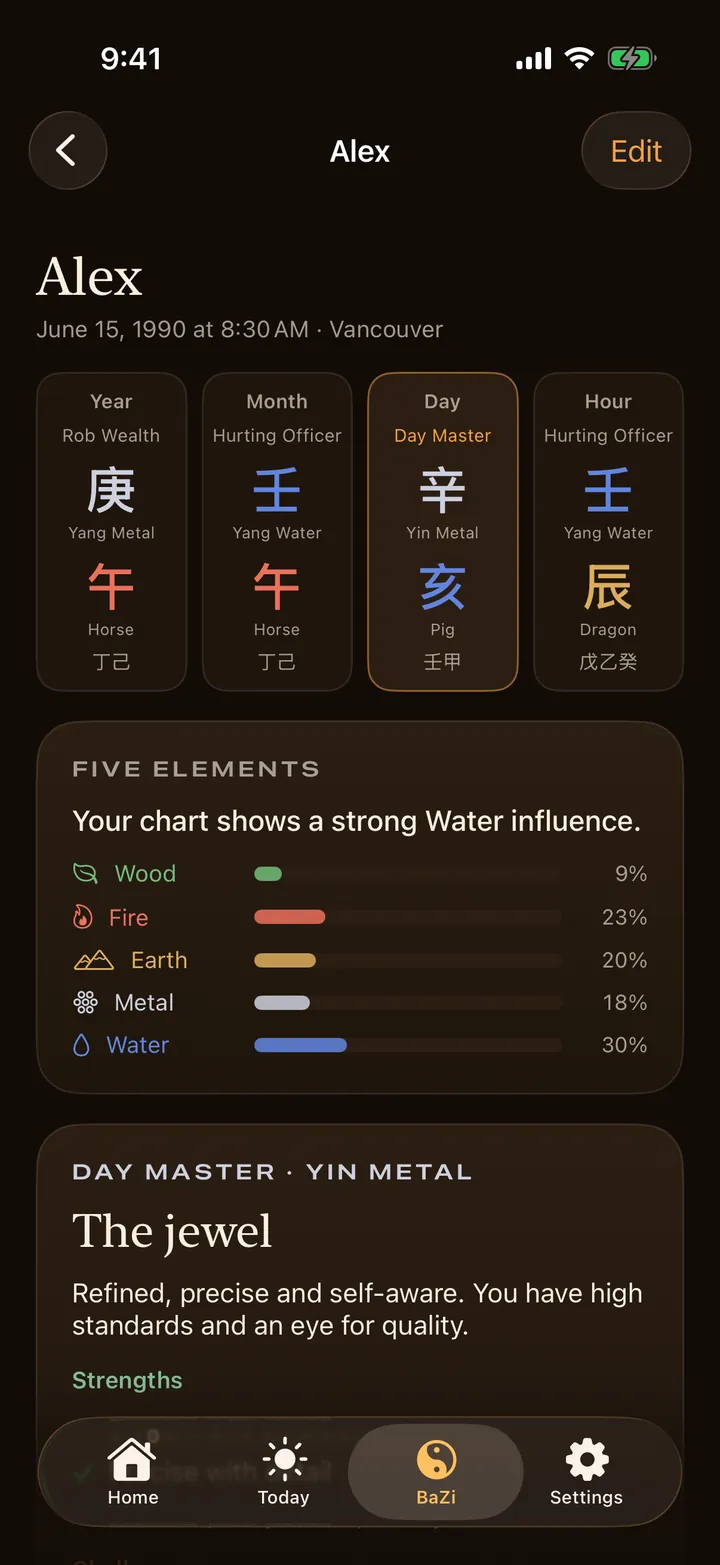
Each pillar has two parts: a Heavenly Stem on top and an Earthly Branch below. There are ten stems, which are the five elements in a yang and a yin form. There are twelve branches, the same twelve that carry the animal signs. Four pillars of two characters make eight, which is where the name comes from.
Most people know only one of their eight characters: the branch of the year pillar, their zodiac animal. A BaZi reading uses all of them, and it gives the most weight to a different one.
Each branch is also said to contain one to three hidden stems. They count toward a chart’s elements, which is why a chart can be rich in an element that does not appear on its surface.
The Day Master and the five elements
The stem of the day pillar is called the Day Master. It stands for the person the chart belongs to, and everything else is read in relation to it. Someone whose Day Master is yang Wood is described differently from someone whose Day Master is yin Water, whatever their year animal.
The five elements are Wood, Fire, Earth, Metal and Water. They are linked by two cycles: each element produces the next, and each controls another. A reading counts how much of each element the chart holds, asks whether the Day Master is strong, balanced or weak within that mix, and from there judges which elements the chart is said to benefit from. That last step is covered under favorable elements.
Ten Gods and luck pillars
The Ten Gods are names for how each other stem relates to the Day Master. There are five relationships: the same element as the Day Master, the element that produces it, the element it produces, the element it controls, and the element that controls it. Each splits in two by yin and yang, giving ten. Practitioners read them as themes such as peers, support, expression, wealth and authority.
Luck pillars are ten-year periods, each with its own stem and branch, that are laid over the birth chart in sequence through a life. Whether the sequence runs forward or backward follows a traditional rule that depends on the birth year and the person’s sex. Years, months and days have pillars of their own as well, which is the basis of yearly and daily readings.
Why the birth time and place matter
BaZi follows the solar calendar, not the lunar one, and its boundaries do not fall where people expect.
- The year pillar turns at Li Chun, the start of spring, around 4 February. It does not change on 1 January or at Lunar New Year. Someone born in late January belongs to the previous year’s pillar.
- The month pillars turn at solar terms, twelve fixed points in the sun’s year, not on the first of a calendar month.
- The day turns at 23:00, the start of the Zi hour.
- The hour pillar needs a birth time. Without one, the chart is read from three pillars.
Because the boundaries are tied to the sun, some practitioners adjust clock time to true solar time using the longitude of the birthplace. For a birth close to a boundary, that adjustment can change a pillar.
What BaZi is, and is not
BaZi is a framework for description that has been taught and argued over for a very long time. Schools differ on method, and two readers can weigh the same chart differently. It does not tell you what will happen, and it is not a basis for medical, financial or legal decisions.
One practical use is in the home. Each element has directions, colours and materials, so a chart’s favoured elements can be applied to where you sleep and work. See BaZi and Feng Shui for how the two fit together, and favorable directions for the compass side. This is a different method from the Kua number used in Eight Mansions, and the two do not always agree.