 Feng Shui Scan
Why the front door counts for so much
Every school gives the front door a leading role, though for different reasons. The form school treats it as the point where the flow comes in, so everything it reads further inside starts there. Black Hat lines its Bagua up with the door. Compass schools take a direction from the entrance or from the way the building faces.
Which door counts is a fair question in a house where everyone comes in through the garage or the side. Many teachers hold to the formal front door, the one the building was designed around. Others read the door the household really uses. If yours are different doors, the common advice is to check both and to use the front door often enough that it is not sealed up behind a coat rack.
In an apartment the answer is simple: it is the door of your own unit.
The door itself
Before looking at what it faces, look at how it works.
- It should open fully. A door that stops at sixty degrees because of what hangs or stands behind it is read as a narrowed mouth. This is also the easiest finding in the whole home to fix.
- It should work well. A lock that sticks, a hinge that squeals, a bell that does not ring and a dead bulb above the step are all counted against it. None of that needs a theory to justify repairing.
- It should be easy to find. A visible number and a lit approach are standard recommendations.
Many practitioners also prefer a solid door to one that is mostly glass, and a door that opens inward. Both are minor points next to what the door faces.
One more thing belongs here: a wall very close in front of the door. If you open the door and meet a wall within a step or two, tradition reads the flow as stopped at once. The usual answer is to give that wall depth with a picture and good light, and to keep the floor to either side clear. The space just inside is the subject of the entryway guide.
Front door facing a window or back door
This is the alignment the tradition talks about most. When the front door lines up with a large window, a patio door or a back door, the flow is said to cross the home in a straight line and leave, without turning into any room.
To check, stand in the open doorway and look straight ahead, not at an angle. If glass or an outside door fills the middle of your view, you have the line. A window off to one side does not count.
The remedies all do the same thing, which is to give the line something to go around:
- A table, bookcase or large plant placed on the line, well inside the home and not in the entry itself.
- A rug laid across the line, which is said to slow it.
- A sheer curtain or blind on the far window, kept at least partly drawn.
- An internal door on the line kept closed.
How this alignment arises in different plans, and why some homes have it built in, is covered under home layout.
Facing a bathroom, a bedroom or stairs
A bathroom. Tradition reads bathrooms as rooms where things drain away, and a straight view from the front door into one is said to send the incoming flow the same way. The plain objection is that guests see the toilet first. Keeping the bathroom door closed is the universal advice. See the bathroom guide for the rest.
A bedroom. The entrance is the busiest point of a home, and a bedroom in its direct view is considered too exposed to rest in. Keep that door closed, and place the bed where the front door cannot see it. Bed placement is covered in the bedroom guide.
Stairs. A staircase that starts directly opposite the front door has a long-standing reading: the flow is said to run straight up to the next floor and miss the ground floor, or to run down the stairs and out. Remedies offered include a rug or a plant at the foot of the stairs and a light on the landing. Practitioners differ on how much distance between the door and the first step takes the problem away; see front door facing stairs.
A related case, two internal doors looking at each other, has its own page under door facing door.
A mirror opposite the door
A mirror hung straight across from the front door is one of the most repeated cautions in popular Feng Shui. The reason given is that it reflects the incoming flow back out before it has entered. The caution is strongest in the Black Hat school and in general advice derived from it. Some classically trained practitioners give mirrors little weight either way.
There is an ordinary reason to agree with the rule. Opening your own door to a figure moving toward you is startling, even when the figure is you. The fix is to move the mirror to a wall at right angles to the door. Mirrored wardrobe doors opposite the entrance are harder, and the usual suggestions are a curtain, a frosted film or leaving the slider open on the side the door faces.
Front door direction and color
This is where the schools separate, and it is best to be honest that they do not converge.
The form school has no preferred direction. Eight Mansions compares the door’s direction with the person’s favourable directions, worked out from a Kua number. Flying Stars charts the building from its facing and the period it was built in. Approaches based on BaZi start from the elements a chart is said to favour and the directions that go with them. Classical practitioners also point out that a building’s facing is not always the direction of its door.
Colour follows the same split. A common compass rule matches the door’s colour to the element of the direction it faces. Black Hat teaching often recommends red whatever the direction. These can contradict each other for the same door.
You cannot turn a door to face another way, so direction is something to read, not something to fix. Paint is cheap if you want to follow one school’s colour. In form-school terms, what the door faces inside the home matters more than either.
Doors that face something
- An apartment door looking across the living room at balcony doors — put a tall plant or a narrow bookcase on that line near the middle of the room, and keep a sheer curtain across the glass. Leave the entry floor clear.
- A front door facing a bathroom at the end of a short hall — the bathroom door stays shut. If it tends to drift open, a self-closing hinge does more than any decoration.
- A front door that opens a metre from the stairs — a rug at the foot of the stairs and a light at the top are the standard measures, and neither gets in the way of the door.
- Mirrored wardrobe doors directly opposite the entrance — cover the panel the door faces with frosted film, or hang a full-length curtain you can draw across it.
Common mistakes
- Checking the view from inside the hall — the line is read from the threshold with the door open. A step to one side changes what is in the centre.
- Blocking the entry to break a line — a screen or cabinet directly inside the door swaps one problem for another. Place the object further in. See blocked entryway.
- Painting the door before clearing behind it — colour is where schools disagree, and a door that opens fully is where they agree.
- Hanging a mirror opposite the door to make the hall look bigger — it does, and it is also the one position the tradition warns about. A side wall gives nearly the same effect.
Whether your front door truly lines up with the balcony door, or only seems to from where you usually stand, comes down to a few centimetres. It is easier to see on a plan than from the doormat.
SCAN YOUR ENTRANCE
Start the scan at your front door and see what it lines up with across the home.
Coming to the App Store · iPhone and iPad · submitted for review
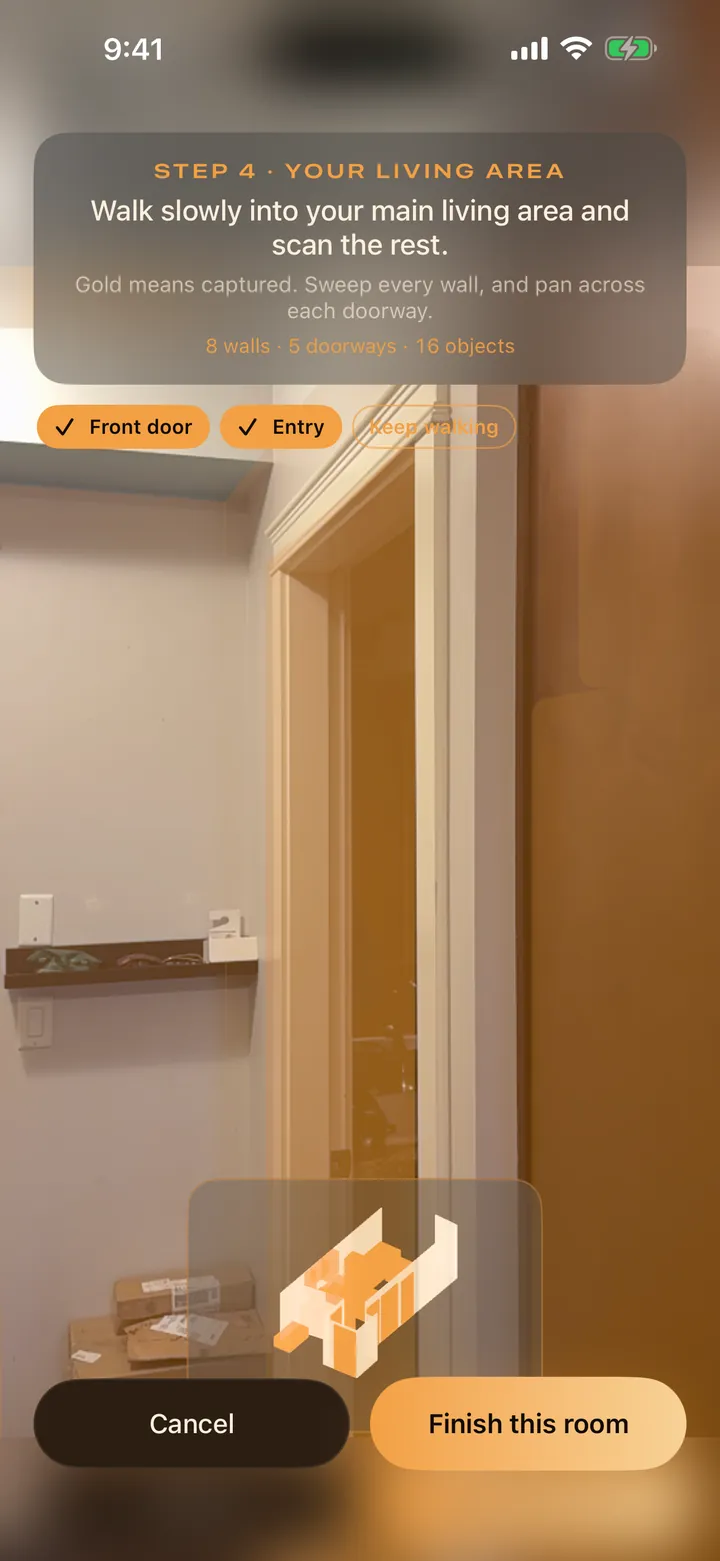
What a scan reads at your front door
- The scan starts at the front door, so every line is measured from it.
- Whether the door lines up with a window or exterior door across the home.
- Whether it has a straight view to a bathroom door, or looks straight into a bedroom.
- A mirror straight across from the front door.
- Furniture standing in the path just inside the door.
- Not read: stairs, so a door facing a staircase is one to check yourself. The app also does not assess the door’s colour, its condition, or what is outside it.
Questions
What should a front door not face in Feng Shui?
Tradition is wary of a front door that looks straight at a back door or large window, a bathroom door, a bedroom, a staircase or a mirror. In each case the concern is the same: the flow coming in is said to be led straight out, drained away or turned back.
Which direction should a front door face?
There is no single answer, because the schools use different methods. Form school has no preferred direction. Eight Mansions works from the occupant's Kua number, Flying Stars from the building's facing and age, and BaZi-based approaches from a person's favourable elements. They can reach different conclusions about the same door.
What color should a front door be in Feng Shui?
A common compass-based rule matches the colour to the element of the direction the door faces. Black Hat teaching often suggests red regardless of direction. Since the two can disagree, choose the school you are following first and the paint second.
Is it bad Feng Shui if the front door faces stairs?
It is traditionally considered unfavourable, since the flow is said to rush up or down the stairs. The usual remedies are a rug or a plant at the foot of the stairs and good light on the landing. How serious it is depends, in most accounts, on how close the first step is to the door.
Can I have a mirror near my front door?
Yes. The caution is specifically about a mirror straight across from the door. A mirror on a side wall of the entry is widely recommended, both for light and for a last look before you leave.