
Problems

Feng Shui Problems in a Home

Form-school Feng Shui calls a layout a problem for one of two reasons. Either the flow that enters at the front door is blocked, rushed or drained before it reaches the rooms, or a place where you rest or work has no support behind it and no view of the door. Most of what gets called bad Feng Shui in a house is furniture standing in the wrong spot, not a fault in the building.

Updated September 30, 2026 · Traditional interpretation, not measurement or advice

BedroomLiving roomHallKitchenFront door
How form school reads a plan: one path from the front door, through each room it can reach.

How form school decides something is a problem

Form school reads a home by its shape and by the route people take through it. Traditional Feng Shui describes qi coming in at the front door and moving through the home roughly as a person would walk it. Three things are said to go wrong with that movement:

The fourth kind of problem concerns you, not the flow: a bed or desk placed where you cannot see the door, have nothing solid behind you, or sit directly in the door’s line. Practitioners call the arrangement that passes all three tests the command position, and a bed or desk that fails one is said to be out of it.

Triage: what to check first

  1. The entrance. Tradition treats the front door as the source of everything downstream, so a fault here is counted first.
  2. Where you sleep. Check whether the bed is in line with the door and whether the headboard is under a window.
  3. Where you work. The same three questions apply to a desk: can you see the door, is there a wall behind your chair, and are you out of the door’s line. The desk placement tool checks them.
  4. Everything else. Corridors, facing doors, sharp corners, and the mirror facing the bed, on which teachers disagree.

The order is practical as much as traditional. You pass through the entrance every day, and you spend more hours in bed than anywhere else in the home.

Most problems are furniture, not the building

Sort what you find into three piles. Things you can move, such as a shoe rack, a bed or a desk, cost nothing to fix. Things you can soften, such as a pair of facing doors, a corridor or a window behind the bed, take a curtain, a rug, a plant or a headboard. Things you cannot change, such as where the bathroom sits, usually get a closed door as their traditional remedy, and after that there is nothing left to do but stop worrying. The first pile is nearly always the largest.

How seriously to take one finding

A single problem is a traditional reading of a layout, not a verdict on a home. Practitioners weigh findings against each other, and schools differ on some of them. Nearly every rule also has an ordinary reason behind it, such as a draught, a light in your eyes or something to trip over, and that is a fair test of whether one is worth acting on.

When two rules pull in opposite directions, as when the only wall that lets the bed see the door has a window in it, practitioners generally keep the view of the door and remedy the rest. For a self-check that needs no app, try the floor plan self-check.
In this section

Three homes, sorted

  • A flat where the front door opens onto a coat stand — One object, moved to the side wall, and the entrance is clear. This is the first pile.
  • A house with a view from the front door to the garden doors — The doors stay where they are. A rug and a plant placed part-way along break the line.
  • A bedroom with one wall long enough for the bed — If that wall has the window in it, a solid headboard and a lined curtain are the whole remedy.

Common mistakes

  • Starting in the spare room — the entrance and the bed come first. A fix elsewhere leaves the two readings that count most untouched.
  • Buying remedies before moving anything — most findings are answered by shifting a piece of furniture you already own.
  • Treating every rule as equal — the command position and a clear entrance are widely agreed. Mirrors and facing interior doors are not.

A list of problems tells you what to look for. It does not tell you which of them your home has, and alignments are hard to judge by eye from inside a room.

SEE IT IN YOUR HOME

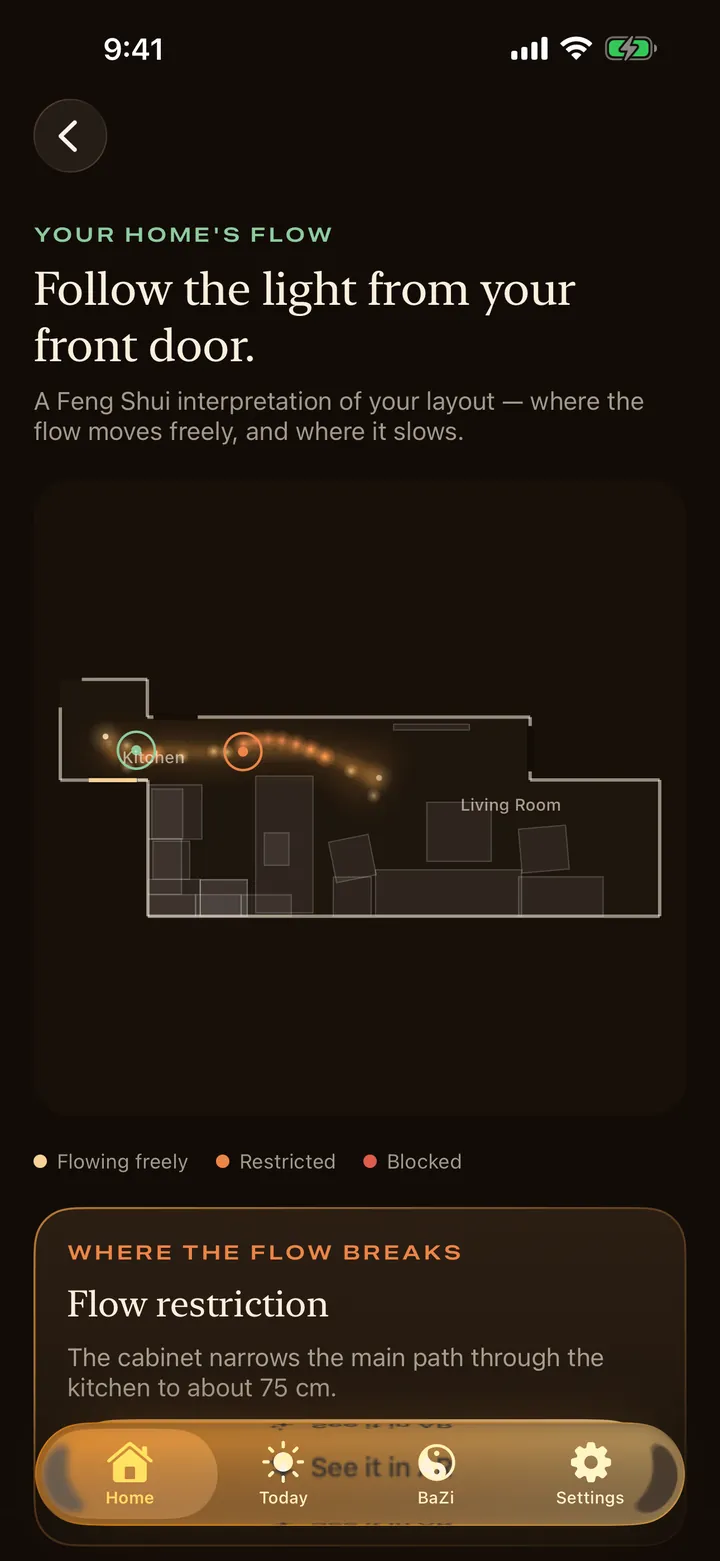
Walk your home with your phone and see where the flow from the front door is blocked, rushed or cut short.

Coming to the App Store · iPhone and iPad · submitted for review

Feng Shui Scan floor plan marking where the flow is restricted

What a scan reads across your home

  • Furniture standing in the path just inside the front door.
  • The front door lined up with a window or exterior door across the home, or looking straight at a bathroom or into a bedroom.
  • Furniture that narrows or cuts the flow path, pinch points, dead-end hallways and rooms the path cannot reach.
  • Beds and desks out of the command position, and sharp corners aimed at a bed, sofa or desk.
  • A Home Flow Score out of 100, so you can rescan after a change and compare.
  • Not read: mirrors facing beds, two interior doors facing each other, stairs, ceiling beams or clutter.

Questions

Which Feng Shui problem should I fix first?

Start at the entrance. Form-school Feng Shui reads the home from the front door inward, so anything standing in the first steps inside it is counted before the rooms beyond. The bed comes second and the desk third.

Can bad Feng Shui be fixed without renovating?

In most homes, yes. The usual findings are about where furniture stands, and the traditional remedies for fixed features are a closed door, a curtain, a rug or a plant. Building work is rarely what a practitioner suggests first.

Is my home bad Feng Shui if it has several of these problems?

Not in any final sense. Each one is a reading of a single part of the layout, and most homes have a few. Practitioners weigh them together and start with the ones that are easy to change.

Do all schools of Feng Shui agree on what counts as a problem?

No. The command position for a bed and a clear entrance are close to universal. Compass-based schools add readings that form school does not make, and on some points, such as mirrors in bedrooms, teachers within one school disagree.

Related