 Feng Shui Scan
Which directions belong to which element
The mapping comes from the Later Heaven arrangement of the eight trigrams, the same one used for the compass version of the Bagua.
- Wood — east and southeast
- Fire — south
- Earth — northeast, southwest and the centre
- Metal — west and northwest
- Water — north
To use it you need your favourable elements first. The method is explained under favorable elements, and the BaZi calculator gives the result for a birth date and time. A chart usually has two favourable elements, so most people end up with between two and four directions. Someone said to favour Fire and Earth, for example, has south, northeast and southwest, along with the centre of the home.
The centre is a location, not a way to face, so it applies to sectors only.
Finding your home’s directions
You need two things: where the centre of the home is, and which way north lies from it.
The centre. On a floor plan of a rectangular home, draw the two diagonals; they cross at the centre. For an L-shaped or irregular plan, practitioners differ on whether to square the shape off or find the balance point, and the answer can move by a metre or more.
North. Stand at or near the centre with a compass and take a reading. Then take two more a few steps away. Steel beams, reinforced concrete, radiators, fridges and even a phone case with a magnet in it pull a compass off, and readings in the same flat can differ noticeably. If three readings agree, use them. If they do not, take one outdoors along the line of the building’s front wall.
A phone compass is good enough for this, with two cautions. Calibrate it when it asks, and check its settings for whether it shows true north or magnetic north. A traditional luopan reads magnetic north, so that is what most compass Feng Shui assumes.
From the centre, divide the plan into eight equal wedges of forty-five degrees, one for each direction. Some schools lay a nine-square grid over the plan instead; the wedges are the version described here.
Sector and facing are different questions
Directions are used in two ways, and they are easy to confuse.
Sector is where something is. A bedroom in the eastern wedge of the plan is in the east sector, which belongs to Wood, whichever way the bed in it points.
Facing is which way you are oriented. A desk in that same east sector might have you looking west, which belongs to Metal.
For one bed or desk the two can match your favourable elements, or one can, or neither. Tradition counts either as support. Facing is usually the easier one to change, since turning a desk is simpler than moving to another room.
Applying it to the bed and the desk
The bed. In this method the direction that counts is the one the top of your head points when you lie down, which is the wall the headboard stands against. A bed with its headboard on the north wall has a north head direction, and that belongs to Water. Some teachers describe bed direction by where the feet point instead, which is the exact opposite, so check which convention any advice you read is using.
The desk. The direction is the one you look toward when seated. If you sit with a wall behind you to the west and look east across the room, the desk faces east, which belongs to Wood.
Work through it in this order. Find the directions that belong to your favourable elements. See which walls of the room could take the headboard or the desk while keeping the door in view. If one of those walls gives a favourable direction, use it. If more than one does, many practitioners prefer the element they rank first for the chart.
When the direction and the room disagree
Often the favourable direction is the wall with the door in it, or the window, or the wardrobe. Practitioners who combine BaZi and Feng Shui generally agree on what to do: the command position comes first.
That means a bed that sees the door, has a solid wall behind the headboard and is out of the door’s line stays where it is, even if it faces an unhelpful direction. The same goes for a desk. You can check the position itself with the bed placement and desk placement tools.
When the direction cannot be had, the element is brought in another way. Each element has colours and materials, and the usual substitute is to put those near the bed or desk. A person said to favour Water whose bed must point south can use deep blue bedding or a glass lamp on the bedside table.
If a room allows a small turn that brings you from an unfavourable direction into a favourable one without losing the door, that is worth making. A full rotation that puts your back to the door is not.
How this differs from Kua directions
Most "lucky direction" charts online are not BaZi. They come from Eight Mansions, which calculates a Kua number from the birth year and sex and assigns four good and four bad directions to it. The Kua number calculator gives those.
The two methods use different inputs. Kua looks at the year alone, so everyone of the same sex born in the same year shares a result. BaZi looks at all four pillars, so two people born a week apart can differ. The directions they produce for one person often do not match, and neither school treats the other’s result as wrong.
Pick one method for directions and stay with it. The app applies BaZi favourable elements and does not calculate Kua numbers.
Directions in real rooms
- Favourable element Wood, headboard possible on the east or the south wall — Both walls keep the door in view. East belongs to Wood, so the east wall is the choice, and nothing else needs adding.
- Favourable elements Metal and Water, a desk that can only look south — South belongs to Fire. Keep the desk where it sees the door, and put Metal or Water on it: a metal lamp, a glass tray, something in white or navy.
- A bedroom in the north sector for someone said to favour Fire — The sector cannot change, but the facing might. If the headboard can go on the south wall with the door still in view, the head direction becomes south.
- Compass readings that disagree by twenty degrees between rooms — Take the reading outdoors along the front wall and use that. A direction that lands on the border between two wedges should be treated as uncertain, not forced into one.
Common mistakes
- Reading the compass next to the fridge — or on a metal desk, or with the phone in a magnetic case. Take several readings in different spots.
- Confusing sector with facing — "my bedroom is in the east" and "my bed faces east" are separate facts with separate elements.
- Mixing head and foot conventions — advice that names a bed direction by the feet gives the opposite result. Check before you turn anything.
- Turning the bed away from the door to gain a direction — the form rule most schools agree on is given up for a personal one that depends on the method.
Reading about BaZi favorable directions is one thing. Seeing them on your own floor plan is another. Finding the centre of the home, dividing it into eight and working out which wedge each bed and desk falls in is slow on paper and easy to get wrong by one sector.
MAKE YOUR HOME PERSONAL
Scan your home, add your birth details, and see which sector your bed and desk sit in and which way you face.
Coming to the App Store · iPhone and iPad · submitted for review
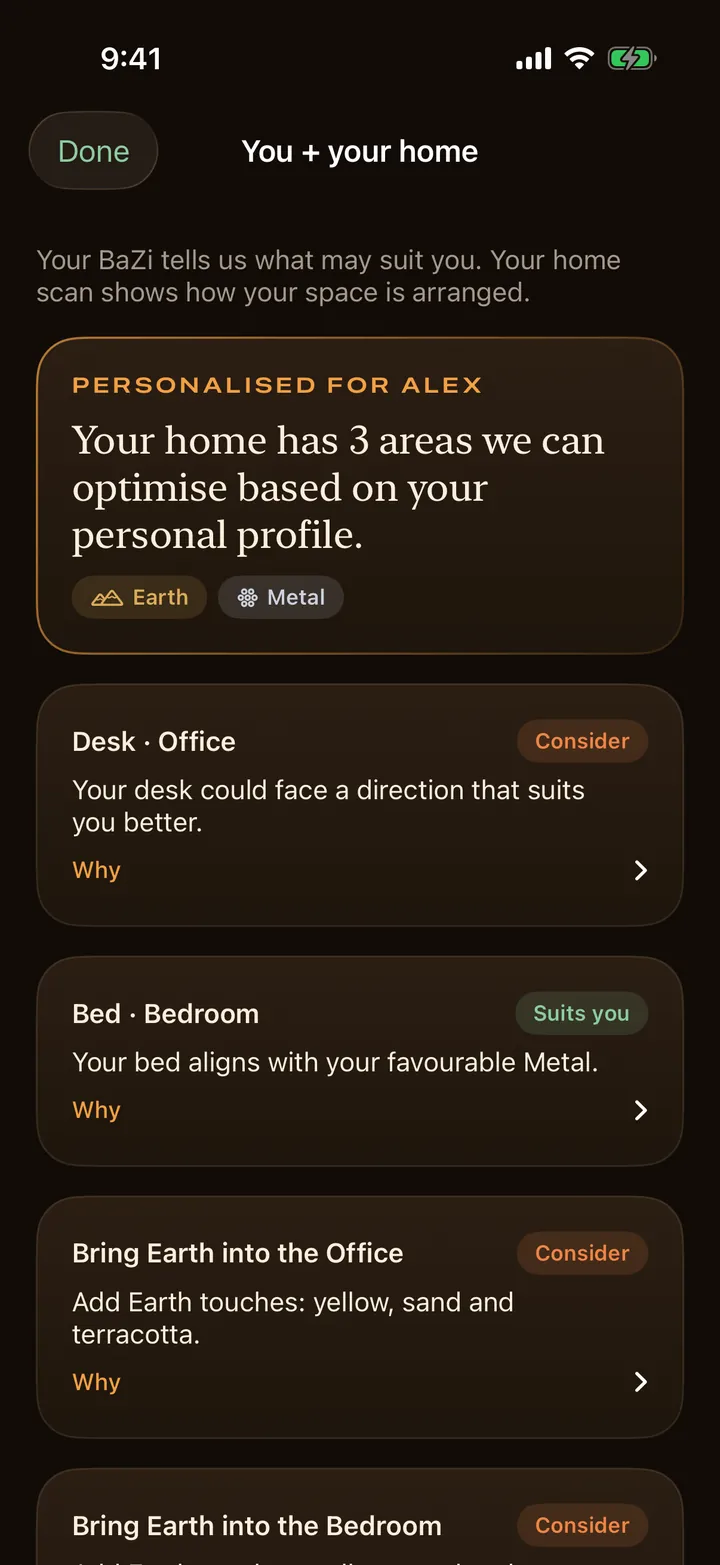
What the app reads for directions
- With a compass heading for a scanned home: which sector each bed and each desk sits in.
- The direction your head points in each bed and the direction you face at each desk.
- How the sector and the facing compare with your favourable elements, with a suggestion to face a favourable direction or to add that element’s colours and materials nearby.
- Whether each bed and desk is in the command position, reported separately so you can weigh a direction against it.
- Not used: Kua numbers, Eight Mansions directions or Flying Stars. A scan also needs a compass heading to say anything about direction; the phone records one as you scan, and a reading taken close to large metal objects can be off.
Questions
What is the best direction to sleep according to BaZi?
There is no single best direction for everyone. It is the direction that belongs to one of your chart's favourable elements, applied to where the top of your head points. For someone said to favour Water that is north, and for Wood it is east or southeast.
Which direction should my desk face by BaZi?
The direction you look toward when seated should belong to one of your favourable elements if the room allows it. Seeing the door from the desk takes priority, so if the two conflict, keep the view of the door and add the element through colour or material.
Is bed direction measured from the head or the feet?
In the method described here, and in the app, it is the direction the top of the head points, which is the headboard wall. Some teachers use the feet, which gives the opposite direction, so check the convention before following advice.
Are BaZi directions the same as Kua directions?
No. Kua directions come from Eight Mansions and are based on the birth year and sex. BaZi directions come from the favourable elements of the whole chart. The two can give different answers for the same person.
Can I use a phone compass for Feng Shui directions?
Yes, if you calibrate it and take several readings away from large metal objects and appliances. Indoor readings are often pulled off by steel and wiring, so compare a few spots and take one outside if they disagree.
What if none of my favourable directions is possible in my room?
Keep the bed or desk in the command position and bring the favourable element in with its colours and materials near where you sleep or work. Most practitioners consider that an accepted substitute.