 Feng Shui Scan
The cook’s view of the door
This is the rule the schools agree on most. The kitchen page introduces it; here are the cases.
- Door in front or to the side. Nothing to do. A door at ninety degrees to the cook counts as in view for most teachers, since a glance takes it in.
- Door behind, off to one side. The milder case. A reflective surface is the remedy.
- Door directly behind. The arrangement the tradition likes least, and the one most kitchens built along a single wall end up with.
The reflective workaround comes in several forms, from least to most effort:
- A polished kettle or a stainless utensil pot standing beside the hob.
- A small mirror or a framed picture under glass on the wall at eye level, angled toward the door.
- A glass or polished steel backsplash behind the hob.
What matters is the aim: from the cooking position you should see the doorway in it. A reflection of the burners is a different practice, favoured by some Black Hat teachers and disliked by others, and it is not what this rule asks for.
Beside the sink, opposite the sink
In the five elements the stove is Fire and the sink is Water, and Water controls Fire. Tradition reads the two set close together as a clash. The details teachers add:
- Side by side. A stretch of worktop between them is generally accepted as enough. No school gives an agreed measurement.
- Directly opposite. In a galley kitchen the stove and sink can face each other across the aisle. Some teachers treat this as the stronger clash, since the two confront each other. Others count only adjacency.
The remedy in each case is Wood, which sits between Water and Fire in the producing cycle: a wooden board, a plant, or a green or wood-toned mat on the floor of the aisle.
The fridge, the dishwasher and the oven
Most teachers count the fridge as Water because it is cold, and the dishwasher for the obvious reason. A few count the fridge as Metal for its casing. Either way, a tall fridge hard against the stove is discouraged, and the same Wood remedy is offered.
A wall oven separate from the hob raises a question tradition does not settle: which one is the stove? Most teachers mean the burners, where the cook stands and tends food.
A stove under a window
Some practitioners caution against it. The reasons given vary: that the stove lacks a solid wall behind it, in the way a bed under a window does, or that the household’s nourishment is said to escape through the glass. Others do not mention windows at all, and a stove under a window with a clear view of the door satisfies the first rule.
The practical objections are more concrete. A draught can disturb a gas flame, curtains hang near the burners, and grease settles on the glass. A blind that sits inside the frame and a tall splashback deal with most of this.
A stove on an island
An island hob is often called the ideal in Western Feng Shui, because the cook faces the room and sees every door.
Some classical practitioners take the opposite position. A stove in the middle of the floor has nothing behind it, and they prefer one backed by a wall. So the island is favoured by one group and doubted by another.
If you have one, the form questions are about the space around it: a passage wide enough to pass behind the cook, and corners that do not point at the stools. Those are covered under home layout.
Seen from the front door, and shared walls
In view of the front door. A stove that is the first thing visible from the front door is said to expose the household’s resources. The remedy is to interrupt the view with a closed door, a plant, a screen or the end of a shelf unit.
Backing onto a toilet. Some teachers caution against a stove on the other side of the wall from a toilet, on Fire and Water grounds or simply on grounds of cleanliness. It is a loosely held rule and many do not teach it.
Backing onto a bed. A bed whose headboard shares a wall with the stove is sometimes discouraged, the reasoning being that Fire sits behind the sleeper’s head. This too is taught by some and ignored by others. Moving the bed along the wall, so that the two are not back to back, is the suggestion.
Stove direction and the "fire mouth"
Form school has no compass rule for the stove. Eight Mansions does. It works from a Kua number, and a common version of its rule is that the stove should stand in one of the person’s unfavourable sectors while its fire mouth points toward a favourable direction.
The difficulty is the fire mouth. The term comes from stoves fed with fuel through an opening, and that opening was the mouth. A modern hob has none. Definitions offered by different teachers include the direction the control knobs face, the side the gas or power enters, and the direction of the oven door. These can point different ways for one appliance.
Teachers also differ on whose Kua number counts: the cook’s, or the household’s main earner’s. If you want to follow this method, pick one teacher’s definition and apply it throughout. Direction rules from different schools do not combine.
A new kitchen, or the one you have
Planning from scratch, the order most practitioners would give is:
- Put the hob where the cook sees the doorway.
- Leave worktop between hob and sink, and between hob and fridge.
- Keep the hob out of the direct line from the front door.
- Only then consider compass direction, if you follow a compass school.
Living with an existing kitchen, nothing in the tradition requires moving an appliance. A reflective surface answers the first rule and a wooden object answers the second. Teachers also stress a stove that is clean and has every burner working.
The floor plan self-check covers the circulation side.
Stoves in real kitchens
- A single-wall kitchen in a studio — The cook’s back is to the whole room. A steel splashback behind the hob shows the front door, and a plant at the end of the counter keeps the hob from being the first thing a visitor sees.
- A galley with the hob facing the sink — A wood-toned runner down the aisle is the traditional answer. Keep the aisle floor otherwise empty, since it is the only way through.
- A hob under the kitchen window, door to the left — The door is in view, so the main rule is met. Swap curtains for a blind inside the frame and treat the window question as optional.
- Hob, then a hand’s width of counter, then the fridge — Stand a wooden board upright in the gap. If the fridge door opens toward the hob, see whether its hinges can be reversed.
Common mistakes
- Aiming the mirror at the burners — the widely accepted purpose is to show the door. Check from where you stand to cook, not from across the room.
- Reading "apart" as "on different walls" — worktop between stove and sink is what most teachers ask for. Nobody needs to replumb.
- Choosing a fire-mouth direction from two teachers — knobs by one definition and oven door by another yields a direction that follows neither.
- Putting compass before position — a hob turned to a favourable direction with the cook’s back to the door gives up the rule most schools share for one they dispute.
- Hanging fabric to screen a window behind the hob — the remedy creates the hazard.
Stove rules you can check standing at the hob. What is harder to judge from inside the kitchen is the room around it: whether the passage behind the cook is the tightest point in the home, and whether the route through to the back door is clear.
SCAN YOUR KITCHEN
Map the kitchen with your phone and see where the route through it narrows and what stands in the way. The stove itself you check by eye.
Coming to the App Store · iPhone and iPad · submitted for review
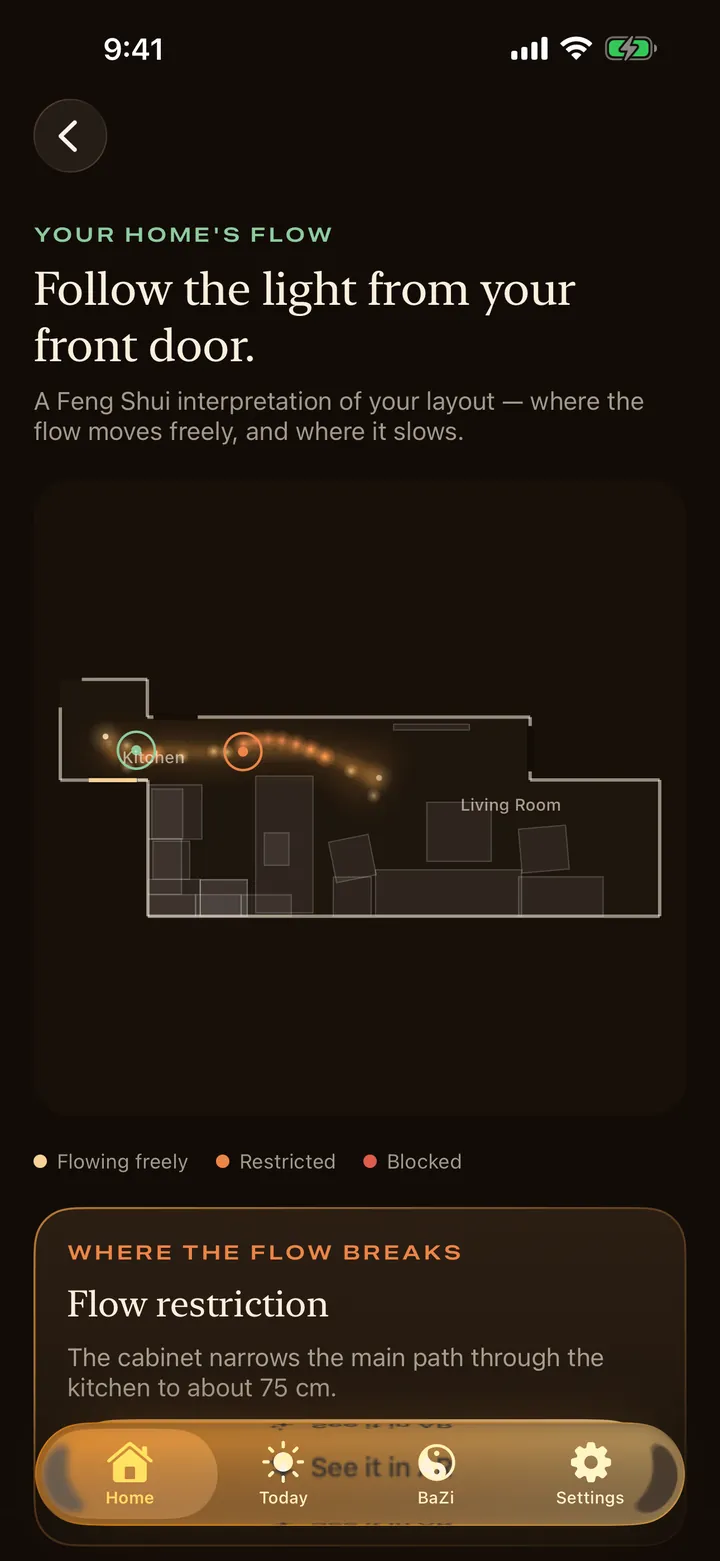
What a kitchen scan reads, and what it does not
- Not read: the stove, the sink and the fridge. A scan does not check where they stand, how far apart they are, which way the stove faces, or whether the cook can see the door. Those you check by eye, using this page.
- Narrow passages: pinch points on the flow path, such as the gap between an island and the counter.
- Furniture that narrows or cuts the path the flow takes through the kitchen, like a table or trolley on the route.
- How much of the kitchen floor is covered by furniture.
- Whether the kitchen is reached by the flow path from the front door at all.
Questions
Which direction should a stove face in Feng Shui?
Form-school Feng Shui gives no compass direction. It asks only that the cook can see the doorway. Eight Mansions gives personal directions based on a Kua number and the stove's fire mouth, but teachers disagree on what the fire mouth of a modern hob is.
Is a stove facing the kitchen door bad Feng Shui?
A cook who faces the door is in the preferred position. What some teachers caution against is the stove being in a direct line with the front door of the home, visible the moment you enter. A screen, a plant or a closed kitchen door is the usual remedy.
Can a stove be under a window?
Some practitioners advise against it and others do not address it. The practical concerns are draughts on a gas flame, curtains near the burners and grease on the glass. A blind inside the window frame and a splashback handle most of them.
How far should the stove be from the sink?
No school gives an agreed distance. A section of worktop between the two is generally accepted, and a wooden object or a plant placed in the gap is the standard remedy when they are close.
Is a stove on a kitchen island good Feng Shui?
Many Western teachers favour it, because the cook faces the room. Some classical practitioners prefer a stove with a wall behind it. Either way the passages around the island need to be wide enough to walk through.
What is the fire mouth of a stove?
On a traditional fuel-fed stove it was the opening where the fuel went in. For modern appliances teachers give different definitions, including the direction of the knobs, the power or gas inlet, and the oven door. There is no single accepted answer.