 Feng Shui Scan
How to use it
Start at the front door, with the door open, and work inward in the order the questions are asked: the entrance first, then the way through the home, then where you sleep and work. That is the order in which the tradition itself reads a home, and it puts the most significant questions first.
Answer "not sure" freely. Several of these are hard to judge by eye, which is rather the point of measuring them.
Why these twelve
Form-school Feng Shui is concerned with a short list of things: whether the entrance is open, whether what comes in through it is held or lost, whether you can move through the home without squeezing, and whether the places you rest and work are supported. The twelve questions cover the entrance (five questions), circulation (three), and beds, desks and seats (four).
They leave out anything that depends on compass direction, on your birth chart, or on the surroundings outside the building. Those belong to other schools and other pages: the Bagua map for life areas, the BaZi calculator for the personal side.
Reading your answers
One or two things flagged is ordinary. Very few homes pass every check, and many of the conditions are a matter of where one piece of furniture stands.
If you want an order to work in, take the entrance first. A blocked entry or a straight line out affects the reading of everything after it. The bed comes next: the pages on a bed facing the door and a bed under a window cover the two commonest findings. The overview of layout problems puts the rest in order.
What a checklist cannot do
It cannot measure. "Is the bed in line with the door?" has a definite answer in your room, and it depends on the width of the bed, the width of the doorway and how far one is offset from the other. "Is there a narrow point on the way through?" depends on what counts as narrow; the app works from the actual width of the gap.
It also cannot follow the path. A home’s flow, in the form-school sense, is one continuous route from the front door through every room. A checklist looks at twelve places along it; reading a floor plan properly means tracing the whole thing.
A checklist asks what you remember about your home. Most people are surprised by what the plan shows once it is drawn to scale.
ANALYZE YOUR FLOOR PLAN
A checklist relies on your memory of the room. A scan measures it.
Coming to the App Store · iPhone and iPad · submitted for review
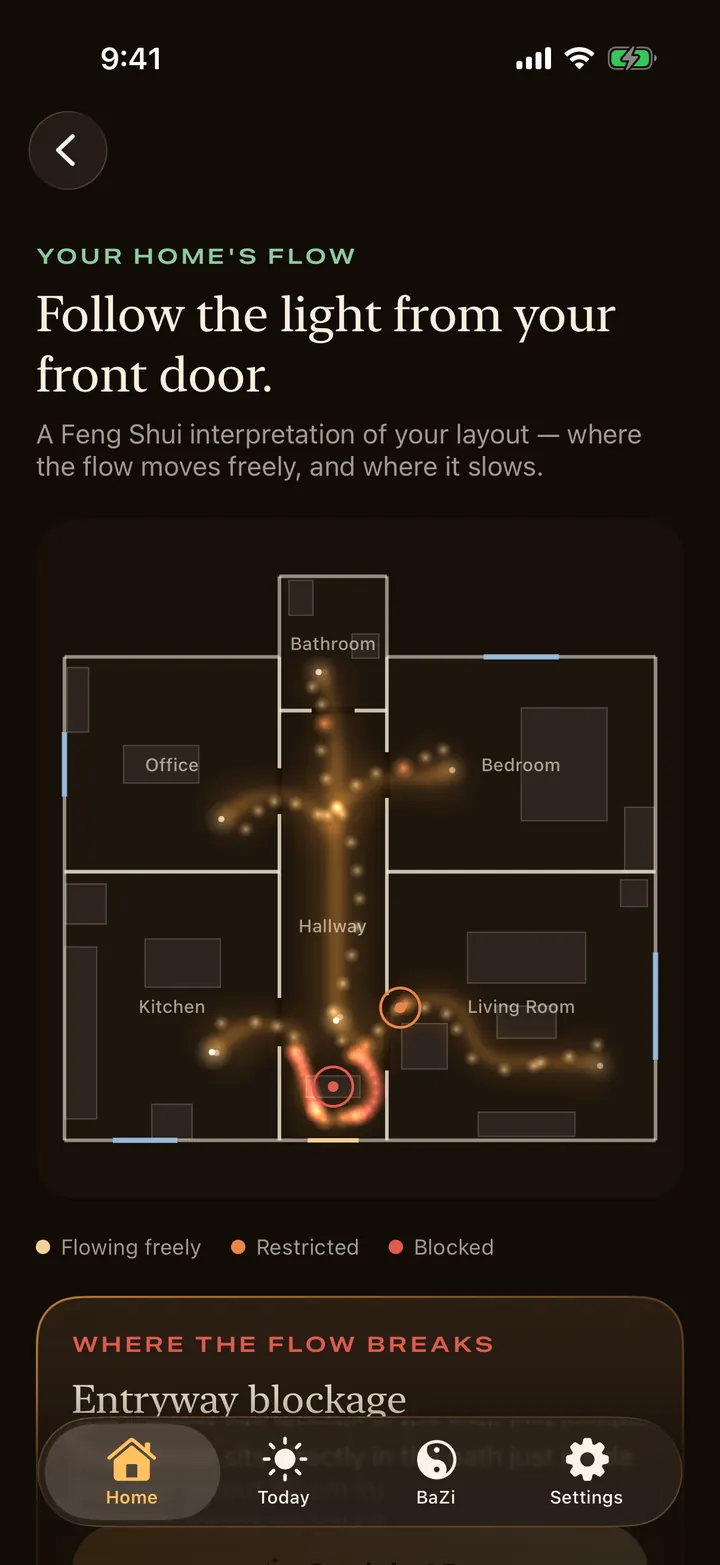
What a scan does with the same twelve questions
- Measures the entry zone and names anything standing in the door’s own width, with its distance in from the door.
- Checks sight lines from the front door to windows, outside doors, bathroom and bedroom doors.
- Draws the flow path and marks each restriction and blockage on it, with the width of the gap.
- Finds dead-end hallways, rooms the path cannot reach, and rooms where furniture covers too much of the floor.
- Runs the command-position check on every bed and desk, and looks for furniture corners aimed at them.
- Scores the home out of 100 across entrance, circulation, connectivity, furniture placement and continuity.
Questions
Can I upload a floor plan to be analysed?
No. This page is a self-check you answer yourself. The app builds the floor plan by scanning the home with your phone, because the reading depends on furniture and on door and window positions that a marketing floor plan does not show.
How many "yes" answers mean bad Feng Shui?
There is no threshold. The questions are a way of finding what to look at, not a score. One blocked entrance matters more, in the tradition's own terms, than three minor items elsewhere.
Does the self-check cover the Bagua or compass directions?
No. It covers form-school layout only: the entrance, circulation, and the placement of beds, desks and seats. The Bagua map tool and the BaZi pages cover the rest.
Is this the same as the app's Home Flow Score?
No. The score is calculated from a measured floor plan and the flow path through it. The self-check is a list of questions and gives no score.