 Feng Shui Scan
Four arrangements that get called "facing the wall"
The phrase covers several layouts, and tradition does not rate them alike. From weakest to strongest:
- Facing a wall, door directly behind you. You cannot see the door and the open room is at your back. This is the one worth fixing.
- Facing a wall, door behind and off to one side. Still out of view.
- Facing a wall, door on a side wall, level with you or ahead. The door is at the edge of your vision. Practitioners treat this as a minor compromise and many would leave it alone.
- Facing a window. A separate case, taken further down.
The form school asks three things of a desk, set out in the home office guide: can you see the door, is there a solid wall behind your chair, and are you out of the door’s direct line. A desk pushed against a wall never has the wall behind. Whether it also loses the view of the door is what separates a real problem from a small one.
The desk placement tool lets you try each arrangement in a sample room.
Why tradition says so
Form-school Feng Shui reads a desk as a seat of responsibility. The person at it should see what approaches and be backed by something that does not move. Facing a wall reverses both. The solid thing is in front, where it stops the view at arm’s length, and the open, moving part of the room is behind.
Practitioners sometimes add that a wall in front stands for an obstacle ahead of you in your work. That is a symbolic reading, and you can take it or leave it.
The practical version needs no symbolism. Someone who walks up behind you while you are concentrating makes you jump, and people who sit with their back to a door tend to keep glancing round. A blank wall half a metre away also gives your eyes nowhere to go when you look up.
It is the same logic the tradition applies to a bed, where seeing the door is wanted and having it behind your head is not.
How much it matters
By most accounts, less than what Feng Shui says about a bed or a front door. You sit at a desk by choice, awake, for part of the day.
It counts for more when you work there all day, or when the door behind you opens onto a busy part of the home. It counts for less when you live alone, when the door is shut while you work, or when the desk is used for an hour in the evening.
Nothing here predicts how your work will go. It is a traditional reading of a layout, with an everyday reason attached.
Fixes, in order of effort
Free
- Close the door while you work. A closed door behind you is a smaller matter than an open one.
- Try another wall. Moving the desk to the wall beside the door, or the wall at right angles to it, puts the door at your side instead of behind.
Small purchases
- A small mirror. On the desk or the wall in front of you, angled to show the door frame and not your own face. This is the traditional workaround for a door you cannot face, and any reflective object does the same job.
- A high-backed chair. Widely recommended as a portable version of the wall.
- A picture with depth. Some practitioners suggest a landscape on the wall you face. This one is loosely attributed and addresses the view in front, not the door behind.
Rearranging
- Turn the desk ninety degrees. With one short end against the wall, the wall is beside you. Choose the side so that you look toward the door and, where possible, have another wall behind.
- Float the desk. Chair to the wall, desk in front, facing into the room on a diagonal from the door.
When to stop
Some rooms hold a desk in one place. Fit the mirror, choose the chair, and stop there. A remedy applied is treated as the matter dealt with.
Facing a window, or with your back to one
Facing a window. Teachers differ. Some welcome the light and the view. Others say attention goes out of the window with it. The more widely shared rule is about what is behind you, so a desk at the window with the door at your side is fine by most accounts. With the door directly behind, it is the first arrangement on the list with a better view.
Back to a window. This is what you often get when you turn the desk to face into a small room. A window is read as weaker support than a wall, but you now see the door, and that test is usually ranked first. A blind kept partly closed and a high-backed chair make up some of what is missing.
Compass direction is a different question again. If a personal favorable direction has you facing a wall with your back to the door, most practitioners keep the view of the door.
Shared offices and hot-desks
In an open office the furniture is not yours to turn. What is left is a short list.
- Choose the seat, when you can. Among hot-desks, take the one with a wall or a full-height partition behind it and a view of the way people come in. Avoid the end of a row beside the main walkway, where everyone passes behind you.
- Treat the approach as the door. In an open floor the entrance that counts is the direction people come from.
- Bring the small things. A mirror the size of a phone on the monitor stand is discreet, and nobody objects to a chair with a higher back.
At home, a desk squeezed into the living room follows the same rules. Other layout cautions and how seriously each is taken are listed on the problems page.
Desks that end up facing a wall
- An alcove desk with the door directly behind — The alcove fixes the desk. Stand a small mirror beside the monitor where it shows the door frame, use a high-backed chair and close the door when you work. That is the whole remedy.
- A desk under the window in a spare room, door behind — Turn it ninety degrees so the window is beside you and the door is in front or to the side. You keep the daylight and gain the view of the door.
- A desk on the wall beside the door — The door is level with your shoulder and you see it open. Most practitioners would leave this alone. A chair with a solid back is the only addition.
- A hot-desk in a row along a partition — Take the seat furthest from the walkway, so that people pass at your side and not behind you, and prop a small mirror against the monitor.
Common mistakes
- Turning to face the door and sitting in its line — a desk straight in front of the doorway fails a different test. Slide it to one side so the door is on a diagonal.
- A mirror that shows your own face — it is meant to show the doorway. Aimed at you, it is only a distraction.
- Floating the desk in a room too small for it — if the chair hits the wall when you stand up, you will stop using the desk. The ninety-degree turn takes less floor.
- Counting the picture as the fix — an image on the wall changes what is in front of you. The door is still behind.
- Chasing a compass direction — a favourable facing with your back to the door trades the rule most schools share for one they dispute.
From the chair, it is hard to tell whether the door is behind you or merely beside you, or whether turning the desk would put you in the doorway’s line. Those are questions about angles, and a plan answers them.
SCAN YOUR OFFICE
Map the room with your phone and see whether your desk sees the door, what is behind your chair, and which way you face.
Coming to the App Store · iPhone and iPad · submitted for review
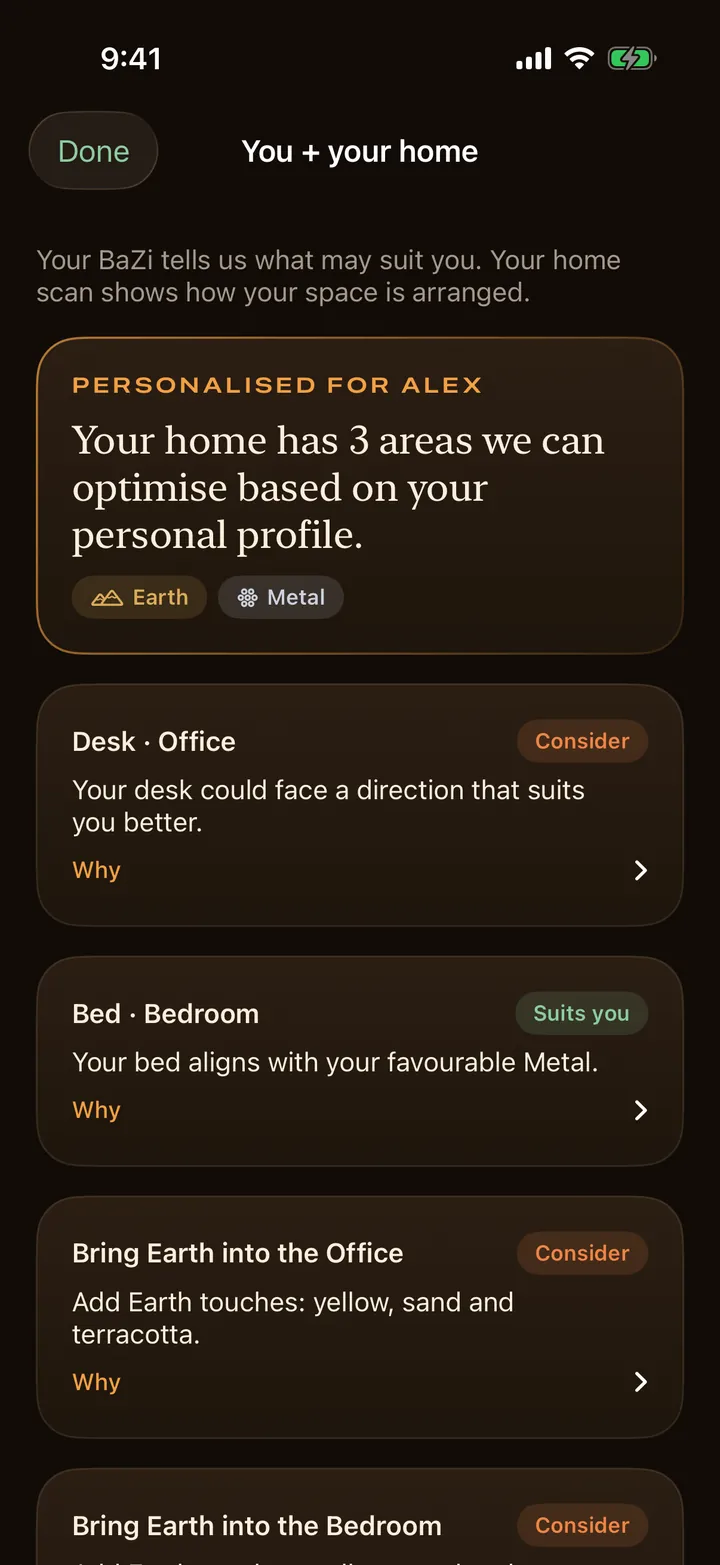
What a scan reads about your desk
- Whether the desk is in the command position. A desk facing a wall is reported as out of it when the door is behind you, when there is no solid wall behind your chair, or when you sit directly in line with the door.
- Sharp corners of shelves, cabinets or a second desk aimed at where you sit.
- Furniture that narrows or cuts the path the flow takes through the room, and how much of the floor is covered.
- Suggested furniture moves, such as turning the desk, which you can preview in AR before lifting anything.
- With your BaZi chart and a compass heading: the direction you face at the desk and the sector it sits in, against your favourable elements.
- Not read: a mirror on the desk, the height of your chair back, or what hangs on the wall in front of you. A scan describes the layout, so a desk with those remedies in place is still reported where it stands.
Questions
Is it bad Feng Shui to have your desk facing a wall?
It is a compromise, not a serious fault, provided the door is not directly behind you. A desk facing a wall with the door at your side is treated as minor. With the door behind you, a small mirror that shows the doorway and a high-backed chair are the usual adjustments.
Is it bad to sit with your back to the door?
It is the desk position tradition likes least, because you cannot see who comes in. The everyday reason is that people concentrate less well with movement behind them. Turning the desk is the first choice, and a mirror showing the door is the workaround when it cannot turn.
Does a mirror fix a desk with its back to the door?
Tradition accepts a reflected view of the door as a substitute for a direct one. It gives you the view and nothing else, so it does not supply the wall behind your chair. Keep the mirror small and aimed at the doorway.
Should my desk face the window or the wall?
Teachers differ on windows: some like the light and view and others say attention drifts outside. The more widely shared rule is about what is behind you. Either is acceptable if the door is at your side or in front, and either is weak if the door is directly behind.
What should I put on the wall in front of my desk?
Some practitioners suggest a picture with depth, such as a landscape, so the wall does not stop your view at arm's length. This advice is loosely attributed. It changes what is in front of you and does nothing about a door behind you.
My desk at work faces a wall and I cannot move it. What can I do?
Use the small remedies: a discreet mirror on the monitor stand that shows the approach behind you, and a chair with a higher back if one is available. If you can choose among desks, pick one with a wall or partition behind it.