 Feng Shui Scan
Two things people mean by "facing the door"
The phrase covers two arrangements that tradition treats in opposite ways.
- The bed sees the door. Lying down, the door is somewhere in front of you, usually off to one side. This is wanted. It is one of the three tests of the command position, set out on the bedroom layout page.
- The bed is in line with the door. The door is directly beyond your feet and the bed’s long axis points through it. This is the arrangement practitioners caution against.
A third arrangement gets mixed in: the head of the bed towards the door, so the door is behind you. That is not facing it at all, and most practitioners consider it the weakest of the three, because you cannot see who comes in.
So the usual advice, "don’t have your bed facing the door," is a poor summary. A better one: see the door, but from the side.
Why tradition dislikes the in-line bed
Practitioners sometimes call it the coffin position, a name usually explained by the custom of carrying the dead out of a room feet first. The form-school reasoning is less dramatic. The door is where a room’s flow enters and leaves, the line straight in from it is where that flow is said to move fastest, and a bed lying along the line sits in the stream all night. It is the same idea, at room scale, as a front door lined up with a back door.
What lies beyond the door changes how seriously it is taken. Practitioners tend to give more weight to a bedroom door at the end of a long hallway, or one the home’s front door looks into, than to a door that opens onto a small landing with a wall opposite.
The practical version needs no belief. A door at your feet puts hall light, movement and anyone who opens it directly in your eye line, and you in theirs. Many people feel exposed lying that way. Nothing here predicts what will happen to you if your bed is in line; it is a traditional reading of a layout with an everyday reason attached.
How to tell whether you are really in line
Stand in the doorway and imagine the opening as a strip of carpet, exactly as wide as the door frame, rolled straight down the room.
- The strip runs up the mattress. You are in line.
- The strip passes beside the bed. You are not, even if the foot of the bed is close to it. This is the common case in rooms where the door is in a corner.
- The strip clips a corner or one edge of the bed. Practitioners differ. Most treat a partial overlap as minor, and the sleeper on the far side as unaffected.
A second check, from the pillow: looking straight down past your feet, can you see out through the doorway into the hall? If what you see is the edge of the frame or the wall beside it, you are off the line.
Two related cases. An en-suite or wardrobe door at the foot of the bed is judged the same way, and the standard advice is to keep it shut at night. A door that opens onto the side of the bed is mentioned by some practitioners and is generally treated as milder.
The bed placement tool runs this check on a sample room you set up, which makes the difference between "sees the door" and "in line with it" easy to see.
Fixes, in order of effort
Free
- Shift the bed sideways until the strip misses it. The distance needed is often less than the width of a bedside table.
- Close the door at night. A closed door is the oldest remedy and the one most practitioners accept.
- Turn the bed onto another wall, if one is long enough, keeping the door in view.
Small purchases
- Something solid at the foot. A footboard, a storage bench or a chest, at least as high as the mattress. The idea is to put an object between you and the line.
- A curtain or screen. A curtain across the doorway, or a folding screen between door and bed, breaks the view in a room where nothing can move.
- A crystal, in one school. Black Hat practitioners sometimes hang a faceted crystal between the door and the bed. Classical practitioners generally do not use that remedy.
Rearranging
Swap the bed with the wardrobe or desk so the bed ends up on the wall opposite the door but to one side of it. Check you have not solved one problem by creating another: a move that puts the headboard under a window or the bed opposite a mirror is a trade, not a fix.
When the room is too small
Some rooms hold a bed in exactly one place. Close the door, put something at the foot, and stop there. Tradition has always allowed for rooms that cannot be changed, and a remedy applied is treated as the matter dealt with.
Rooms where the bed ends up in line
- A box room with the bed across the far wall — The bed fills the wall opposite the door and cannot shift. A closed door at night and a chest or bench at the foot are the whole remedy.
- A long narrow room with the door at one end — The bed is centred at the other end. Moving it hard against one side wall may take it out of the strip, and a single sleeper loses nothing by it.
- A door in the corner, bed on the opposite wall — The strip runs down the side of the room and misses the bed, and you see the door on a diagonal. This is the command position. Nothing needs fixing.
- An en-suite door at the foot — The main door is to one side and fine. Keep the bathroom door closed, which is the usual advice for a bathroom in any case.
Common mistakes
- Turning the bed so your head is at the door — you no longer face it, and you can no longer see it. Most practitioners rate this below the arrangement you started with.
- A bench lower than the mattress — it is furniture at the foot of the bed, but it does not interrupt anything.
- Measuring from the middle of the door — the line is as wide as the opening, not a single thread from its centre.
- Chasing a compass direction onto the line — a bed turned towards a personal favorable direction and left pointing out of the door has swapped a rule the schools agree on for one they do not.
Whether the door’s line runs up your mattress or just past it comes down to a few centimetres, and from the pillow the two look the same. A measured plan settles it.
SCAN YOUR BEDROOM
Map the room with your phone and see whether the door's line runs up your bed or past it.
Coming to the App Store · iPhone and iPad · submitted for review
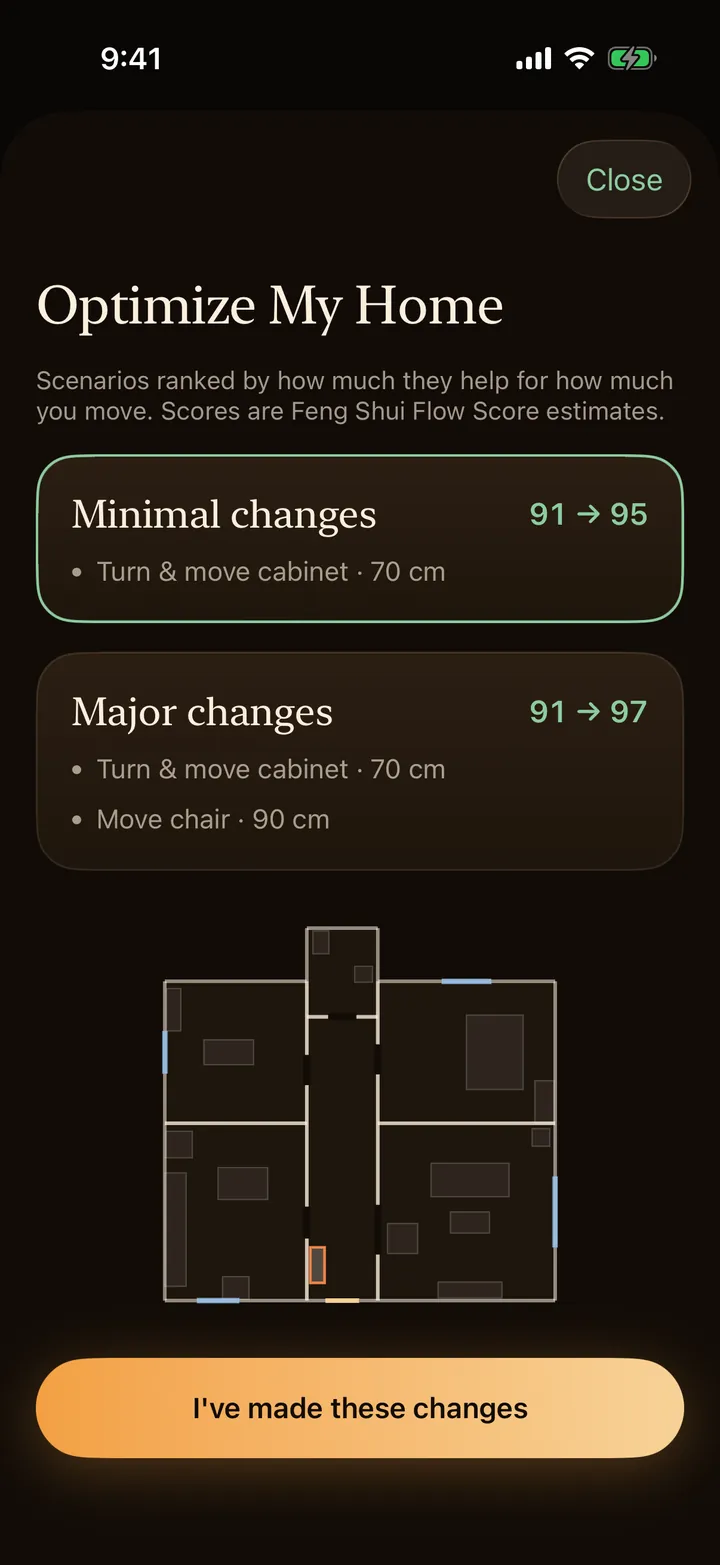
What a scan reads about your bed and the door
- Whether the bed is directly in line with the door, which is reported as the bed being out of the command position.
- Whether the door can be seen from the bed at all.
- Whether the headboard is on a solid wall, and whether a window sits behind it.
- Sharp furniture corners aimed at the bed.
- Whether the home’s front door looks straight into the bedroom.
- Not read: whether you keep the door closed, a curtain across the doorway, or mirrors. A scan describes the layout, not your habits.
Questions
Is it bad Feng Shui to sleep with your feet facing the door?
Only when the bed is directly in line with the doorway, so your feet point out through it. Feet towards the door with the door off to one side is the recommended command position. The test is whether the doorway's width, continued into the room, runs along the bed.
What is the coffin position in Feng Shui?
It is the common name for a bed in line with the door, with the sleeper's feet pointing out. The name is usually explained by the custom of carrying the dead out feet first. Practitioners use it as shorthand for the layout, not as a prediction.
Is it better to sleep with my head towards the door?
No. With your head at the door you cannot see who comes in, and most practitioners consider that weaker than lying in line with it. The preferred arrangement keeps the door in view from the side.
Does keeping the bedroom door closed fix it?
A closed door is the simplest traditional remedy and most practitioners accept it. If you sleep with the door open, something solid at the foot of the bed or a small sideways shift does the same job.
Does it count if only part of the bed is in line with the door?
Views differ. Most practitioners treat a partial overlap as a minor issue that mainly concerns the sleeper on that side. Shifting the bed a little further usually clears it.