 Feng Shui Scan
The landing zone
Think of the entry as a landing zone and not as a room. It is where you stop with your hands full, put something down, take your shoes off and turn toward the rest of the home. Tradition holds that the flow does the same thing: it comes in at the door, needs a little open space to collect, and then moves on. It is the second stop in a whole-home walkthrough, straight after the door itself.
Some practitioners call this space the bright hall, a term that first described open ground in front of a building and is now often applied to the area just inside. Whatever it is called, the test is physical. You should be able to step in, close the door behind you and stand with a bag in each hand without touching anything.
This page is about that space. What the door looks at across the home, such as a window, a bathroom or a mirror, is covered under front door.
What "blocked" means in practice
"Keep the entry clear" is too vague to act on. A workable definition is a strip of floor as wide as the door itself, running straight in from the threshold for the first couple of steps, plus the arc the door swings through. Anything standing in that strip is in the path. Anything outside it, against a side wall, generally is not.
The things that end up there are rarely furniture anyone chose to put there:
- A shoe rack that started beside the door and crept in front of it.
- A stroller, a bicycle or a suitcase waiting to be put away.
- A coat stand whose coats reach further out than its base.
- A console table deeper than the wall it stands on can take.
- Parcels and recycling on their way out.
Try it with the door open as far as it goes. If the door stops short, or you have to step sideways within the first two paces, the entry is blocked in the sense the form school means. The causes and remedies have their own page under blocked entryway.
Shoes, coats and the console table
Shoes. The traditional view is that shoes bring the outside in and should not sit loose in the path of the door. A closed cabinet on a side wall is what most practitioners suggest, kept low so it does not loom over the doorway. A neat row on an open rack beside the door is a reasonable second best. A pile in front of the door is the thing to avoid, for reasons that include tripping over it.
Coats. Hooks loaded with winter coats can take a surprising amount off the width of a hall. Put them on the wall the door does not open against, or inside a cupboard, and keep to the coats in current use.
The console table. A narrow table on a side wall gives the entry somewhere to put keys and post, which is most of what stops them landing on the floor. Keep it shallow enough that you still walk past it without turning. If the only place for it is the wall opposite the door, that is acceptable when the wall is several steps away, and less so when it is the first thing you meet.
A bench is welcome under the same rule as everything else here: beside the path, not in it. A healthy plant near the door is widely recommended, on the same condition.
Mirrors in the entry
A mirror is the most useful thing you can hang in an entry and the easiest to hang in the wrong place. The traditional preference is a side wall, at right angles to the door, where it brings light into the space and gives you a last look before you go out. The position tradition warns against is straight across from the door, and what counts as "straight across" is worked through on the entryway mirror page.
Two smaller points are worth checking once it is up. Look at what the mirror shows from the doorway, since a mirror that reflects the shoe pile or an open bathroom door doubles the thing you least want to look at. And keep it at a height where an adult sees their whole face. Some practitioners say a mirror that cuts off the top of the head is unlucky. It is certainly irritating.
Light
A dark entry is read as stagnant. The flow is said to hesitate at a threshold it cannot see past. The practical version is that people do the same.
Check that the bulb works and is bright enough to find a keyhole and read a label. If the ceiling fitting is weak, a lamp on the console does the job. Where daylight reaches the entry through a glazed panel or an open internal door, let it. A light further in, at the end of the hall or in the room beyond, gives the eye somewhere to go and draws you forward. That matters most when the entry is the start of a long hallway.
Small entries, and homes with no hall at all
A narrow corridor entry. Choose one wall and leave the other bare. Hooks go high, shoe storage goes low and shallow on the same side, and nothing stands on the floor opposite. A mirror on the bare wall helps the width without costing any.
The door opens straight into the living room. Many apartments have no entry at all. The traditional response is to make one out of furniture:
- A rug just inside the door marks where the entry is.
- A console or a low bookcase to one side of the door gives keys and shoes a place.
- The back of the sofa, or a shelf unit set at right angles to the wall, forms the edge between entry and room, provided it stays outside the door’s strip.
The aim is a first view that is not the whole room at once, without putting anything in the path. How the seating sits behind that edge is covered in the living room guide.
A studio. The same approach applies, with one more check: whether the door looks straight at the bed. If it does, the piece that forms the edge of the entry can shelter the bed as well. The bedroom guide explains why that view matters.
Entries that are hard to arrange
- A corridor entry 90 cm wide — floor-standing furniture will not fit without entering the path. Use wall hooks and a wall-mounted shelf above elbow height, and keep shoes in a cabinet in the next room.
- A family entry with a stroller, bikes and school bags — give each a place that is not the strip: bags on low hooks along the side wall, and the stroller folded behind the next door in. A bike that has to live in the hall goes on the wall, not the floor.
- The only wall wide enough for a mirror is opposite the door — hang a smaller mirror off-centre so it does not face the doorway squarely, or put one on the inside of a cupboard door.
- A door that opens against a wall of built-in cupboards — nothing can be added, so the work is all subtraction. Clear the floor completely and check that the front door and the cupboard doors can open without meeting.
Common mistakes
- Buying the console before measuring the walkway — a table that looked narrow in the shop can leave a gap you have to turn sideways for.
- The temporary shoe rack — it arrives for a week in winter and is still in front of the door in spring.
- A rug the door cannot clear — a thick mat that catches the door stops it opening fully, which defeats the purpose of marking the entry.
- Decorating before clearing — a plant, a picture and a lamp added to a crowded entry make it more crowded.
- A screen that shelters the room and blocks the door — a divider is useful to the side of the path and a problem when it stands in it.
An entry changes week by week. It was clear when you arranged it, and then a delivery arrived and a bag was put down. Whether what is there now counts as in the path is a matter of where the door’s line falls, and that is hard to judge by eye.
SCAN YOUR ENTRYWAY
Scan from your front door and see whether anything stands in the path just inside it.
Coming to the App Store · iPhone and iPad · submitted for review
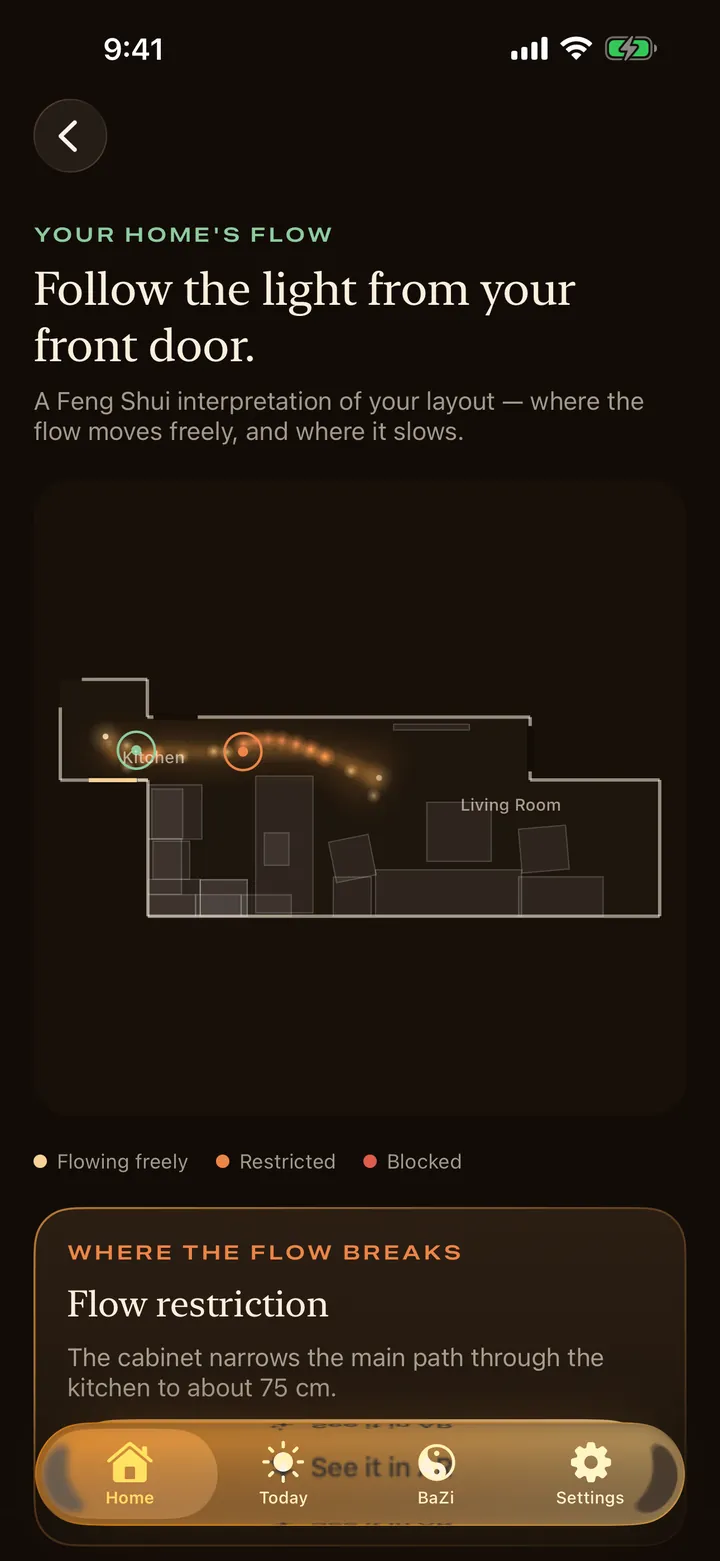
What a scan reads in your entryway
- Furniture standing in the path just inside the front door.
- A mirror straight across from the front door.
- Furniture that narrows the route from the entry into the home, and pinch points along it.
- What the front door lines up with beyond the entry: a window or back door, a bathroom or a bedroom.
- With no hall, how much of the room the door opens into is covered by furniture.
- Not read: loose shoes, coats, bags and other clutter, lighting, or what a mirror on a side wall reflects. Those you check by eye.
Questions
Where should a mirror go in a Feng Shui entryway?
On a side wall, at right angles to the front door. There it adds light and width and lets you check yourself on the way out. The position tradition advises against is directly across from the door, where the mirror is said to send the incoming flow back out.
Is it bad Feng Shui to keep shoes by the front door?
Shoes left loose in the path of the door are discouraged, both in tradition and for the obvious reason that people trip on them. A closed shoe cabinet on a side wall is the usual recommendation. A tidy rack beside the door, out of the walkway, is a common compromise.
What should be the first thing you see when you walk in?
Open space, and then something pleasant to look at: a picture, a plant or a lit wall. What tradition prefers you not to see first is a blank wall very close to the door, a mirror facing you, or a direct view of a bathroom or a bed.
How do I Feng Shui a small entryway?
Use one wall for everything and keep the opposite wall and the floor clear. Hang storage instead of standing it, choose a shallow shelf over a table, add a mirror on the bare side wall and make sure the light is good. Size matters less than whether you can walk straight in.
What if my front door opens straight into the living room?
Create an entry with furniture. A rug inside the door, a console or low bookcase to one side, and the back of a sofa as an edge are the usual pieces. Keep all of them out of the strip of floor directly in front of the door.
What furniture is good in an entryway?
A narrow console or wall shelf, a closed shoe cabinet, a bench and a mirror on a side wall are the pieces most often recommended. Each should stand against a wall and leave the path from the door clear. In a very small entry, a shelf and hooks may be all that fits.