 Feng Shui Scan
Two homes, two answers
Take a flat whose front door faces east. By the front-door method you stand in the doorway, look in, and the love corner is the back right of the plan, which in this flat is the northwest. By the compass method the relationship area is the southwest, which here is the back left: the corner the door method calls Wealth.
Neither reading is a mistake. They come from different schools, and the two only agree in a home whose door faces north. The Bagua map tool lets you switch between the two grids so you can see what your own door does to the answer. Whichever you choose, use it for all nine areas, including the wealth corner diagonally across from this one in the door grid.
The area is named after Kun, the trigram associated with earth and with receptiveness. It is often labelled Marriage. Modern teachers widen it to partnership of any kind, and some include close friendships and business partners.
The bedroom’s own relationship corner
Most people who search for the love corner are thinking about the bedroom, and the bedroom has one of its own. Stand in the bedroom doorway: the far-right corner of that room is its relationship area, by the same grid at a smaller scale.
What stands there is often accidental. It may be the laundry basket, a chair under a pile of clothes, an exercise bike, or the desk that moved in during a spell of working from home. The traditional suggestion is to give the corner one deliberate thing instead: a lamp, a small table with two objects on it, or a picture of something in a pair.
In many bedrooms the far-right corner is where the bed itself has to go. That is no fault. The bed’s position is decided by the door and the walls, as set out on the bedroom page, and the corner is dressed around it.
A few bedroom cautions are traditionally tied to relationships and apply whichever corner the bed is in:
- Room on both sides of the bed. A bed pushed against a side wall is read as having space for one person.
- Matching bedside tables and lamps. They need not be identical, only comparable.
- Work kept out of sight. A laptop and a stack of papers in the relationship corner is one of the most repeated objections.
- Mirrors. Many teachers dislike a mirror facing the bed for separate reasons.
Pairs, and why tradition asks for them
The central idea is plain symbolism. A space arranged for one person is said to describe a single life, and a space arranged for two describes a shared one. So the corner is given things in twos: two candles, two cushions, a pair of chairs, a pair of matching lamps.
Teachers who work this way usually add three refinements.
- Equal, not just double. Two chairs of the same height say something different from an armchair and a stool.
- Soft over hard. Fabric, cushions, a rug and rounded forms are preferred here to bare metal and sharp edges.
- Pictures count. Art showing one solitary figure, or an empty landscape, is the example every teacher reaches for. The suggested swap is an image with two of something.
The ordinary observation underneath is fair enough: a room with one chair and one bedside lamp does not have anywhere for a second person to sit or read.
Earth, and the colours that go with it
The area belongs to Earth. In the five elements Fire produces Earth, which is how red and pink come to sit beside the earth tones in the traditional palette, and white is given as well. Materials follow the element: ceramics, stone, terracotta, and low square shapes.
Black Hat books often suggest rose quartz or fresh flowers. Many classical practitioners do not use life areas this way, and compass schools have their own methods for relationship questions that depend on birth data and are not tied to this square.
Scale matters. A pink cushion and a pair of ceramic lamps is the size of gesture intended. Nobody is asking for a red wall.
Clearing what belongs to earlier relationships
This is the piece of advice that comes up most and has least to do with element theory. Teachers suggest removing from the corner, and usually from the bedroom as a whole, things that are strongly tied to a past partner: photographs, gifts on display, letters kept in the bedside drawer.
It is easy to overread. The tradition does not ask you to throw away your history, and nothing here applies to mementos of someone who has died unless you want it to. The suggestion is only about what the room keeps in front of you every day. Moving a box to another cupboard meets it.
When the corner is a bathroom, a storeroom, or not there
A bathroom. Tradition associates bathrooms with draining, so teachers treat one in the relationship area as something to offset. The standard measures are a closed door and toilet lid, good repair, and Earth added to the room: a ceramic pot, stone-coloured towels, a plant in a terracotta planter. More on the room itself is on the bathroom page.
A storeroom, garage or cupboard. The reading is that the area is shut away. Order and a working light are the remedies. What is stored matters less than whether you can walk in.
Missing. In an L-shaped or notched plan the far-right square may lie outside the walls. Black Hat teaching offers symbolic completions, such as a light or a plant at the inside corner. Many people simply work with the bedroom’s corner instead. Reading a floor plan explains how missing areas are judged.
None of these says anything about the people who live there. A floor plan cannot describe a relationship, and it should not be read as a forecast of one.
Relationship corners in practice
- The far-right corner of the home is a child’s bedroom — Leave the child’s room to the child. Use the corner of your own bedroom, measured from its door, and treat the home-level area as occupied by family, which no school objects to.
- The bedroom’s far-right corner holds a desk — If the desk cannot leave the room, move it to the near wall and put a chair and a lamp in the corner instead. Failing that, close the laptop and clear the surface at night.
- A single person in a one-bedroom flat — The usual advice is practical: a second bedside table, space on both sides of the bed, and room in the wardrobe. It describes a home someone else could step into.
- A couple whose corner is the en-suite — Door shut at night, a pair of matching towels, something ceramic on the shelf. Then give the bedroom’s own far-right corner a lamp.
Common mistakes
- Decorating the corner and ignoring the bed — two rose quartz hearts do not offset a bed jammed against the wall with one lamp.
- Pairs of everything, everywhere — the advice concerns one corner. A home where every object has a twin is a theme, not a remedy.
- Reading a bathroom there as a verdict — it is a placement tradition suggests offsetting. It says nothing about your relationship.
- Switching methods when the first answer disappoints — if the door method puts the corner in the garage, moving to the compass for this one area mixes two maps.
- Keeping a shrine to an ex, tidily — framing it nicely does not change what the corner is showing you each morning.
In a plain rectangle the far-right corner is obvious. In a home with a hallway down one side, an extension at the back or a bedroom that straddles two squares, it takes a drawn plan to say which room the relationship area really is.
SEE IT ON YOUR FLOOR PLAN
Scan your home and see which room the Love and Relationships area falls in, by front door or by compass.
Coming to the App Store · iPhone and iPad · submitted for review
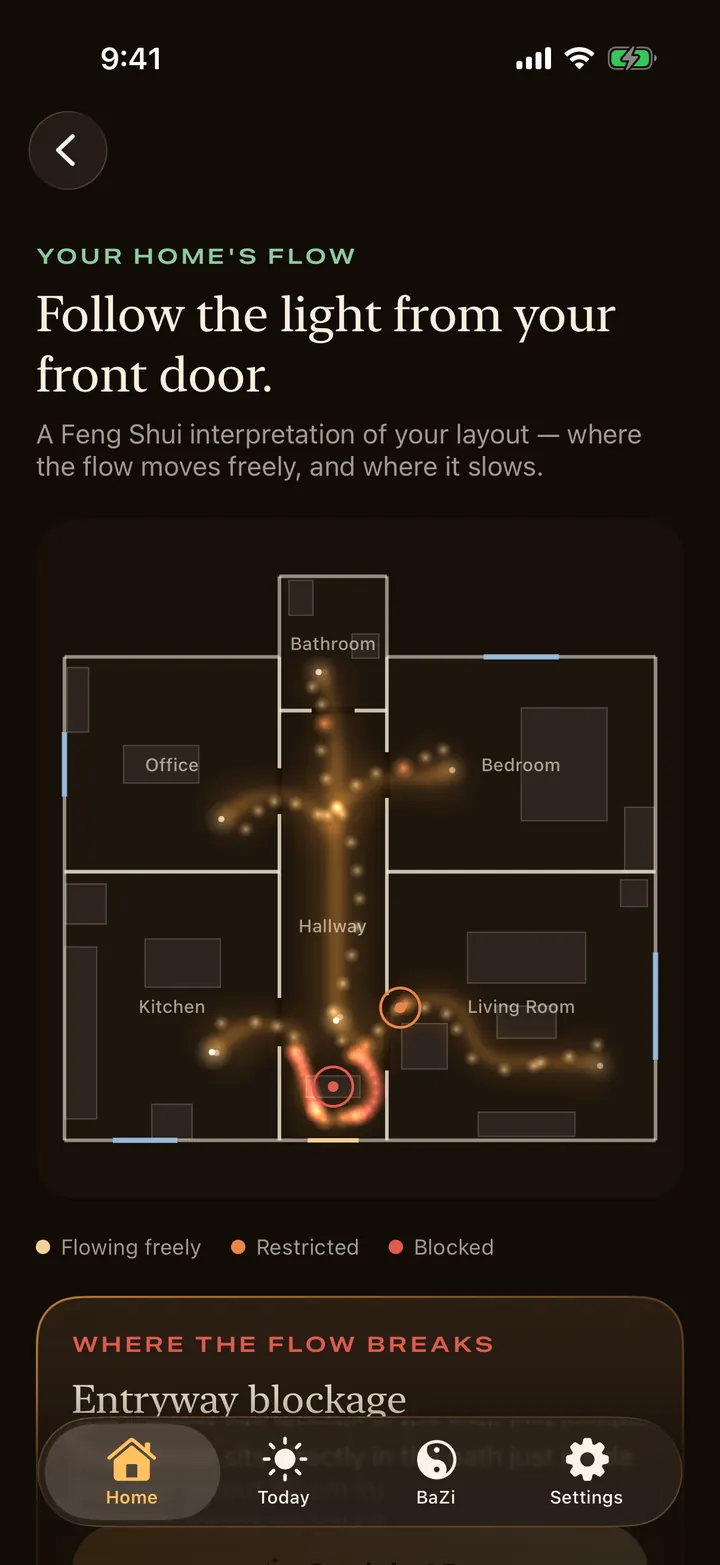
What a scan shows for the love corner
- The Bagua over your scanned floor plan with the Love and Relationships area marked, by entrance or by compass.
- Which rooms fall mostly inside that area under each method.
- Whether the area is missing, listed when less than half of its square is on your floor.
- In the bedroom: whether the bed is in the command position, with the door in view and a solid wall behind it.
- Whether the bedroom is crowded, meaning a high share of its floor is covered by furniture.
- Not read: what you have placed in the corner. The app does not check pairs, pictures, colours, clutter or mirrors facing the bed.
Questions
Where is the love corner in a bedroom?
Stand in the bedroom doorway looking in. By the Black Hat method the far-right corner of the room is its relationship area. Compass practitioners would use the southwest part of the room instead.
What should I put in my love corner?
Tradition suggests things in pairs, such as two lamps, two cushions or two chairs, along with soft textures and touches of pink, red, white or earth tones. Fresh flowers and ceramics are also common suggestions. These are symbolic gestures and are not said to guarantee anything.
What should not go in the relationship corner?
The usual list is work equipment, exercise machines, clutter, pictures of solitary figures, and prominent reminders of past partners. Dead plants and broken objects are discouraged in every Bagua area.
Is the love corner the southwest or the far-right corner?
Both are taught, by different schools. The Black Hat school uses the far-right corner from the front door, and classical compass practice uses the southwest. They coincide only when the front door faces north, so choose one and apply it to the whole home.
Can Feng Shui help me find a partner?
No arrangement of a room can promise that. What the practice offers is a way of looking at whether your home has space for another person in it, which is a reasonable thing to consider on its own.
What if a bathroom is in my love corner?
Keep the door and the toilet lid closed, keep the room in good repair, and add something of the Earth element such as ceramics or a terracotta planter. Many people also use the relationship corner of the bedroom as the one they pay attention to.