 Feng Shui Scan
Two readings, two subjects
Form-school Feng Shui gives the same advice to everyone who lives in a room. The bed should see the door, the path from the entrance should be clear, and a sharp corner should not point at a seat. None of that depends on who you are.
BaZi is the opposite. It says nothing about buildings. It takes the year, month, day and hour of a birth, writes them as four pillars, and reads the balance of the five elements around the Day Master, the character that stands for the person.
Putting the two together answers a question neither answers alone: given that this room is arranged well in general, is there anything about it that suits this particular person more or less? Two people sharing a home can get the same form reading and different personal ones.
The five elements are the bridge
A BaZi reading ends with one or two elements the chart is said to benefit from. How that judgement is made is set out under favorable elements. If you do not know yours, the BaZi calculator works them out.
Feng Shui uses the same five elements and attaches each to things you can find in a home:
- Directions. Each of the eight compass directions, and the centre, belongs to an element. East is Wood, south is Fire, north is Water, and so on. The full mapping is on the favorable directions page.
- Colours. Greens for Wood, reds for Fire, yellows and sand tones for Earth, white and grey for Metal, black and deep blue for Water.
- Materials and shapes. Plants and timber, warm lighting, ceramics and stone, metal and round forms, glass and flowing shapes.
So an element that began as a judgement about a birth chart becomes a compass direction to face or a colour to put near the bed.
Where it is applied: the bed and the desk
Practitioners concentrate on the places where a person spends hours without moving. In a home that means where you sleep and where you work.
For each, two things are looked at. The first is the sector: which part of the home, measured from its centre, the bed or desk sits in. The second is the facing: for a desk, the direction you look when seated, and for a bed, the direction the top of your head points. Each is compared with the directions that belong to your favourable elements.
When one of them matches, the tradition counts that as support. When neither does, the suggestions come in order of effort. Turn the bed or desk if the room allows it. If it does not, bring the favoured element in by colour or material: bedding, a lamp, a rug, a plant, an object on the desk.
The same idea extends to rooms. A living room, bedroom or office containing nothing of a favoured element is a common thing for a practitioner to remark on, and the answer is equally small.
BaZi or Kua: two ways to personalise
BaZi is not the only method for fitting a home to a person, and it is not the most widely known. Eight Mansions works from a single Kua number, calculated from the birth year and sex, which sorts the eight directions into four favourable and four unfavourable ones. You can find yours with the Kua number calculator.
The two methods start from different information. Kua uses the year only. BaZi uses all four pillars. They can therefore give different directions for the same person, and often do. Some practitioners use only one. Some use Eight Mansions for directions and BaZi for colours and timing. Neither result is an error; they are different schools.
It helps to know which you are following so that you do not mix advice from both. The app works from BaZi favourable elements and does not use Kua numbers.
Form first, personal directions second
When personal directions and the layout of the room disagree, there is a broadly shared order of priority.
- Form. The command position for the bed and desk, and a clear path through the home. These apply to everyone and most schools agree on them.
- Personal directions and elements. Applied within whatever the form rules leave open.
A bed turned to a favourable direction with its back to the door is not considered an improvement. If the only way to face your direction breaks the command position, keep the position and use colour and material for the element instead. The bedroom and home office pages go through the form rules for each.
There is also a reason of confidence. Whether a bed can see the door is something anyone can check. Which element a chart favours depends on the method used to read it.
How it works out in real homes
- A chart said to favour Water, a bedroom in the south of the flat — South belongs to Fire, and the bedroom cannot be moved. If the headboard can go on the north wall without losing sight of the door, that is the first choice. Otherwise bring Water in with deep blue bedding or a glass lamp.
- A couple whose charts favour different elements — The bed is shared, so it is placed by form alone. Each person then uses their own side for colour, with a bedside lamp or a throw, and applies facing direction at their own desk.
- A favourable direction that puts the desk’s back to the door — Keep the desk where it sees the door. Add the favoured element on the desk or the wall in front of you.
- A renter who cannot rearrange much — Sector and facing are fixed by the furniture that fits. Colours and materials are not, and they are what the tradition offers when nothing can be moved.
Common mistakes
- Putting direction ahead of the door — personal directions are the second layer. They do not override a bed or desk that has lost the command position.
- Redecorating the whole home in one element — the method is applied at the bed and desk. A house painted entirely in your favoured colour is not what any practitioner means.
- Mixing Kua directions with BaZi elements without noticing — they are different methods and can contradict each other. Decide which you are using for directions.
- Assuming the element you lack is the one you need — scarcity counts only in some charts. Favourable elements follow from the Day Master’s strength.
Reading about BaZi Feng Shui is one thing. Seeing it on your own floor plan is another. Which sector your bed is in and which way your head points depend on the home’s centre and a compass heading, and both are tedious to work out with a paper plan.
MAKE YOUR HOME PERSONAL
Scan your home, add your birth details, and see how your bed and desk sit against the elements your chart is said to favour.
Coming to the App Store · iPhone and iPad · submitted for review
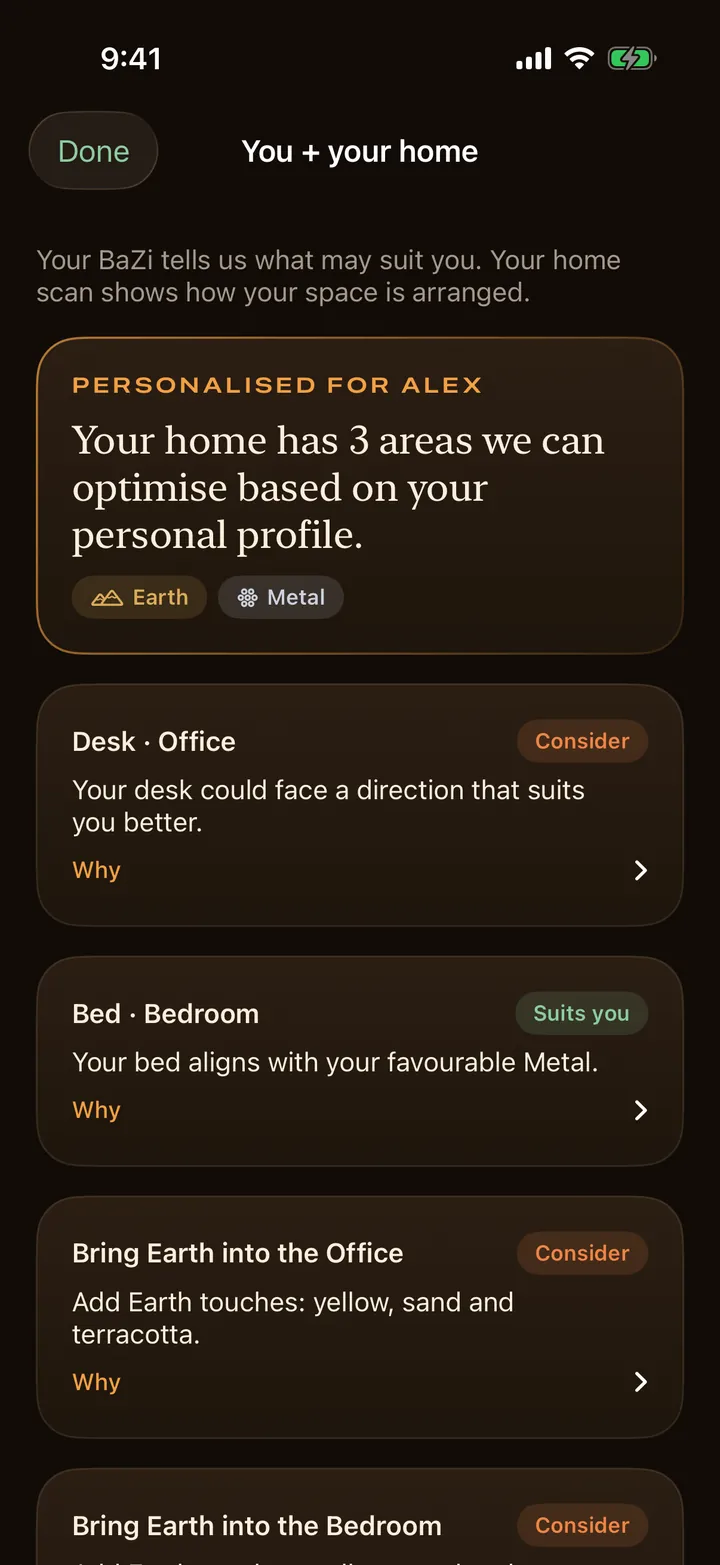
What the app reads when you add your chart
- For each bed and desk in a scanned home with a compass heading: the sector of the home it sits in and the direction you face, or for a bed the direction your head points.
- How both compare with your favourable elements, with a suggestion to face a favourable direction or to add that element’s colours and materials nearby.
- Living rooms, bedrooms and offices that contain nothing of a favourable element.
- The form reading underneath it: whether each bed and desk is in the command position, and where the flow from the front door is narrowed or blocked.
- Not used: Kua numbers, Eight Mansions directions or Flying Stars. The colours already on your walls are not read either.
Questions
What is BaZi Feng Shui?
It is the practice of using a person's BaZi chart to adjust their home. The chart's favourable elements are matched to compass directions, colours and materials, which are then applied mainly to the bed and the desk.
Is BaZi Feng Shui better than using a Kua number?
Neither is established as better. They are different schools that start from different information: Kua from the birth year and sex, BaZi from all four pillars. They can give different directions for the same person, and practitioners differ on which to follow.
Do I need a compass for BaZi Feng Shui?
For directions and sectors, yes, because you need to know which way the home faces. For colours and materials you do not; those can be applied from the favourable elements alone.
What if two people share a bedroom and have different favourable elements?
The bed is placed by the form rules, which are the same for both. Personal elements are then applied individually, on each person's side of the bed and at each person's own desk.
Should I move my bed to face my favourable direction?
Only if it keeps the command position: the bed still sees the door, the headboard is on a solid wall, and it is out of the door's direct line. If the direction would break that, most practitioners keep the position and add the element through colour and material.