 Feng Shui Scan
Finding it by the front door
This is the method of the Black Hat school, and the one most Western books mean when they say "wealth corner". Stand in the front doorway facing in. Picture the whole floor as a three-by-three grid with the door wall along the near edge. The wealth area is the square at the back on your left.
Three things trip people up:
- Use the front door of the home, not the door you happen to use most. In an apartment that is your own door, not the building’s.
- The grid covers the whole outline. Teachers generally include an attached garage and leave out a detached shed.
- The corner is an area, not a point. It is roughly a ninth of the floor. If a wall runs through it, part of the area is in each room.
The Bagua map tool lets you set where your door sits on its wall and shows which square is which.
Finding it by compass
Classical practice fixes each area to a direction, and wealth belongs to the southeast. To use this method you find the centre of the plan, take a compass reading, and mark the southeast sector, wherever the door happens to be.
The two answers coincide only when the front door faces north. In every other home they point to different rooms, and practitioners of each school hold to their own. There is no neutral test. What does not work is using both: taking wealth from the door grid and another area from the compass gives you a map that belongs to neither. Reading a floor plan goes through both methods on a whole home.
What tradition puts in the wealth corner
The area’s element is Wood, and its traditional colours are purple, green and gold. The advice that follows from that is modest in scale.
- Order first. Almost every teacher starts with the same instruction: clear the corner, and repair or remove anything broken in it.
- Light. A corner that is dim is said to be stagnant. A lamp is the usual answer.
- A healthy plant. A living plant is Wood in its most literal form. Upward-growing plants with rounded leaves are the ones most often named. A dying plant is considered worse than none, so choose one that suits the light the corner really gets.
- Colour in small amounts. A purple cushion, a green vase or a gold frame is the scale intended.
- Water, with a caveat. Small fountains are popular in Western Feng Shui, on the reasoning that Water feeds Wood in the five elements. Schools differ here. Classical practitioners generally place water by compass calculation, not by the Bagua area, and many teachers advise against water features in a bedroom.
Some people keep something there that stands for what they are working toward. That is a personal habit more than a rule.
What tradition avoids there
The list is short: clutter, broken or unused things, dead plants, dust, and the rubbish bin. If the bin has nowhere else to go, a lidded one emptied often is the compromise.
The harder cases are the ones you cannot move.
A bathroom in the wealth corner. Tradition associates bathrooms with water leaving the home, so this is the placement people worry about most. The usual remedies are small: keep the door closed and the toilet lid down, fix drips, keep the room clean and bright, and add a plant, since Wood is said to take up the Water. Black Hat teachers sometimes add a mirror on the outside of the door. The bathroom page covers these in more detail.
A storeroom or cupboard. Storage is not a fault in itself. What tradition objects to is a corner nobody can enter. Shelve it, light it, and remove what you will never use.
A bedroom or kitchen. Neither is treated as a problem. The room’s own layout rules come first.
The wealth corner of a single room
The same grid can be laid over one room, taken from that room’s door: the far-left corner as you stand in the doorway. Black Hat teachers apply it this way routinely, and some go as far as the top of a desk.
This is the practical route for anyone whose home-level corner is a bathroom, a neighbour’s wall or a room they do not control. People sharing a house often use only their own bedroom or home office. In a living room the far-left corner is frequently where an armchair or a lamp already stands, which is all the tradition is asking for.
When the corner is missing
In an L-shaped plan, or one with a notch, the grid’s far-left square can fall partly or wholly outside the walls. Black Hat teaching reads that as a missing wealth area. The remedies offered are symbolic ways of completing the shape: a light or a plant at the inside corner nearest the gap, a mirror on one of the walls beside it, or, where there is a garden, a lamp or a planted pot at the point where the corner would have been.
By the compass method the same home may be missing nothing in the southeast, or missing something else entirely.
Keeping it in proportion
No arrangement of a corner earns, saves or attracts money, and a plant does not stand in for a budget. What the practice offers is attention: one part of the home kept in order on purpose. A tidied corner is worth having on its own terms.
It also comes second. The form school’s questions about the layout itself, such as whether the entrance is clear and whether the route through the rooms is open, apply before any Bagua area is dressed.
Four wealth corners
- The far-left corner is the main bedroom — Nothing needs to be added that the bedroom’s own rules would not want. A lamp and a plant on the far-left side, away from the bed, are enough. Leave out the fountain.
- A studio apartment — The home and the room are the same grid. The far-left corner is often where the bed or wardrobe has to stand; keeping the top of the wardrobe and the floor beside it clear is the whole job.
- The corner is a shower room — Door closed, lid down, extractor working, a plant that tolerates humidity on the windowsill. Then apply the grid to the living room and use that corner as well.
- An L-shaped flat where the corner is the neighbour’s stairwell — By the door method the area is missing. A floor lamp at the inside corner of the L is the traditional gesture. By compass, check the southeast before deciding anything is absent.
Common mistakes
- Using both methods at once — a plant in the far-left corner and a fountain in the southeast means following two maps. Pick one.
- Measuring from the wrong door — the back door or the garage door you use every day does not set the grid. The front door does.
- Filling the corner — a money plant, a fountain, three crystals and a gold statue on one shelf is clutter by another name.
- Leaving a plant to die there — tradition reads a failing plant as worse than an empty corner. Replace it or take it out.
- Expecting a result — the corner is symbolism. Treating it as a financial plan is the one mistake that can cost you something.
The far-left corner is easy to point at in a square room. In a real home, with a notch, an extension or a wall that cuts the corner in two, it is harder to say which room the Wealth area is in, or whether it is there at all.
SEE IT ON YOUR FLOOR PLAN
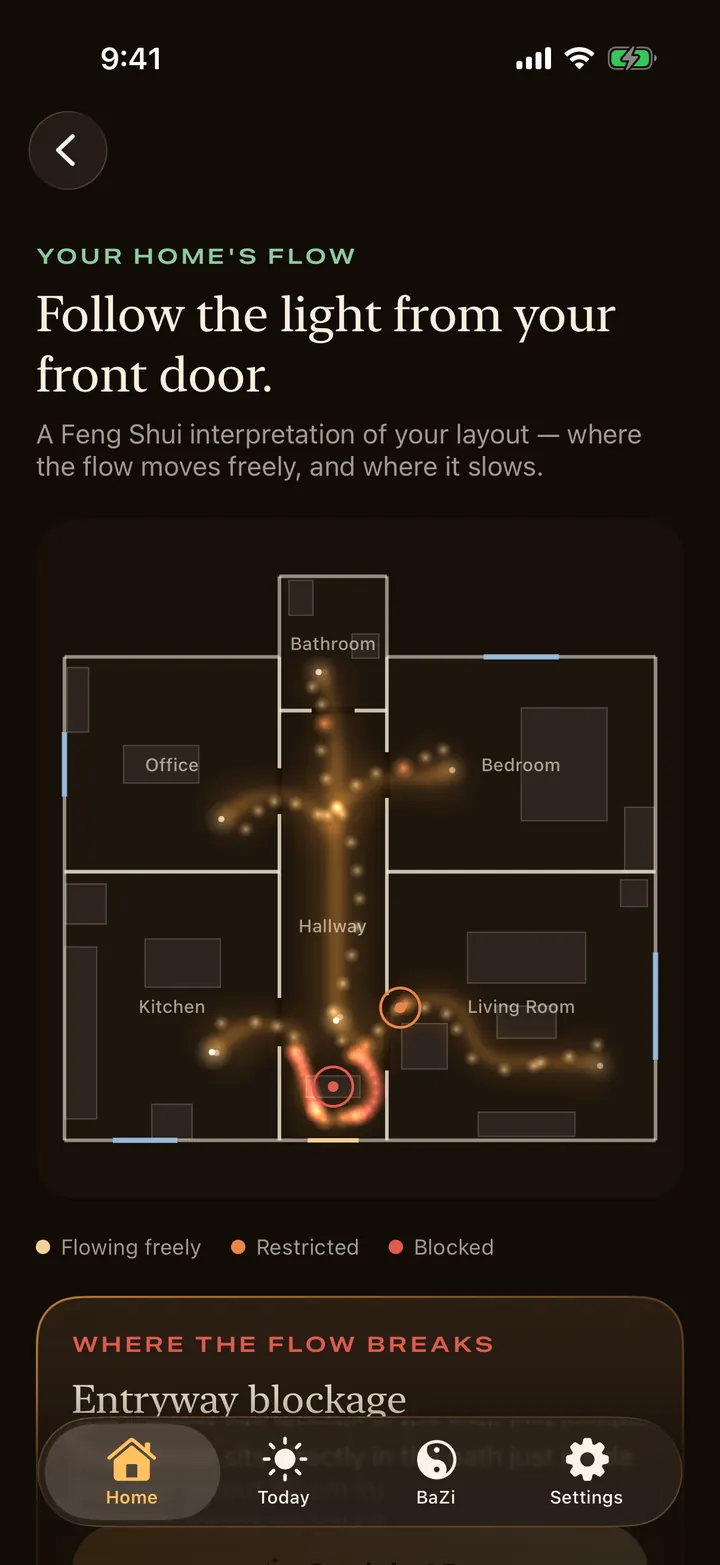
Scan your home and see which room the Wealth area lands in by either method, and whether your plan has that corner at all.
Coming to the App Store · iPhone and iPad · submitted for review
What a scan shows for the wealth corner
- The Bagua laid over the floor plan you scanned, stretched to its real outline, with the Wealth area marked.
- Both methods: by entrance, and by compass, using the heading recorded during the scan.
- Which rooms fall mostly in the Wealth area under each method.
- Whether the area is missing: it is listed when less than half of its square is on your floor.
- Furniture that crowds a room or cuts the flow path, including in the room that holds the corner.
- Not read: what is in the corner. The app does not check clutter, the condition of a plant, colours, or whether a bin stands there.
Questions
Where is the wealth corner in my house?
By the front-door method it is the far-left corner as you stand in the front doorway looking in. By the compass method it is the southeast part of the home. The two match only when the front door faces north, so decide which method you are following first.
What should I put in my wealth corner?
Tradition suggests keeping it tidy and well lit and adding a healthy plant, with small touches of purple, green or gold. Water features are popular in Western Feng Shui, though classical practitioners place water by other rules. None of this is said to guarantee anything.
Is a bathroom in the wealth corner bad Feng Shui?
It is the placement people worry about most, because bathrooms are associated with water draining away. The usual remedies are a closed door, a closed toilet lid, repairs to any leak, good light and a plant. Many people also apply the Bagua to another room and use its wealth corner.
Does the wealth corner of a bedroom count?
Black Hat teaching applies the same grid to any single room, measured from that room's door, so a bedroom has its own far-left corner. Most teachers advise against water features in a bedroom; a lamp or a plant is the usual choice there.
Does the wealth corner really bring money?
No. It is a symbolic practice within Feng Shui, and nothing placed in a corner earns or attracts money. What it does is keep one part of your home deliberately in order.
What if my home has no wealth corner?
In an L-shaped or notched plan the far-left square can fall outside the walls, which Black Hat teaching reads as a missing area. The traditional remedies are a light, a plant or a mirror near the gap. By the compass method the same home may not be missing that area at all.