 Feng Shui Scan
Why a mirror facing the front door is the classic caution
The front door is treated in every school as the place a home’s qi comes in. A mirror is treated as something that sends back whatever meets it. Put the two opposite each other and the reading follows: what arrives at the door is said to be turned straight out again, before it has reached any room.
The caution is strongest in Black Hat teaching and in the popular advice that grew from it. Some classically trained practitioners give mirrors little weight either way and would look first at what the door lines up with across the home, as described on the front door page.
A sceptic can still find a reason to move the mirror. Opening your own door to a figure coming toward you is a small jolt, even when the figure is you, and visitors meet their own reflection before they meet their host.
What counts as "facing"
The rule is narrower than "a mirror you can see from the door". Three things have to be true.
- Straight across. The mirror is on the wall opposite the door, within the width of the doorway continued into the home. Stand on the threshold with the door open and look dead ahead. If you see yourself full on, it faces the door.
- Close enough. A mirror two steps inside the door is the case every teacher means. One across a long room is treated as weaker, and practitioners do not agree on a distance at which it stops counting.
- In line of sight. A wall, a cupboard or a closed internal door between the two removes the alignment.
The app applies a fixed version of this. A mirror you have marked on the plan counts as facing the front door when it is straight across from it, within about 3.5 metres, with a clear line of sight. That figure is the app’s working threshold, not a traditional measurement.
A mirror on the opposite wall but well off to one side is a borderline case, and most advice treats it as milder. The same test from the threshold is used for every alignment in a whole-home walkthrough.
Where it goes instead
The preferred place is a side wall of the entry: a wall at right angles to the door, so the mirror looks across the hall and not out of it. There it gives a last look on the way out, spreads the light and makes a narrow space feel wider. The rest of the arrangement, from shoes to the console table, is in the entryway guide.
A mirror on the same wall as the door, beside the frame, is also fine. It cannot face the door it hangs next to.
Once it is up, make sure the open door does not cover it, and that it has not brought a console or shelf out into the strip of floor in front of the door, which would turn a mirror question into a blocked entryway.
The end of a hall, and mirrored wardrobe doors
A mirror at the end of a hallway. If the hall runs straight in from the front door, a mirror on its end wall faces the door, however far away it is. Distance weakens the reading. There is a second objection: tradition already reads a long straight corridor as flow moving too fast, and some practitioners say a mirror at the end makes the corridor look twice as long. A picture or a lit wall is the usual choice for that spot. Mirrors on the side walls of a corridor are a separate matter, covered under long hallway.
Mirrored wardrobe doors. Built-in sliding wardrobes with mirror fronts cannot be rehung. Along the side of the hall they are a side-wall mirror, large but acceptable. Opposite the front door, the usual suggestions are to cover the panel the door faces with frosted or patterned film, to hang a curtain that draws across it, or to leave that slider open so the door looks at the inside of the wardrobe.
What the mirror reflects
A mirror is said to double whatever it shows, so position is half the question. Stand at the door, then at the spot where you take your shoes off, and look at what is in the glass.
- Clutter. A mirror that shows the coat pile or the recycling shows it twice.
- A bathroom door. Tradition is wary of a front door that looks at a bathroom, and some practitioners extend that to a mirror that brings the bathroom into view. Keeping that door shut settles it. See the bathroom guide.
- Stairs. A mirror reflecting a staircase is said by some to repeat the effect of a front door facing stairs.
- Liked. A window, a plant, a picture, a lit wall or the room beyond.
Sliding the mirror half a metre along the wall is often all that is needed.
Size, height, and schools that use mirrors on purpose
Advice on size and height is loosely attributed and varies from teacher to teacher. The points repeated most often are that the mirror should show the whole head of the tallest person in the household, that it should be one piece and not tiles or segments that break the reflection, and that it should be clean and uncracked. None of these comes with a measurement the schools share.
Mirrors are also not only something to avoid. Black Hat teachers sometimes place them deliberately, most often on a side wall, to widen a tight entry. Some accounts go further and suggest one on a wall that stands very close in front of the door, to give that wall depth. That is exactly where the general caution says not to hang one. Teachers who recommend it are judging the cramped wall to be the greater problem. Others would hang a picture there instead.
So the schools differ. Hang the mirror on the side wall first. If the entry still feels like walking into a wall, you are at the choice they disagree about.
Mirrors in real entries
- A full-length mirror two metres opposite the door — Move it to a side wall. If both side walls are taken up by doors, the inside of the coat cupboard door gives the same last look without facing anything.
- A corridor entry with hooks along one wall — Hang the mirror on the bare wall, toward the door end, where it shows the light from the doorway and not the row of coats opposite.
- Mirrored sliding wardrobe straight ahead of the front door — Put frosted film on the panel in line with the door and leave the other panels as they are. From the threshold you now see a plain surface.
- A side-wall mirror that shows the bathroom door — Move it along the wall until it reflects the picture or the wall opposite, or keep the bathroom door closed.
Common mistakes
- Judging from inside the hall — the line is read from the threshold with the door open. One step to the side changes what is in the middle of your view.
- Mirroring the whole opposite wall to widen the hall — it does widen it, in the one position tradition warns about. A side wall gives most of the effect.
- Moving the mirror and keeping its console — the table that stood under the mirror is still in front of the door.
- Hanging it by the wall space and not by what it shows — the mirror fits the gap and reflects the shoe rack.
- Fixing the mirror and stopping there — a door that lines up with a balcony door or a bathroom is a separate reading, and often the larger one.
Whether your mirror is straight across from the door or merely visible from it comes down to where the doorway’s line falls on the opposite wall. On a measured plan that is one line. From the doormat it is a guess.
SCAN YOUR ENTRYWAY
Scan from your front door, mark the mirror on the plan and see whether it counts as facing the door.
Coming to the App Store · iPhone and iPad · submitted for review
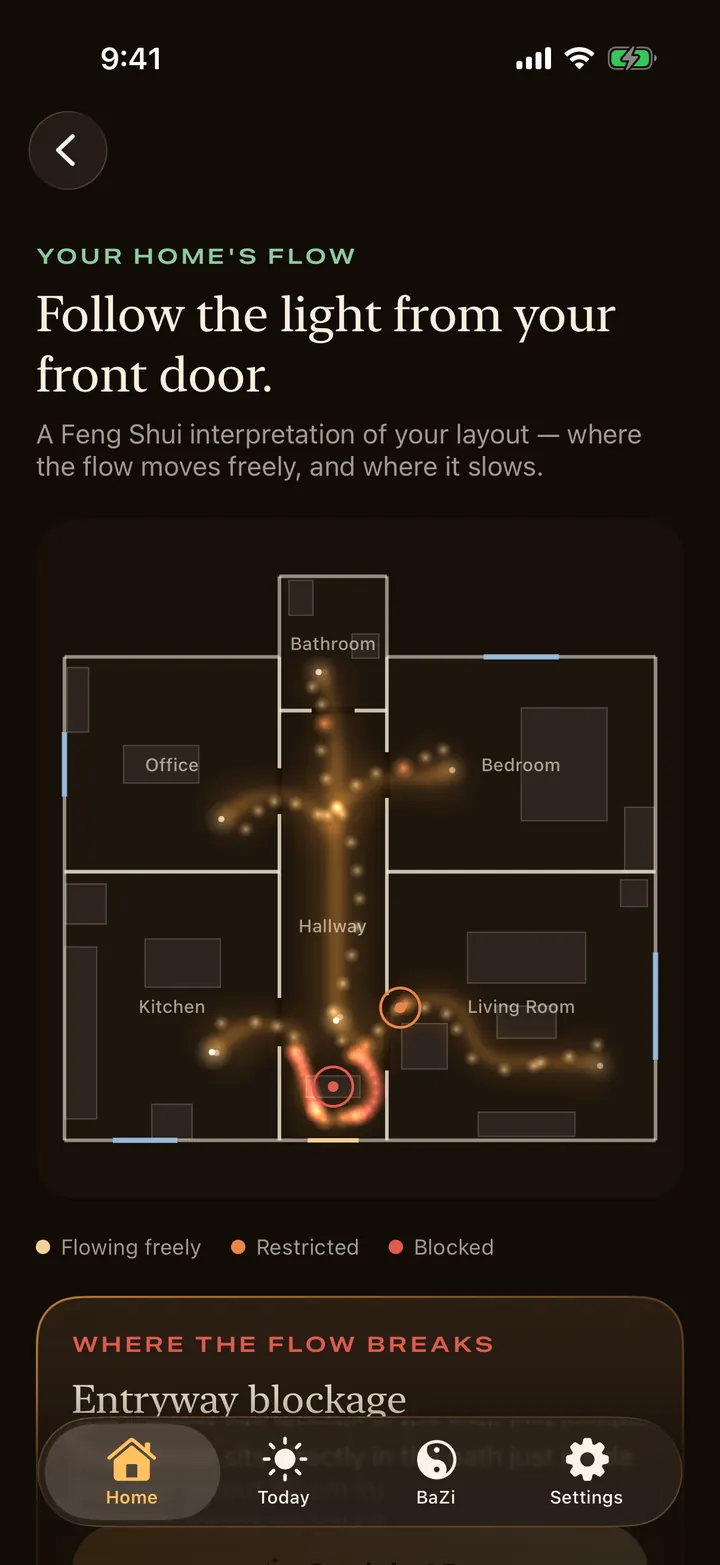
What a scan reads about your entryway mirror
- A mirror you have marked on the plan that is straight across from the front door, within about 3.5 metres and in clear line of sight. It is reported as the finding "Mirror facing the door".
- Furniture standing in the path just inside the front door, such as a console under the mirror.
- What the front door lines up with beyond the entry: a window or exterior door, a bathroom door or a bedroom.
- Furniture that narrows the route from the entry into the home, and pinch points along it.
- A hallway that ends in a dead end.
- Not read: mirrors on side walls, what any mirror reflects, its size, height or condition, and stairs. The app also does not check mirrors facing beds elsewhere in the home.
Questions
Is it bad Feng Shui to have a mirror facing the front door?
It is one of the most repeated cautions. The mirror is said to send arriving qi back out before it enters the home. The caution is strongest in Black Hat teaching, and some classical practitioners give it less weight. Moving the mirror to a side wall is the usual fix.
Where should I hang a mirror in the entryway?
On a side wall, at right angles to the front door, where it adds light and gives you a last look on the way out. Check what it reflects from the doorway, and make sure the open door does not cover it.
Can a mirror go right next to the front door?
Yes. A mirror on the same wall as the door, beside the frame, cannot face the door and raises no objection. The caution applies only to a mirror straight across from the door.
How far from the door does a mirror have to be before it stops counting?
There is no agreed traditional distance. Practitioners treat a mirror a few steps from the door as the clear case and one across a large room as weaker. The app uses about 3.5 metres as its own working threshold.
What should an entryway mirror reflect?
Something you are glad to see twice: a window, a plant, a picture or a lit wall. Clutter, an open bathroom door and, in some accounts, a staircase are the things to keep out of it.
Are mirrored closet doors in the hallway bad Feng Shui?
Along the side of a hall they are treated like any side-wall mirror. Directly opposite the front door they fall under the caution. Frosted film on the panel the door faces, or a curtain across it, are the usual remedies.