 Feng Shui Scan
The desk and the door
The form school asks the same three questions of a desk that it asks of a bed:
- Can you see the door from your chair? Without turning, and ideally on a diagonal.
- Is there something solid behind you? A wall, not a window, a doorway or an open room.
- Are you out of the door’s direct line? A desk straight in front of the doorway sits in the path the room’s flow takes.
The reasoning given is that the person at the desk should be in charge of the room. The everyday version is easy to accept: it is harder to concentrate with a door behind you, and people who work with their back to the room tend to keep glancing over a shoulder.
The classic arrangement is the desk in the corner diagonally opposite the door, turned so you look across the room toward it. The desk placement tool runs the three checks on a simple room you set up.
What is behind you
A solid wall behind the chair is read as support. The two common failures are a window and a door.
Back to a window. This is the usual result of turning a desk to face into a small room. Tradition reads it as missing support. In practical terms you get glare on a screen from one side or the other, and you appear as a silhouette on video calls. The remedies are a blind or curtain kept at least partly closed while you work, a chair with a high solid back, and, if there is depth for it, a low cabinet or a row of plants along the sill.
Back to the door. This is the position the tradition likes least for a desk, and it is the default in most home offices, because the desk goes against the far wall and the door is behind you.
The chair. A high-backed chair is widely recommended, as a portable version of the wall. It does not replace one, but it is the easiest thing in the room to change.
When the desk has to face a wall
In a box room or an alcove the desk often can only go against a wall. Feng Shui treats that as a compromise with known adjustments, not as a failure, and desk facing a wall sorts the minor versions from the one worth fixing.
- Turn it ninety degrees. A desk set at a right angle to the wall, with one short end touching it, usually puts the door in your side vision and a wall behind you. It needs less floor than a desk floating in the middle.
- Choose the wall beside the door, not opposite it. Facing a wall with the door to your left or right is better regarded than facing a wall with the door directly behind.
- Show yourself the door. A small mirror, or anything reflective on the desk angled toward the doorway, is the traditional workaround when you cannot face it.
- Give the wall some depth. Some practitioners suggest a picture with distance in it, such as a landscape, on the wall you face. It is a small thing, and a blank wall at arm’s length is tiring to look at.
A desk facing a window is a separate case. Some teachers like the view and the light. Others say attention goes out of the window with it. If you choose it, make sure the door is not directly behind you.
Shelves, corners and the path to your chair
Sharp corners pointing at the place you sit are called poison arrows. In an office they come from the corner of a bookcase, a filing cabinet, or a second desk standing at an angle. Turn the piece or slide it along the wall until the corner points past you.
A shelf fixed to the wall directly above your head is widely disliked, on the reasoning that weight hangs over you while you work. Move the shelf, or move the chair out from under it. Some practitioners say the same of open shelving with its edges facing the seat and prefer cupboards with doors.
Then look at the floor. The route from the door to your chair should be walkable without stepping over a printer, a box of files or a cable. A spare-room office often holds a guest bed, an exercise bike and storage as well. When furniture covers most of the floor the room reads as crowded, and the usual advice is to take a piece out before rearranging the rest.
A desk in a bedroom or living room
Many people have no separate room. Feng Shui’s concern here is keeping work and rest from running into each other.
In a bedroom, practitioners prefer the desk where it cannot be seen from the pillow, or screened in the evening with a curtain, a folding screen or simply a cloth over the monitor. The bed keeps first claim on the command position. The desk takes the best of what is left, and its corner should not point at the bed.
In a living room, keep the desk off the routes people walk and give it a wall behind the chair, even at the cost of the view. A desk that folds or closes, so that work is out of sight when it is finished, is a common recommendation.
Which room the office is in also matters to the form school. A workroom at the far end of a narrow corridor, or one the home’s flow does not reach well, is covered under home layout.
Which direction should a desk face?
Form school gives no compass direction for a desk. It cares about the door and the wall.
Compass-based methods do give one, and they differ from each other. Eight Mansions assigns each person four good facing directions from a Kua number. Approaches built on BaZi start from the elements your chart is said to favour and the directions that belong to those elements. The two can give different answers for the same person.
For a desk, the direction that counts is the one you face when seated. If a favourable direction would put your back to the door, most practitioners keep the command position and add the favoured element in colour or material instead.
Offices that don't cooperate
- A box room where the desk only fits along one wall — Turn the desk to stand out from the wall at a right angle if the room is wide enough to walk past it. If not, use the wall beside the door, and stand a small mirror on the desk where it shows the doorway.
- The desk can only face into the room with the window behind — Fit a blind you can half-close, use a high-backed chair, and put a low cabinet or plants along the sill so there is something solid at your back.
- A desk in the corner of the bedroom — Place it on the wall the bed does not face, screen it at night, and check that no corner of the desk points at the pillow.
- Two people sharing one office — Desks facing each other leave one person with their back to the door. Set the two desks at a right angle in the far corner so both can see the doorway.
Common mistakes
- Pushing the desk against the wall to save space — it often saves less than expected and puts the door behind you. Try the right-angle position before settling for it.
- Chasing a compass direction with your back to the door — it trades the rule most schools share for one they dispute.
- Shelves over the chair — they go up because the wall above the desk is free. Hang them beside the desk instead.
- Letting the office become the storeroom — boxes and spare furniture arrive one at a time until the path to the chair is a squeeze.
Reading about Feng Shui home office layouts is one thing. Seeing your own office is another. Whether you are in line with the door, or whether that bookcase corner really points at your chair, is hard to judge from the seat itself.
SCAN YOUR OFFICE
Map the room with your phone and see whether your desk sees the door, what is behind your chair, and which way you face.
Coming to the App Store · iPhone and iPad · submitted for review
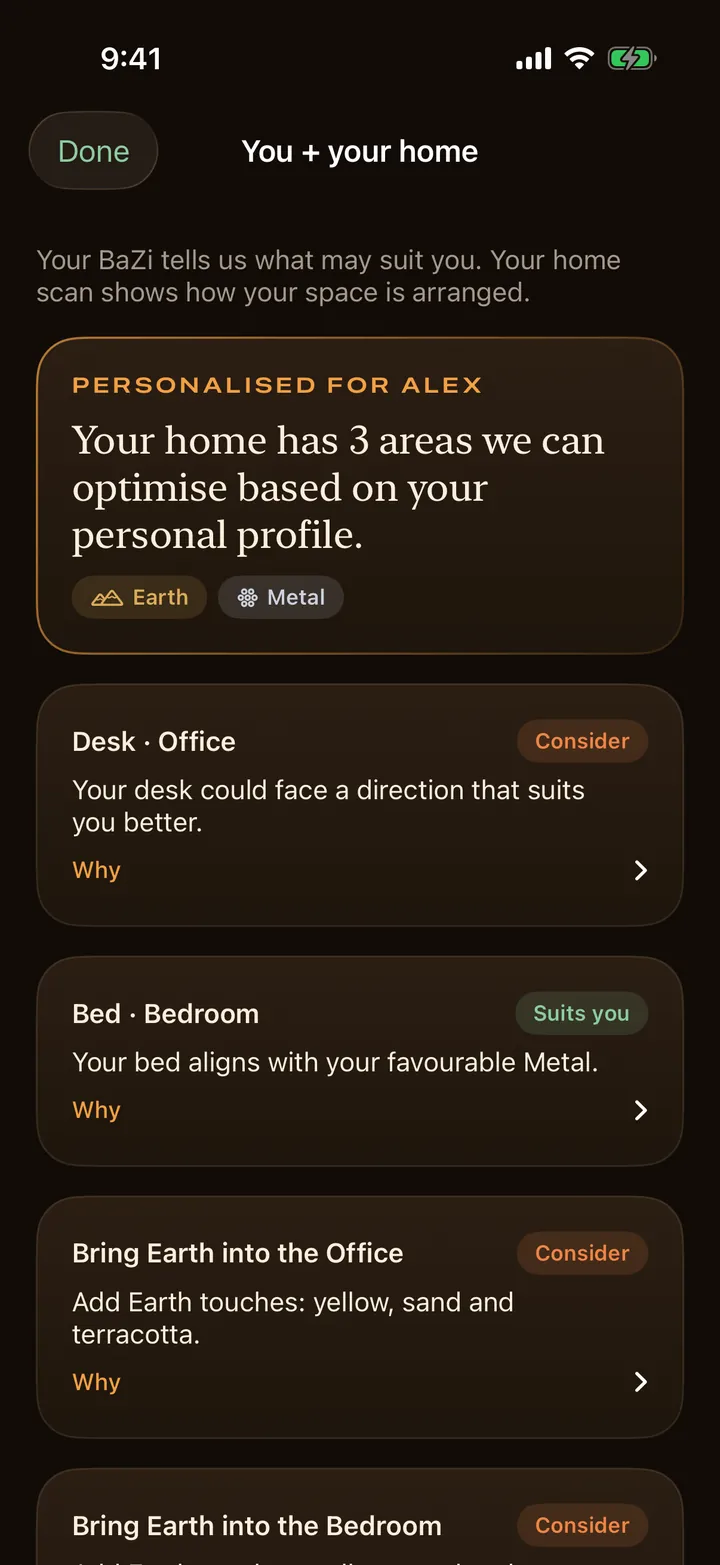
What a scan reads in your home office
- Whether the desk is in the command position: can you see the door from it, is there a solid wall behind you, and are you directly in line with the door.
- Furniture corners pointing at the desk.
- Furniture that narrows or cuts the path the flow takes through the room, and how much of the floor is covered.
- Whether the room is reached by the flow path from the front door at all.
- With your BaZi chart and a compass heading: the direction you face at the desk and the sector of the home it sits in, compared with your favourable elements, with a suggested direction or colours and materials to add.
- Not read: shelves or beams above your head, what is on the desk, cables or clutter. Those you check by eye.
Questions
Where should a desk be placed in a home office?
In the command position: facing the door, usually on a diagonal from the far corner, with a solid wall behind your chair and the doorway out of your direct line. Most schools of Feng Shui agree on this before anything else about a workspace.
Is it bad Feng Shui to have a desk facing a wall?
It is considered a compromise, not a serious fault, as long as the door is not directly behind you. Turning the desk at a right angle to the wall, or placing a small mirror that shows you the doorway, are the usual adjustments.
Should a desk face a window?
Teachers differ. Some welcome the light and the view, and others say the view draws attention away from the work. The more widely shared rule is about what is behind you, so a desk facing a window is acceptable if your back is not to the door.
Is it bad to sit with your back to a window?
A window is read as weaker support than a wall. If that is the only way to face the door, close the blind partly while you work, use a high-backed chair, and put something solid along the sill.
Which direction should my desk face?
Form-school Feng Shui does not name a compass direction. Eight Mansions and BaZi-based methods each suggest personal directions and do not always agree. Where a direction conflicts with seeing the door, practitioners generally keep the view of the door.
Can I have a desk in my bedroom?
Yes, and many people must. The traditional advice is to keep it out of sight from the bed or to screen it at night, and to let the bed, not the desk, have the best position in the room.