 Feng Shui Scan
The command idea, applied to seating
The living room guide covers the room as a whole: the group of seats, the table, the screen, the plants. This page is about one piece and where it stands.
Form-school practitioners read a sofa by the two questions they ask of a bed. What is behind the people sitting on it, and can they see who comes in? A wall behind is read as support. A view of the room’s entrance means nobody is approached from behind. The position tradition likes least is a sofa with its back to the door and open floor behind it.
In a room with several openings, the entrance that counts is the one people most often arrive through.
The everyday reason is plain enough. On a sofa that people walk behind, whoever sits at the end keeps looking round.
Sofa in front of a window
A window behind a sofa is read as weaker backing than a wall, for the same reason as a window behind a headboard. In many living rooms it is also the only wall long enough.
How much it matters depends on the window. A sofa below a high sill, with wall behind the cushions and glass above head height, is barely different from a sofa on a wall. A sofa across floor-to-ceiling glass or a balcony door has nothing behind it, and it stands in the way out.
The usual remedies, easiest first:
- Use a sofa whose back is higher than the sill, so the solid part is behind your shoulders.
- Hang a curtain or blind and close it in the evening, when the glass turns dark and the room is on show.
- Pull the sofa forward far enough to stand a narrow console or a row of plants between it and the window.
A floating sofa in open plan
In an open-plan room the sofa often has to stand in the middle, because it marks where living ends and dining or cooking begins. Tradition reads this as a seat with no backing. The usual remedy is to build the backing: a console table, a low bookcase or a shelf unit standing directly behind the sofa, as long as the sofa or close to it.
A few details decide whether it does the job. The piece should come up to about the height of the sofa back. It should be solid or filled, since an open frame with nothing on it backs nothing. And it must not take the walkway: if people pass behind the sofa to reach the kitchen, that route stays wide enough to walk without turning.
Then check the direction. A floating sofa can face any way, so turn it until the people on it see the room’s entrance. If the front door opens into the same space, the back of the sofa can form the edge of an entryway, provided it stays clear of the door’s swing and does not become a blocked entryway.
Facing the door: straight on or from an angle
Seeing the door from the sofa is wanted. Sitting squarely opposite it is a separate matter, and practitioners differ. Some apply the bed rule by analogy and say a seat directly in line with a door is too exposed. They give it more weight when the door is the home’s front door, so that whoever opens it looks straight at the people sitting down. Others do not raise it for seating at all.
The diagonal view is the arrangement nobody objects to. The sofa stands on the wall opposite the entrance or the wall next to it, shifted to one side, so the door is in view without being dead ahead.
If the room fixes the sofa in line with the door, a coffee table, a rug or a plant between the two is the usual softening.
The position to avoid is the same in every account: back to the door. If the sofa cannot turn, a mirror on a side wall that shows the doorway from the seat is the common workaround.
L-shaped sofas, sectionals and two sofas
An L-shaped sofa is two runs of seating with one decision between them. Put the longer run against the wall and let the shorter return or chaise come into the room, so that the main seats are backed.
The end of the chaise is where trouble comes from. It projects into the floor, and its outer corner behaves like any furniture corner. Pointed at another seat it is read as a poison arrow. Pointed across a walkway it narrows the route. Check where that corner aims when the room is in use. Moving the chaise to the other end, where the model allows it, often solves both.
Two sofas facing each other across a table suit conversation. The catch is that one of the two usually has its back to the entrance or to open floor. Give that one the console, or set the two at a right angle with one on the wall. Some teachers prefer the right angle in any case and call two sofas squarely opposite confrontational. That view is not universal.
Walkways, and what is not a Feng Shui matter
A sofa is the largest object in the room, so it decides where people walk. The form school reads those routes as the path the home’s flow takes.
A walkway behind the sofa is acceptable when there is backing between the sofa and the people passing. Without it, every trip to the kitchen goes behind someone’s head.
A walkway in front, between sofa and table or sofa and screen, is harder on the people sitting, since others cross their view. How the routes join up from room to room is covered under home layout, and the floor plan self-check asks about them.
Finally, distance to the TV is not a Feng Shui matter. The classical sources are older than screens and no school gives a measurement. Sofa colour is similar: form school has no view, and methods based on the five elements make it depend on the person.
Sofas in awkward rooms
- The only long wall is all window — Keep the sofa there with a back higher than the sill, or pull it forward and stand a narrow console behind it. Close the curtain in the evening. Put an armchair on a solid wall so one seat has full backing.
- Open plan, with the route to the kitchen behind the sofa — Stand a low bookcase directly behind the sofa and keep the route on the far side of it. Check that two people can still pass.
- A chaise that points at the armchair — The squared end of the chaise aims its corner at the person in the chair. Move the chair along, or move the chaise to the other end of the sofa.
- The front door opens straight at the sofa — Shift the sofa along the wall until the door is off to one side, and put a rug and a table between them. If the sofa cannot move, a plant beside the door’s path breaks the direct view.
Common mistakes
- Backing that is too low or empty — a bench at seat height, or a bare open frame, does not stand in for a wall. The piece should reach the sofa’s back and have something in it.
- A console that takes the walkway — the sofa gains a back and the route to the kitchen becomes a squeeze. Measure the passage first.
- Floating the sofa when a wall is free — pulling it into the middle of a small room gives up real backing for the look of it.
- Choosing the spot by the screen — the sofa goes opposite the TV wall whatever that does to the view of the door. Place the sofa first.
- The chaise on the door side — it reaches into the route people take into the room. Put it on the far end.
From the sofa you sit on every day, it is hard to see what the sofa itself is doing to the room: whether its arm narrows the way to the balcony, or which seat the corner of the shelf unit points at. A plan shows it from above.
SCAN YOUR LIVING ROOM
Map the room with your phone and see where the sofa cuts the flow path and which furniture corners point at it.
Coming to the App Store · iPhone and iPad · submitted for review
What a scan reads around your sofa
- Sharp corners of furniture aimed at a sofa, such as a shelf unit, a sideboard or a square table. Armchairs and dining chairs are not checked.
- Furniture, the sofa included, that narrows or cuts the path the flow takes through the room.
- Pinch points on that path, such as the gap between a sofa arm and a wall.
- How much of the room’s floor is covered by furniture.
- When the front door opens into the room: furniture standing in the path just inside it.
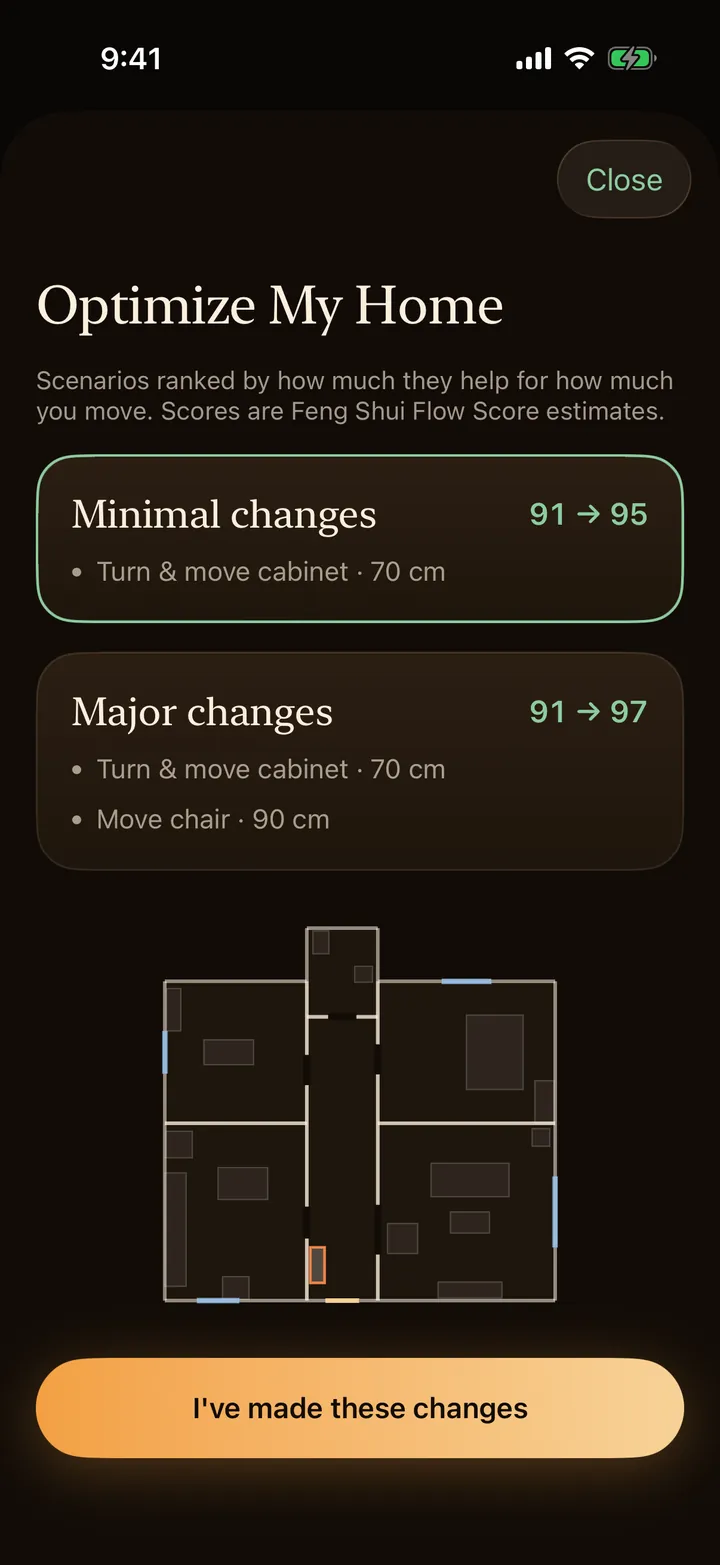
- Suggested furniture moves, which you can preview in AR before lifting anything.
- Not read: whether the sofa has a wall behind it, sees the entrance or sits in line with a door. The command-position check is made for beds and desks only, so backing and view are yours to judge.
Questions
Can a sofa go in front of a window in Feng Shui?
Yes, as a compromise. A window is read as weaker backing than a wall. A sofa with a back higher than the sill, a curtain or blind closed in the evening, or a narrow console between the sofa and the glass are the usual remedies.
Should a sofa face the door?
The people on it should be able to see the door, ideally from an angle. Practitioners differ on a sofa directly opposite a door: some call it too exposed and others do not mention it. The position all accounts advise against is a sofa with its back to the door.
Is it bad Feng Shui for a sofa to float in the middle of the room?
It is read as a seat without backing, which is weaker than a sofa on a wall. In an open-plan room it is often unavoidable. A console table, low bookcase or shelf unit directly behind the sofa is the usual substitute for the wall.
Which way round should an L-shaped sofa go?
Put the longer run against a wall and let the shorter return or chaise come into the room. Check that the end of the chaise does not point at another seat or reach into a walkway. Moving the chaise to the other end often fixes both.
How far should the sofa be from the TV?
Feng Shui has no rule for this. The classical sources are older than television, and no school gives a distance. Choose where the sofa goes by its backing and its view of the door, then set the screen distance by the size of the screen.
Does the sofa have to touch the wall?
No. A small gap for a curtain, a radiator or a skirting board changes nothing. What tradition asks for is something solid close behind the people sitting, not contact with the plaster.