 Feng Shui Scan
What "energy flow" means in a home
Qi is usually translated as energy, which makes it sound more mysterious than the form school treats it. In this school qi behaves like anything else that moves through a building. It comes in at the front door, follows open floor, slows where a room widens, speeds up along a straight corridor and stops where furniture stands in the way.
You do not have to accept qi as a substance to use the method. In practice the flow path is the route you walk with shopping from the door to the kitchen, and a home that reads badly is usually one where you turn sideways to pass the sofa.
This page is the walkthrough, in the order a practitioner would take it. How rooms sit relative to one another is covered under home layout, and reading a drawing under floor plans.
Step one: stand at the front door
Open the door as far as it goes and stop on the threshold. Before you look at any room, note three things:
- Does the door open fully? Coats, a shoe rack or a box behind it count against it.
- What is in the first two steps? Anything you have to walk around belongs on the list. The entryway guide covers that strip of floor in detail.
- What is straight ahead? A window or back door, a bathroom door, a bedroom or a mirror directly across from you are the four alignments tradition is wary of. Each is explained under front door.
Write these down and change nothing yet. The point of walking the whole home first is that a fix at the door often alters what happens further in.
Step two: walk the path
From the door, walk to each room in the order you naturally would. Pay attention to your body more than to the decor.
- Where do you narrow your shoulders or step around something? Those are restrictions. A chair that sticks out, a cabinet at a corner, a door that cannot open all the way.
- Where does the route run long and straight? Tradition holds that a straight run moves the flow too fast to do a room any good. A long hallway is the usual case.
- Where does it turn? A gentle turn or two between the door and the main room is what the form school prefers. A route with a sharp double-back around furniture is something else.
Two plain tests help. Could two people pass each other here? Could you walk this route in the dark without hitting anything?
Step three: read the rooms where people gather
The living room is read as the place where the flow should arrive and stay a while. Check that the route into it is open, that the main seat has a wall behind it and a view of the doorway, and that no single piece dominates the floor. The living room guide goes through seating in detail.
Then look at how full each shared room is. A room can be spotless and still crowded if furniture covers most of its floor. Tradition reads that as flow with nowhere to go. The practical version is that you cannot cross the room in a straight line.
Kitchens and bathrooms have their own rules, mostly about the stove and about drains, and schools differ on them. For a whole-home pass, note only whether the kitchen’s working route is clear and whether the bathroom door is usually left open.
Step four: check where you rest and work
You spend more hours in bed and at a desk than anywhere else, so these two positions carry the most weight. For each, ask the command-position questions: can you see the door, is there a solid wall behind you, and are you out of the door’s direct line? The bedroom and home office guides explain what to do when the answer is no.
While you are there, look for furniture corners pointing at where you lie or sit. The edge of a wardrobe aimed at the pillow is the kind of thing practitioners call a poison arrow, and turning the piece usually deals with it.
Step five: find what is stuck
Last, look for the places the route does not go.
- A corridor that ends in a wall with nothing at the end of it.
- A room you reach only by moving something, or whose door is kept shut because of what is stored behind it.
- A corner of a room that the path never passes and where things collect.
Tradition calls this stagnant qi. Without the vocabulary, it is the part of your home you pay for and do not use. Give a dead end something to arrive at, such as a light or a picture, and give a cut-off room a clear doorway.
When you have the whole list, work in this order: the entrance, then the path, then the bed and desk, then everything else. Make one change at a time and walk the route again.
Four homes, read in order
- A one-bedroom flat where the door opens into the living room — there is no hall to slow anything down, so the first check is what the door faces across the room. If it is the balcony door, a plant or a low bookcase off to one side of that line does more than rearranging the sofa.
- A house with a central hall and rooms off both sides — the hall is the whole flow path. Clear its floor completely, then look at each doorway in turn for furniture standing just inside it.
- A studio — the walkthrough is short, so the bed matters most. Check whether the front door looks straight at it, and whether you can see the door from the pillow.
- A home with a spare room used for storage — if the door will not open fully, the room reads as cut off. Clearing enough floor to walk in and turn round is the fix, not emptying it.
Common mistakes
- Starting with the room you like least — the reading runs from the door inward, and a problem at the entrance changes what reaches every other room.
- Reading each room on its own — a living room can be well arranged and still sit at the end of a route with two pinch points in it.
- Treating tidy as the same as open — clutter is one thing and furniture footprint is another. A tidy room with too many pieces is still crowded.
- Changing six things in an afternoon — you will not know which one made the hall easier to walk.
Walking your home with a notebook gets you a long way. What it cannot give you is the plan view: the line from your front door to the far window, or how much of each room’s floor is covered. Those are easier to see drawn than to feel.
SCAN YOUR HOME
Walk your home from the front door with your phone and see the flow path, where it narrows and which rooms it never reaches.
Coming to the App Store · iPhone and iPad · submitted for review
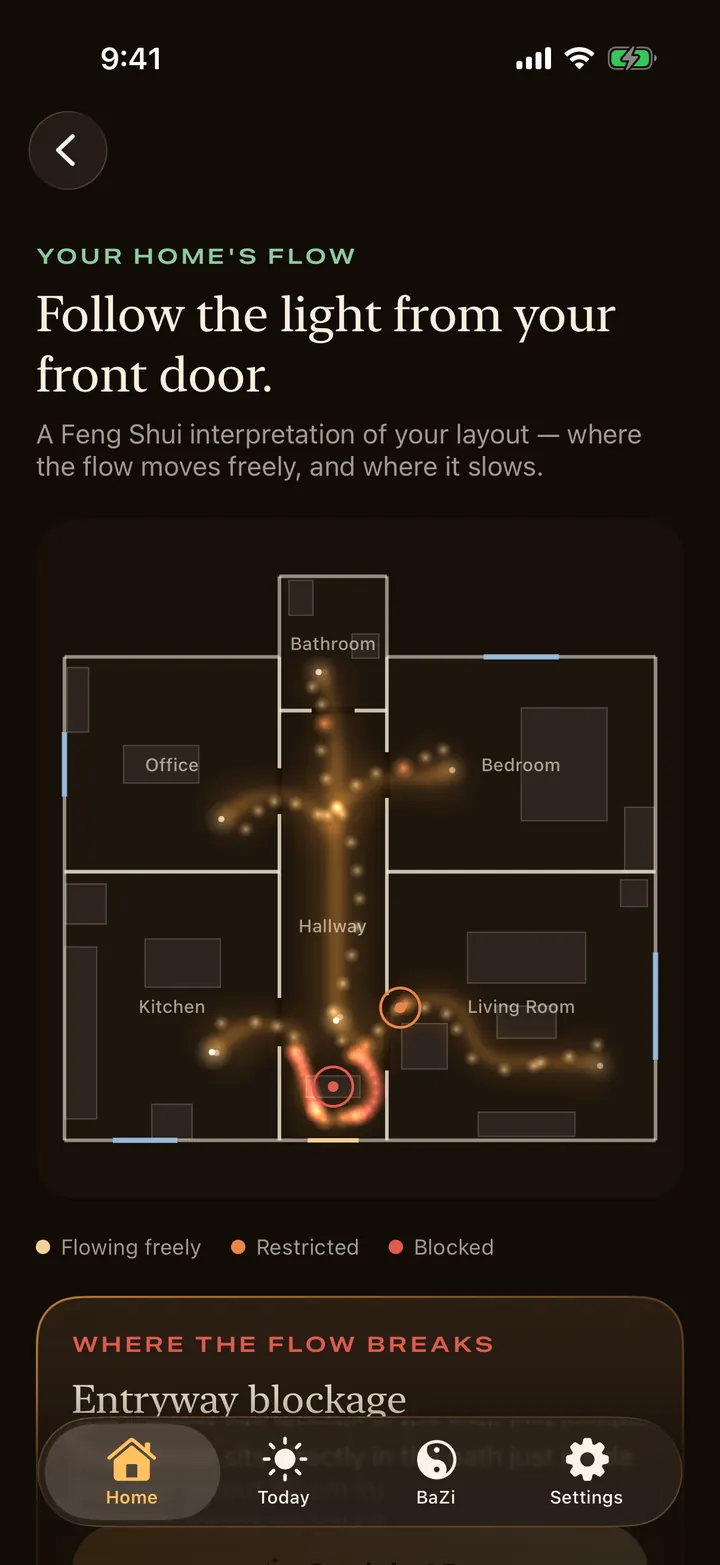
What a scan reads across your home
- Furniture in the path just inside the front door, and what the door lines up with: a window or back door, a bathroom, a bedroom or a mirror.
- The flow path from the front door, drawn on your floor plan and shown as moving light in AR.
- Where furniture narrows or cuts that path, and pinch points along it.
- Rooms where furniture covers a high share of the floor, dead-end hallways, and rooms the path cannot reach.
- Each bed and desk against the command position, and sharp corners aimed at a bed, sofa or desk.
- A Home Flow Score out of 100, built from entrance flow, circulation, room connectivity, furniture placement and flow continuity.
- Not read: stove and sink positions, stairs, clutter, wall colours, or anything outside the building.
Questions
What is a Feng Shui home analysis?
In the form school it is a reading of how a home is entered and moved through. The practitioner starts at the front door, follows the route into each room, and notes where it is blocked, where it runs too straight, and whether beds, seats and desks are well placed. Compass-based schools add directions and dates on top of that.
How do I check the energy flow in my house?
Stand at the open front door and walk to every room in turn. Note anything you step around, any long straight run, any dead end and any room you cannot easily get into. That list is your flow reading, and most of it can be dealt with by moving furniture.
Which room should I fix first?
Start with the entrance, because tradition holds that everything else depends on what gets in. Then clear the route through the home, and after that look at the bed and the desk. Decorative changes come last.
Do I need a compass to Feng Shui my home?
Not for a form-school reading, which is about shape and movement. A compass is needed for Eight Mansions, Flying Stars and the compass version of the Bagua, and those methods do not always agree with one another or with the form school.
Does this work in a rented apartment?
Yes, because almost everything in a form-school reading is about where furniture stands. You cannot move a bathroom or a front door, but you can keep a door closed, clear a path and turn a bed, and none of that needs a landlord's permission.