 Feng Shui Scan
How to use it
Set the door first, because everything is judged from it. Then put the headboard on the wall you are considering and move the bed along it. Add a window if the room has one on a wall the bed might use. The plan redraws as you go, with a line from the pillow to the door: green when the view is good, red when the door is behind you or the bed lies in its path.
If the bed is not in command, the tool tells you how many of the twelve wall positions would be, and can show you one.
What the three checks mean
Seeing the door. Lying in bed, the door should be somewhere in front of you. The tool counts the door as visible if it is ahead of you or to the side, and not visible once it is behind the line of your shoulders. The traditional preference is a diagonal view, which is why positions across the room from the door and to one side of it score best.
A solid wall behind. The headboard should rest against a wall. Pulling the bed into the room fails this, and so does a window behind the headboard, which tradition reads as a gap in the support. There is more on that case in bed under a window.
Out of the door’s line. If the doorway, extended into the room, runs down the length of the bed, your feet point out of the door. This is the arrangement Feng Shui likes least, covered in bed facing the door. The tool allows a margin of 25 cm either side of the bed, the same margin the app uses.
A bed that passes all three is rated in command. One that sees the door and stays out of its line but lacks support is partly in command. One that cannot see the door, or lies in its line, is out of it.
When no position works
Some rooms have no wall that passes all three: a door in the middle of the short wall, a window on the only long one. The tool will tell you so. The traditional order of priority is to keep the view of the door and stay out of its line, and then to make up the missing support with a tall, solid headboard. The page on bedroom layout goes through the usual workarounds.
Compass direction is a separate question, and one on which schools disagree. If you want it, the BaZi favorable directions page explains one method and the Kua calculator another.
The sample room is 3.6 by 4.2 metres with a double bed. Yours is not. Whether your bed is in the door’s line depends on your doorway, your bed and the gap between them.
SCAN YOUR BEDROOM
The tool uses a sample room. A scan checks your bed, in your room, to the centimetre.
Coming to the App Store · iPhone and iPad · submitted for review
What a scan checks that the tool cannot
- Your real room’s shape, including alcoves, angled walls and more than one door.
- The actual width of your bed and doorway, which decides whether the bed is in line.
- Windows where they really are, at their real width.
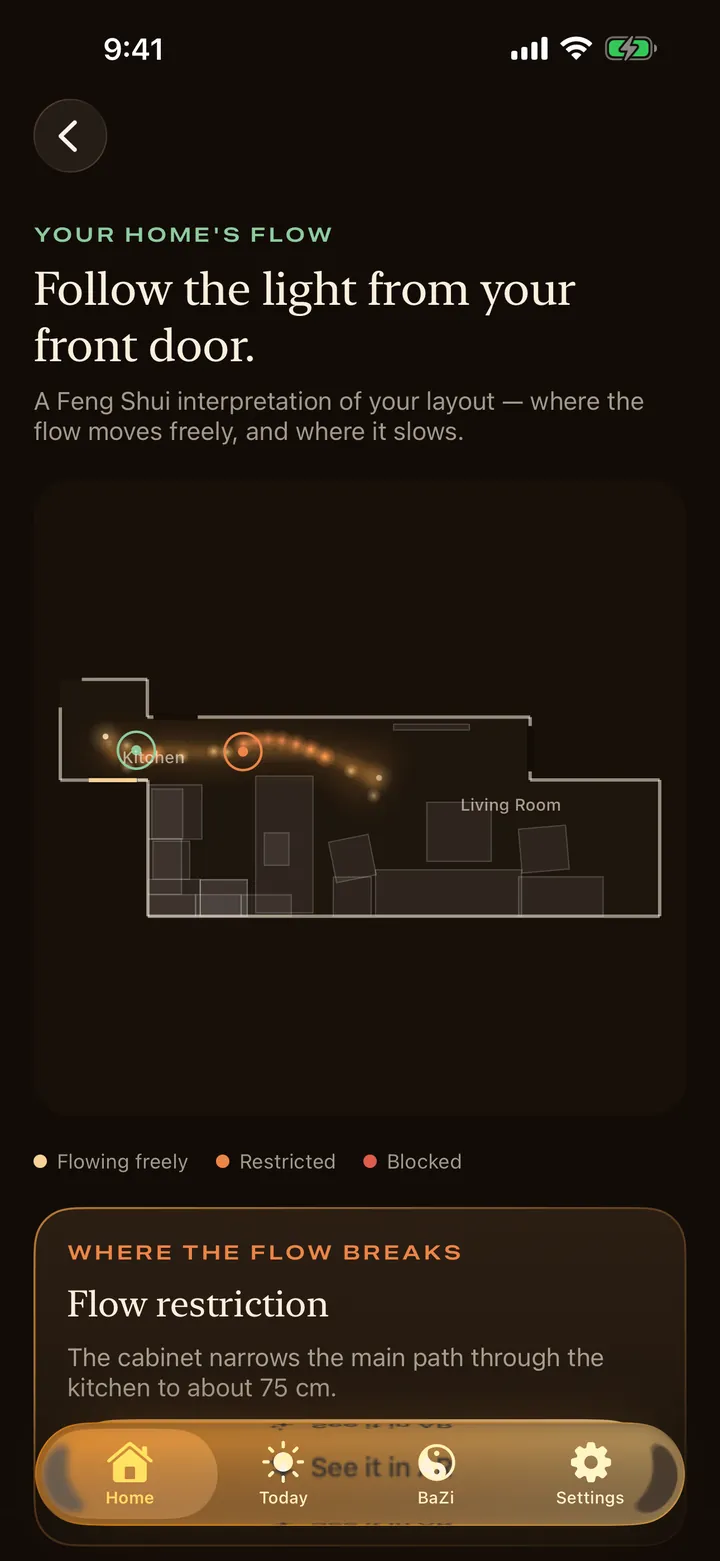
- Furniture corners aimed at the bed, and furniture narrowing the way in.
- With your BaZi chart and a compass heading, the direction your head points.
Questions
What is the command position for a bed?
A position from which you can see the bedroom door without lying directly in line with it, with the headboard against a solid wall and no window behind it. Form-school Feng Shui treats it as the most important decision in a bedroom.
Does the bed have to be diagonal to the door?
The bed itself stays square to the wall. It is the view that is diagonal: the door is across the room and off to one side, so you can see it without your feet pointing through it.
What if my bed fails only the window check?
It is rated partly in command. Tradition treats a window behind the headboard as weaker than a wall but better than a bed that cannot see the door. A solid headboard taller than the sill and a curtain closed at night are the usual remedies.
Is this the same check the app runs?
Yes, the same three checks with the same margins, applied to a simple rectangular room. The app applies them to the room you scan.