 Feng Shui Scan
How to use it
Pick the wall the door is on and where along it the door sits. Then pick a wall for the desk and decide how you sit at it. "Facing the wall" is the usual small-room arrangement, with the desk pushed up against the wall. "Back to the wall" turns it around: your chair is between the wall and the desk and you look into the room.
The line from your chair to the door turns green when the door is in view and you are off its line.
Why facing the wall rarely passes
A desk against a wall is the arrangement most rooms end up with, and it fails the support check every time: the open room is behind you. If the door is also behind you, it fails the first check too. Feng Shui’s objection is that you cannot see who comes in. The ordinary version of the same point is that people concentrate less well with movement behind them.
Turning the desk so your back is to a wall fixes the support. Whether it fixes the view depends on where the door is. The strongest positions have the door across the room and off to one side, the same diagonal that applies to a bed in the bed placement tool.
In line with the door
Sitting so that you look straight down the line of the doorway is treated as too exposed: you are in the path of whatever comes through it. The tool counts you as in line when the door is within 15 degrees of straight ahead, which is the tolerance the app uses. Sliding the desk a little along the wall is usually enough to clear it.
When the desk cannot move
Small rooms, shared rooms and desks under a window often leave one option. The traditional workaround for a back to the door is a small mirror on the desk or the wall in front of you, placed so it shows the doorway. A chair with a high, solid back is the usual answer to open space behind. The home office page covers these cases, and the question of which compass direction to face is taken up in BaZi favorable directions.
A sample room can show you the principle. It cannot tell you whether the door of your own office is within your field of view from your own chair.
SCAN YOUR OFFICE
The tool uses a sample room. A scan checks your desk where it really stands.
Coming to the App Store · iPhone and iPad · submitted for review
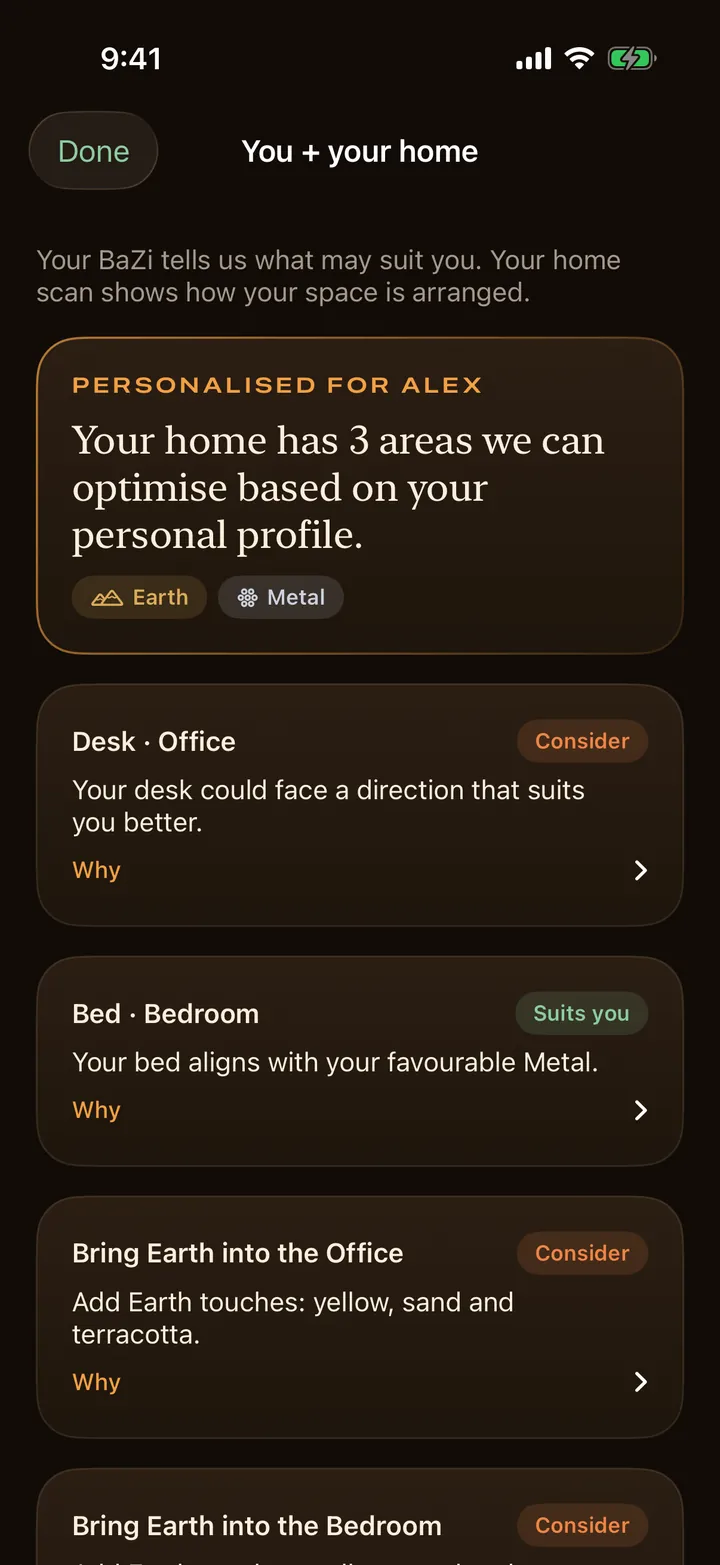
What a scan checks that the tool cannot
- Where your desk really stands and which side you sit on.
- Whether a wall is within about a metre behind your chair.
- Whether you are in line with the nearest door of the room you scanned.
- Sharp corners of shelves or cabinets aimed at your desk.
- With your BaZi chart and a compass heading, the direction you face when you sit.
Questions
Where should a desk go in Feng Shui?
Where you can see the door from your chair, with a solid wall behind you, and without sitting directly in line with the doorway. Across the room from the door and to one side of it is the usual answer.
Is it bad Feng Shui to have a desk facing a wall?
It is considered a weak position, because the room and usually the door are behind you. If the desk cannot be turned, a mirror that shows you the door and a high-backed chair are the traditional workarounds.
Should my desk face the window?
Form school has no rule in favour of it. A window in front of you is fine if the door is still in view. A window directly behind your chair is treated like open space: no support.
Does the tool consider compass direction?
No. It checks position relative to the door and walls, which is what form school cares about. Compass direction is a separate method and depends on the person.