 Feng Shui Scan
Reading the result
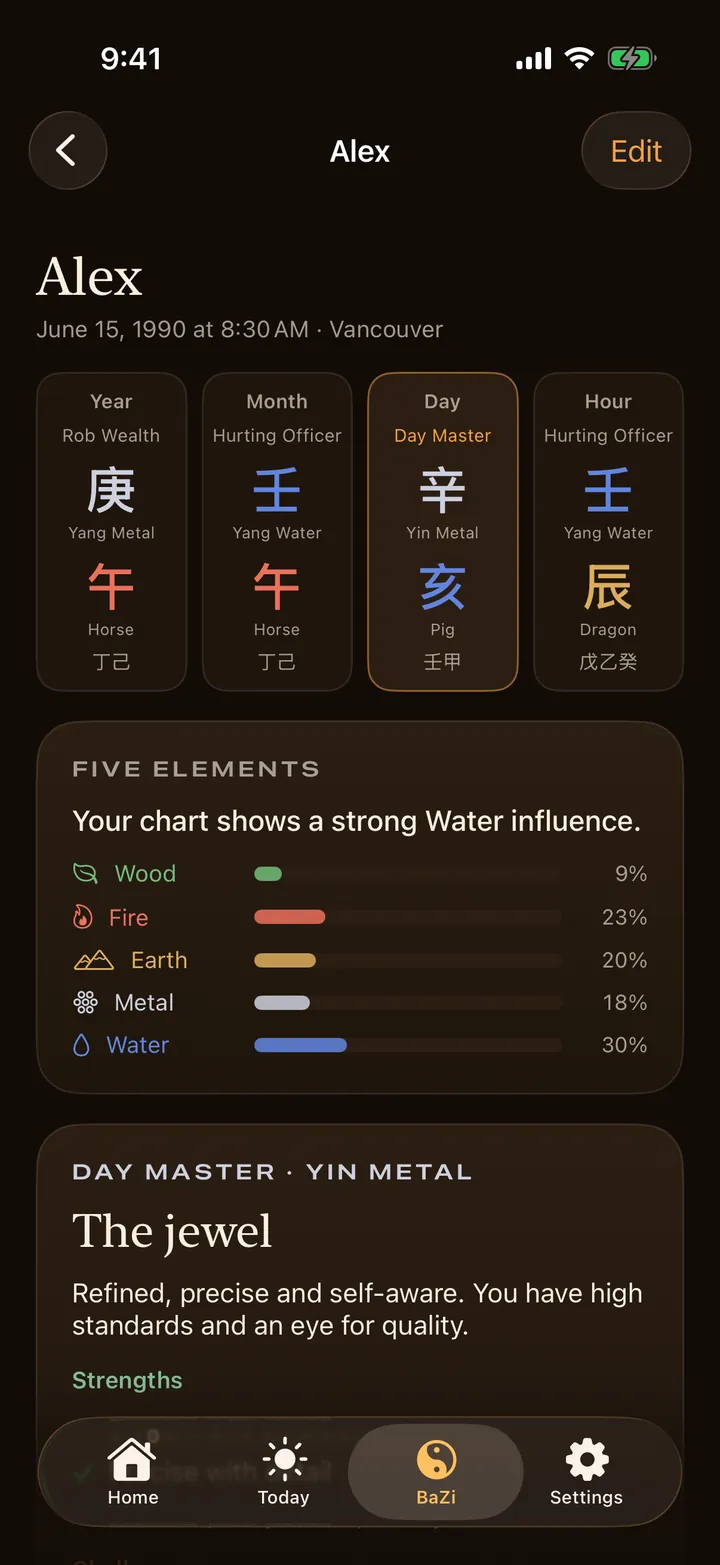
The four pillars. Each column is one pillar. The top character is the heavenly stem, with its element and whether it is yin or yang. The bottom character is the earthly branch, shown with its zodiac animal and element. The year branch is the animal most people know as their Chinese zodiac sign.
The Day Master. The stem of the day pillar, outlined in gold, stands for you. Every other part of the chart is read by its relationship to that one stem. The page on what BaZi is explains how.
The balance. The bars show each element’s share of the chart. Stems count once. Each branch also contains one to three hidden stems, counted by their conventional weights, and the month branch counts for more because it represents the season you were born in.
Favourable elements. From the balance, the calculator judges whether the Day Master is strong, weak or balanced, and names two elements accordingly. How that judgement is made, and why practitioners sometimes reach a different one, is set out under favourable elements.
The conventions it follows
BaZi charts depend on where the boundaries are drawn, and calculators differ. This one follows the conventions most widely used in Four Pillars practice:
- The year turns at Li Chun, the start of spring, around 4 February. Not on 1 January and not at Lunar New Year.
- Months turn at the solar terms, twelve points in the sun’s yearly path, each falling a few days into a Western month. The calculator works out the sun’s position for your birth moment.
- The day turns at 11 pm, the start of the Zi hour. A birth at 11:30 pm takes the next day’s pillar.
- Hours are two-hour blocks counted from 11 pm.
If your birth falls within a couple of hours of a solar term, the calculator says so, because a small error in the recorded time could change the month pillar.
Why the time zone matters
The month and year pillars depend on the exact moment of birth, and that moment depends on where you were. The same clock time in Vancouver and in Shanghai is fifteen or sixteen hours apart. The calculator uses the time zone you choose, including whatever daylight-saving rules applied on that date, to find the moment.
If you do not know your birth time, tick the box. You will get three pillars, and the balance is worked out from those. The hour pillar cannot be guessed.
What it leaves out
A full reading goes on to the Ten Gods, the ten-year luck pillars, and the interaction of the chart with the current year and day. Practitioners also weigh combinations and clashes between branches, which can change how strong an element really is. The calculator does not attempt those; it gives the chart and a first reading of its balance, and says plainly that this is one method.
Nothing in a BaZi chart is a prediction. It is a traditional way of describing a person in terms of five elements, and what you do with it is up to you. One practical use is in the home: BaZi and Feng Shui explains how favourable elements become directions, colours and materials.
A chart tells you which elements are said to favour you. Whether your bed points toward one of them is a question about your home.
SEE YOUR FULL CHART
The app adds daily readings, luck cycles and compatibility, and applies your chart to the home you scan.
Coming to the App Store · iPhone and iPad · submitted for review
What the app adds to the chart
- The Ten Gods for each pillar and a profile of your Day Master.
- Ten-year luck pillars, and readings for the day, the month and the year.
- Compatibility between two charts, side by side.
- An optional adjustment to true solar time from the birthplace’s longitude.
- Your favourable elements applied to a scanned home: the sector each bed and desk sits in and the direction you face.
Questions
Is this BaZi calculator accurate?
The pillars follow the standard conventions: year from the start of spring, months from the solar terms, day from 11 pm. It is the same engine the Feng Shui Scan app uses, and it is tested against the app. The reading of strength and favourable elements is one common method, and a practitioner may judge a chart differently.
What if I do not know my birth time?
Tick "I don't know the time". The calculator gives the year, month and day pillars and leaves the hour pillar out. The element balance is then based on three pillars.
Does it use the lunar calendar?
No. BaZi uses the solar calendar: the year begins at the start of spring and the months follow the solar terms. Lunar New Year, which moves between late January and mid-February, is not the boundary.
Do you store my birth details?
No. The chart is worked out in your browser. Nothing you enter on this page is sent to a server.
Why is my year animal different from what I expected?
If you were born in January or early February, you were born before the start of spring, and BaZi counts you in the previous year. Popular zodiac charts usually change at Lunar New Year instead, which can differ by a few weeks.