 Feng Shui Scan
What counts as blocked
Traditional Feng Shui often calls the front door the mouth of qi: the point where everything the home receives comes in. Form-school practitioners read the first step or two inside it as the place where that flow either gets going or stalls. Three things are read as a blockage:
- Something in the door’s width. Picture the door opening continued straight into the home as a strip of floor. A coat stand, a shoe rack turned end-on, a bicycle, a stroller or a stack of parcels standing on that strip in the first couple of steps is in the way.
- A door that cannot open fully. Coats hung behind it, a cabinet it knocks against, shoes that stop it at two-thirds. Tradition reads a door that opens part-way as a home that receives part-way.
- A path you have to sidestep. If the only way in is around the corner of a console table, the flow is said to do the same.
The ordinary reason is not hard to find. You come home with your hands full, and the first thing the house asks of you is to squeeze past something. The door itself, its size and what it faces, is a separate subject covered under front door. Many practitioners read the outside step the same way, counting bins, planters or bicycles that crowd the approach, though this page is about the inside.
What does not count
Plenty of things near a front door are fine, and it is worth knowing them before you start emptying the hall.
- Storage that lies flat against a side wall, leaving a clear walking width beside it.
- A doormat or a rug.
- Coats on wall hooks along a side wall, provided they do not hang into the door’s swing.
- A plant, an umbrella stand or a bench in the corner beside the door, outside the door’s swing and outside its width.
- A console table further down the hall, on one side.
A quick test: open the door as far as it goes, stand on the threshold with a bag in each hand, and walk two steps straight ahead. If you did not turn your shoulders or change direction, the entry is clear in the sense tradition means. The floor plan self-check asks the same question as part of a wider self-check, and the entryway page covers what belongs there once it is clear.
A wall straight ahead is a different case
A wall facing the front door a short distance in is not clutter, and no amount of tidying changes it. Form-school writers describe a bright hall, an open area at the entrance where qi is said to collect before moving on, and many modern practitioners apply the idea to the space just inside the door. A wall close in front leaves little of it. No school gives a fixed distance; "close" is a judgement about whether the entry feels like a stop.
Because the wall is structural, the remedies work on the wall and not on the floor:
- Keep it clear of hooks, shelves and anything that brings it nearer.
- Light it well, and hang a picture with some depth to it, such as a landscape.
- Make the turn obvious with a runner or a lamp on the side you walk towards.
- Avoid a mirror on it. A mirror directly facing the front door is said to send the flow back out, and a side wall is the usual place for one.
One thing worth knowing: a wall or screen facing the door is sometimes put there on purpose, to stop a front door lining up with a back door or window. The same feature that crowds a small entry protects a long one.
Fixes, in order of effort
Free
- Clear behind the door until it opens flat to the wall, or as far as its hinges allow.
- Move whatever stands in the door’s width to a side wall or another room.
- Turn anything end-on so its long side lies along the wall.
- Give daily arrivals, such as bags, parcels and recycling on its way out, a place that is not the floor inside the door.
Small purchases
- Wall hooks at shoulder height in place of a floor-standing coat rack.
- A slim closed shoe cabinet in place of an open rack that spreads.
- A brighter bulb. A dim entry looks narrower than it is.
Rearranging
- Swap a deep console for a shallow shelf.
- Find the bicycle or stroller a home further in, where it sits beside the route and not on it. Check that you have not just moved the pinch point down the hallway.
When to stop worrying
If the door opens fully and you can walk two steps straight in, you have met the rule. A very small entry will never look generous, and tradition does not ask it to. A wall facing the door that has been lit, dressed and kept clear has had what can be done for it. Move on to the rest of the problems list, where the bed is next.
Entryways people really have
- A narrow flat hall with a shoe rack facing the door — The rack stands in the door’s width one step in. Moved to the hinge-side wall and laid flat, it clears the strip without losing the storage.
- A front door that opens into the living room — There is no hall, so the first steps of the room are the entry. A sofa back across the door’s width at that distance is a blockage. The same sofa a few steps further in, with walking room around one end, is read as a useful screen.
- A family hall with a stroller — Folded and stood against the side wall, it is storage. Open and parked inside the door, it is the first thing the flow meets.
- A door that stops against a cabinet — The floor is clear but the door opens to about two-thirds. Moving the cabinet a hand’s width along the wall fixes it.
Common mistakes
- Clearing the floor and forgetting the door — a door stopped by coats on its back is still counted as a partly closed entrance.
- Adding a remedy to the path — a large plant, a fountain or a statue placed inside the door to improve the entry becomes the obstruction. Put it beside the route.
- Treating a facing wall with a mirror — it makes the hall look deeper, and tradition holds that it turns the flow around at the door.
- Tidying once — entryways refill. If things keep landing there, they need a place of their own nearby.
Whether something is in the door’s width is a matter of a few centimetres, and you stop seeing your own hall after a week of living in it. A plan drawn from a scan shows the door, the furniture and the gap between them to scale.
SCAN YOUR ENTRYWAY
Start the scan at your front door and see whether anything stands in the path, and how far inside the door it is.
Coming to the App Store · iPhone and iPad · submitted for review
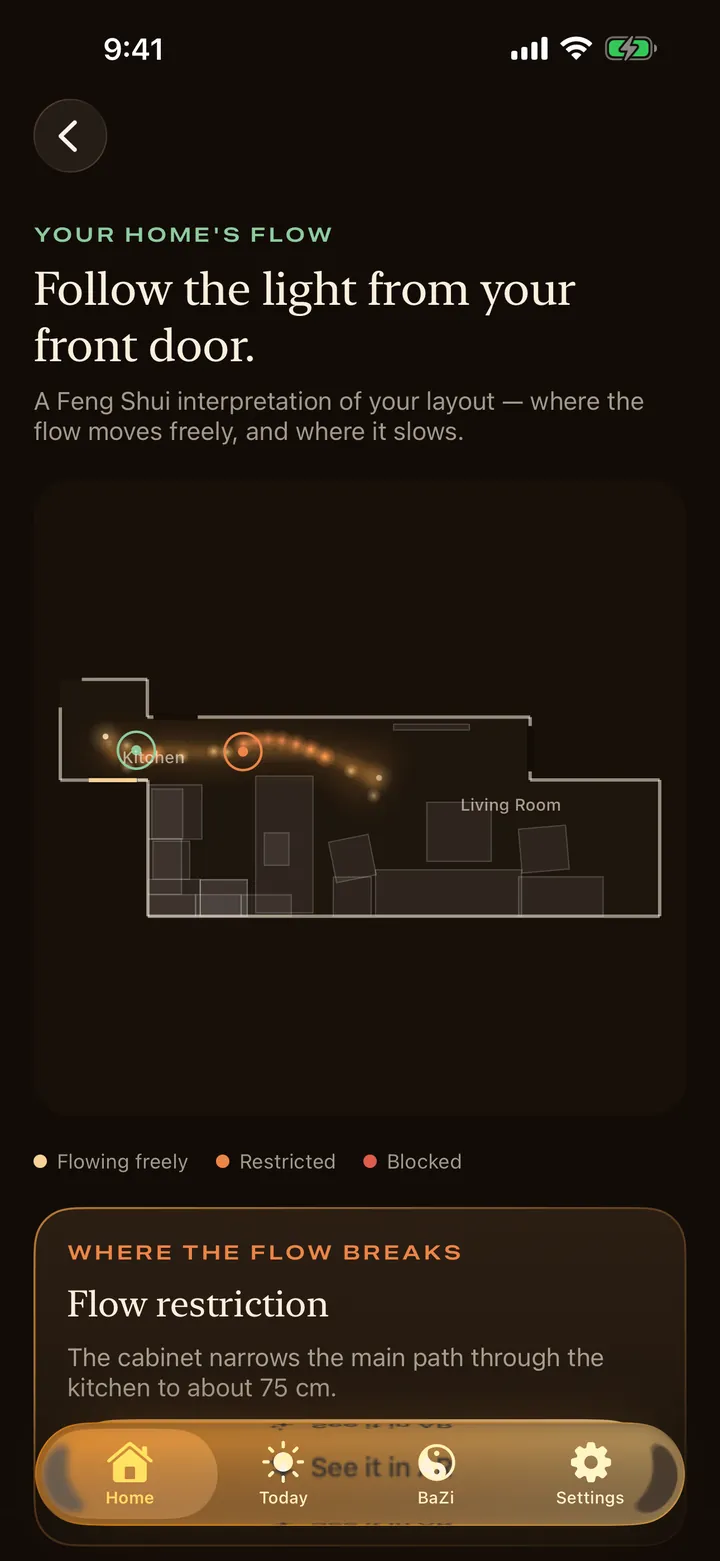
What a scan reads at your entrance
- Entryway blockage: furniture standing in the path just inside the front door, with its distance in from the door.
- Furniture further along that narrows or cuts the path the flow takes, and any pinch point on it.
- A mirror straight across from the front door.
- The front door lined up with a window or exterior door across the home.
- The front door looking straight at a bathroom door or into a bedroom.
- Not read: whether the door itself opens fully, a bare wall facing the door, or shoes, bags and other loose clutter. Those you check by eye.
Questions
Is a shoe rack by the front door bad Feng Shui?
It depends where it stands. Flat against a side wall with clear walking width beside it, it is ordinary storage. Standing in the door's own width in the first step or two, it is what form school calls a blocked entry. Some practitioners also prefer shoes behind a closed cabinet door, which is a preference about tidiness more than a layout rule.
Does a wall facing the front door count as a blocked entryway?
Not in the same sense. A blocked entry is furniture you can move; a facing wall is part of the building. Tradition treats a wall close in front of the door as leaving too little open space at the entrance, and the usual remedies are good light, a picture with depth and a clear cue for which way to turn.
How much clear space should there be inside the front door?
Traditional sources give no measurement. A workable rule is the door's own width, kept free for the first two steps, with the door able to open as far as its hinges allow.
Can I put a plant inside the front door?
Yes, beside the route and outside the door's swing. A plant in the corner next to the door is a common suggestion. The same plant standing where you have to walk around it is an obstruction.
What if my home has no hallway at all?
Then the first steps of the room the door opens into serve as the entry. Keep the door's width clear for those steps, and use furniture further in, such as a sofa or a bookcase, to mark where the entry ends and the room begins.