 Feng Shui Scan
What each tool is for
Start with the question you have.
- "Where should my bed go?" The bed placement tool checks a bed against the command position: can it see the door, is the headboard on a solid wall, is it out of the door’s line. The desk placement tool does the same for a desk.
- "Which part of my home is the wealth corner?" The Bagua map lays the nine life areas over a plan two ways, by the front door and by compass, so you can see that the two methods give different answers.
- "What are my lucky directions?" There are two traditional answers. The Feng Shui calculator gives your Kua number and its eight directions. The BaZi calculator works out your Four Pillars chart and the elements it is said to favour.
- "Does my home have bad Feng Shui?" The floor plan self-check is twelve yes-or-no questions drawn from the things the app looks for, each linked to a page that explains it.
What a browser tool can and cannot do
A tool on a web page knows only what you type into it. That is enough for a calculation: a Kua number needs a birth year, a BaZi chart needs a date, time and place. It is enough for a rule you can describe in a sentence, like whether a headboard is on the door wall.
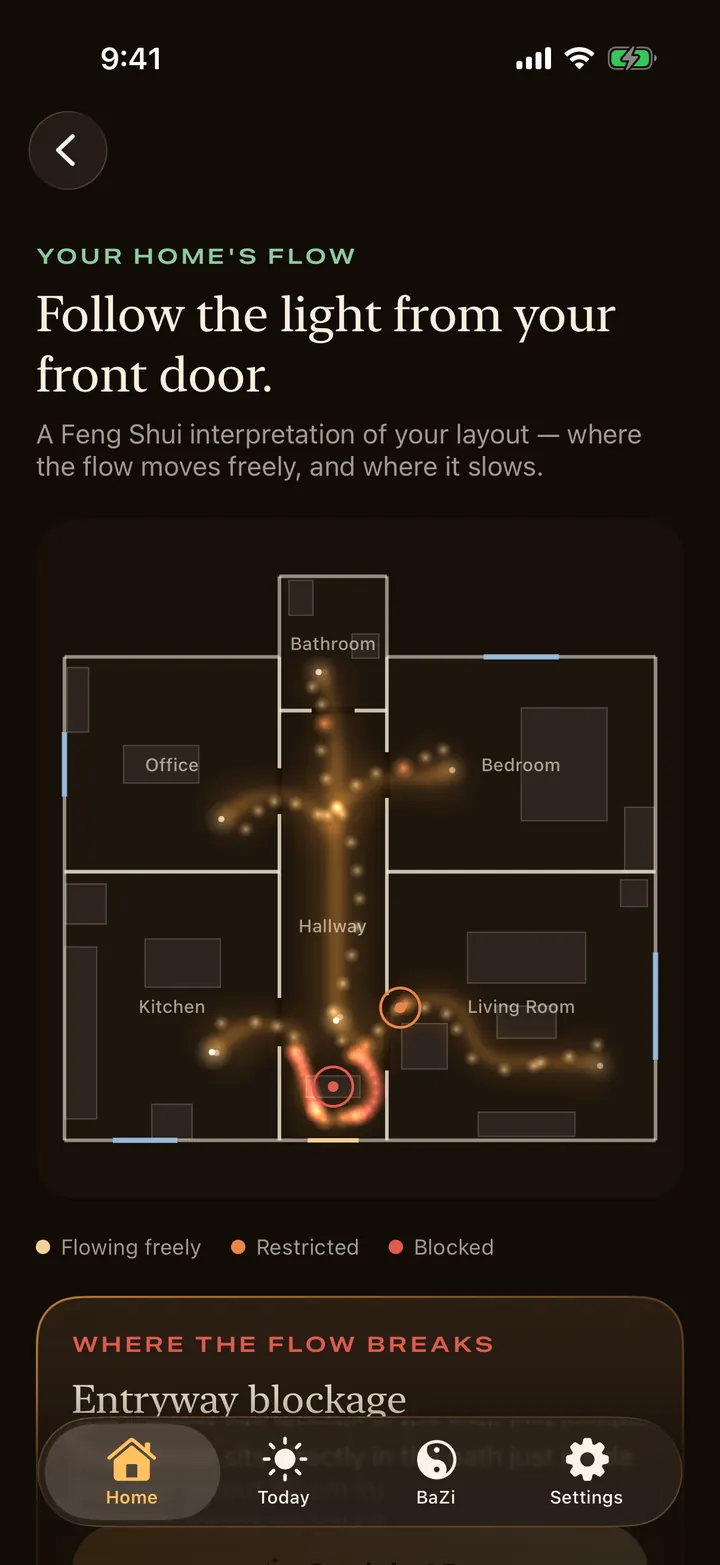
It is not enough for anything that depends on measurement. Whether a bed is in line with a door comes down to the width of the bed, the width of the doorway and a few centimetres of offset. Whether a hallway is too narrow depends on what is standing in it. A Feng Shui reading of a whole home follows the path from the front door through every room, and that path is a property of your actual floor, not of a form.
So the tools answer "what does the rule say?", and a scan answers "does my room meet it?".
The rules behind them
The placement tools follow form-school Feng Shui, which reads a room by its shape and its doors. The Bagua tool shows both the Black Hat layout, aligned to the front door, and the compass layout; they are different schools and are presented as such. The Kua calculator is Eight Mansions, a compass school. The BaZi calculator follows common Four Pillars practice: the year turns at the start of spring, months turn at solar terms, and the day turns at 11 pm.
Every one of these is a traditional method of interpretation. None of them measures anything about your home or predicts anything about your life.