 Feng Shui Scan
Front door lined up with a back door or window
Stand in the open front doorway. If you can see daylight through a back door, patio doors or a large window directly ahead, with nothing between, form school reads the home as having a straight line out. The flow that enters is said to cross the home and leave without turning into the rooms on either side. It is easiest to check on a floor plan: lay a ruler from the front door and see what it meets.
How strongly it is read depends on a few things:
- How open the line is. A clear run of floor is the full case. A line that passes through a room with furniture standing in it is already partly broken.
- What is at the far end. An exterior door or floor-to-ceiling glass is counted most heavily. Many practitioners give a small or high window less weight.
- How direct it is. Doors a little out of line with each other are generally treated as milder than doors squarely opposite.
The everyday version: a home you can see straight through from the step has little sense of arrival, the draught runs front to back when both are open, and anyone at the door sees into the garden. The front door page covers the door itself.
Two interior doors facing each other
Here it is honest to say that views differ.
Some practitioners use the name arguing doors, or clashing doors, and mean something fairly specific: doors that face each other but are out of line, so each looks partly at the other’s frame; doors of different sizes; or doors that knock together when both are open. The folk reading is that the people behind them will be at odds.
Others hold that two equal doors squarely opposite each other are an ordinary feature of a corridor and no problem at all. A stricter minority counts any two facing bedroom doors. A door facing a door of a different kind is sometimes singled out as well, the usual example being a bedroom facing a bathroom across a hall, where the common advice is again to keep the bathroom door shut.
None of this can be tested, and you should not read a prediction about your household into a floor plan. The practical points stand without help: doors that collide are a nuisance, and two bedroom doors facing each other give each occupant a view into the other’s room.
Front door facing a bathroom or bedroom door
This is a different reading from the straight line out, though it looks alike on a plan.
- Bathroom. Tradition associates bathrooms with water leaving the home, so a front door that looks straight at a bathroom door is said to send the incoming flow towards the drains. The remedy is a closed door, every time. See the bathroom page.
- Bedroom. A bedroom the front door looks straight into is considered too exposed to the active end of the home. Again the first remedy is the door, and the second is where the bed stands inside it; the bedroom page has more.
Breaking the line, in order of effort
The aim is to make the route bend, not to wall it off. Something you walk around is enough.
Free
- Close the door at the far end, or keep it closed as a habit.
- Move a piece you already own into the line: a plant, an armchair, a side table.
- Draw the curtain or lower the blind on the far window when the front door is in use.
Small purchases
- A sheer curtain or blind on the far window or glass door, which keeps the light and softens the line.
- A rug or runner laid across the line, or one with a pattern that does not point along it.
- A plant on a stand, tall enough to register from the doorway.
- Black Hat practitioners often hang a faceted crystal or a wind chime midway. Classical practitioners generally do not.
Rearranging
- A console table, bookcase or folding screen placed so the path curves around it.
- In an open plan, turning the sofa so its back crosses the line.
One caution: put the break part-way along or towards the far end, not in the first steps inside the front door, where it becomes a blocked entryway.
When to stop worrying
If you already walk a curve to get from one door to the other, the line is broken, whatever you can glimpse through it. And if the far door is shut most of the day, the alignment exists mostly on paper.
When a corridor joins the two doors
A corridor between the doors adds to the reading: a straight channel is said to speed things up along the way. The remedies overlap with those for a long hallway, and a runner does double duty. How the alignment sits within the rest of the plan is covered under home layout.
Four alignments
- A terraced house: front door, hall, kitchen, back door — With every door open you see the garden from the step. Keeping the kitchen door closed breaks the line for free. A runner and a plant near the hall’s far end do it with the door open.
- An apartment door facing balcony doors across the living room — A sheer curtain on the glass and a sofa or round table standing in the line turn a straight run into a route around furniture.
- Two bedroom doors half overlapping across a landing — This is the version some practitioners call arguing doors. Nothing can be moved. Keeping one door closed deals with the practical side, which is the view from one room into the other.
- A front door looking at a toilet at the end of a short hall — Keep that door shut. A picture hung on it gives the eye something else to land on.
Common mistakes
- Putting the break at the front door — an obstacle in the first steps inside trades one finding for another.
- A mirror facing the front door to bounce the flow back — tradition holds that this turns it around at the threshold, which is its own problem.
- Blocking the line completely — a tall cabinet square across the route stops you as well as the line. Slow it; do not seal it.
- Treating every pair of facing doors alike — the front-to-back alignment is widely agreed. The interior-door rule is not.
From inside a home it is hard to tell whether two openings truly line up or only look as if they do from where you happen to stand. Drawn on a plan, with the route from the front door laid over it, the answer is plain.
SEE YOUR HOME'S FLOW
Scan from the front door and see whether the route through your home bends into the rooms or runs straight out the other side.
Coming to the App Store · iPhone and iPad · submitted for review
What a scan reads about facing doors
- Straight line out: the front door lined up with a window or exterior door across the home.
- Entrance faces the bathroom: a straight view from the front door to a bathroom door.
- Entrance faces a bedroom: the front door looking straight into a bedroom.
- A mirror straight across from the front door.
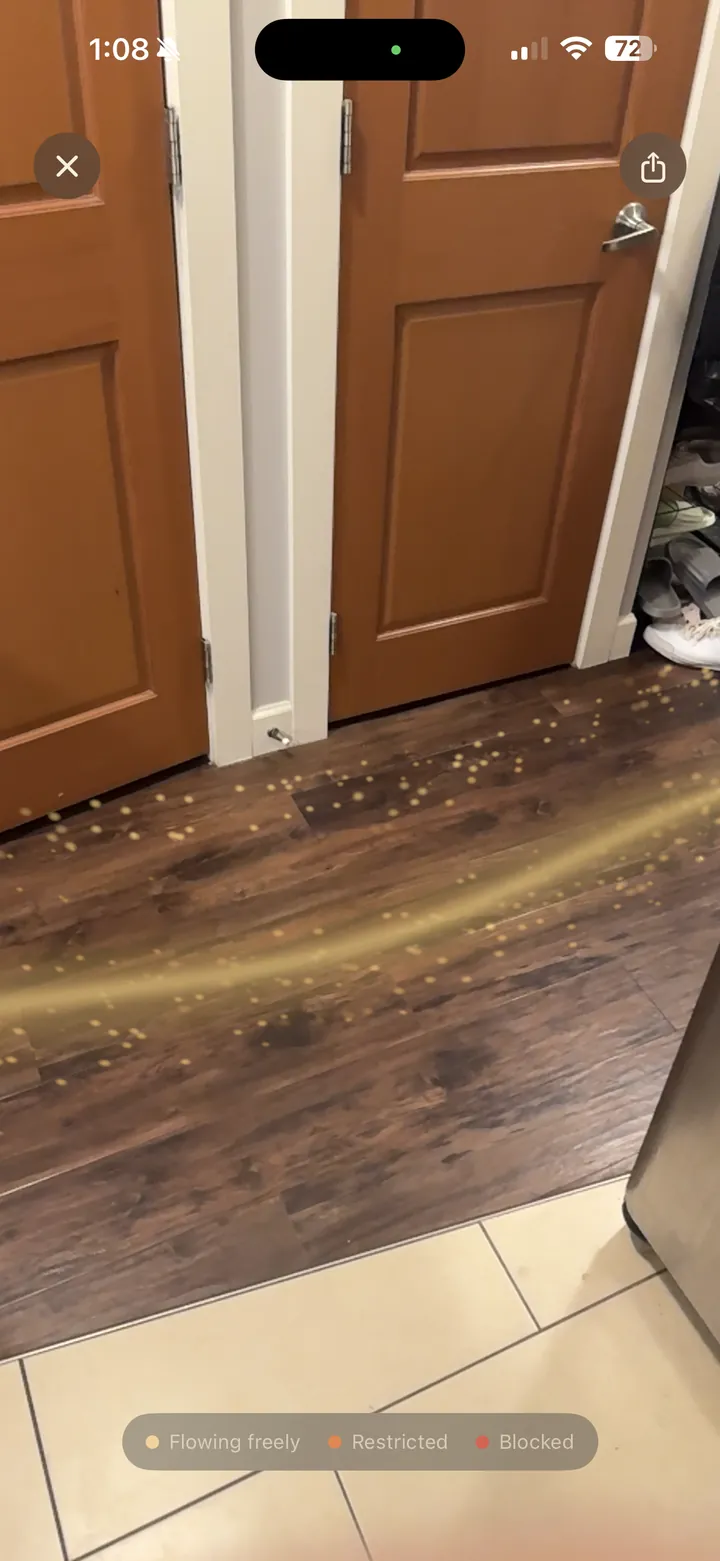
- The flow path from the front door drawn over your plan, so you can see where it runs straight and where furniture bends it.
- Not read: two interior doors facing each other. A scan does not flag them, and it does not compare door sizes, overlap or whether doors collide.
Questions
Is a front door facing a window bad Feng Shui?
Tradition treats a front door lined up with a large window as a form of the front door facing a back door: the flow is said to cross the home and leave. Many practitioners give a small or high window less weight. A curtain on the window or furniture standing in the line is the usual remedy.
Are two bedroom doors facing each other bad Feng Shui?
Practitioners disagree. Some object only when the doors are out of line, different in size or collide when open; others see two equal, aligned doors as unremarkable. It is not among the alignments most schools agree on.
What are arguing doors in Feng Shui?
A name some practitioners give to interior doors that face each other out of line, or that knock together when both are open. The folk reading is that the people who use them will quarrel. It is a traditional interpretation, not a prediction.
What can I put between a front door and a back door?
Anything that makes the route curve: a plant on a stand, a round table, a console, a screen, or a rug laid across the line. Place it part-way along, not immediately inside the front door.
Does the alignment matter if the back door is usually closed?
Much less. A closed solid door interrupts the line, and keeping the far door shut is the first remedy most practitioners suggest. Glass doors are the exception, since the view remains, and a curtain or blind does the same job there.