 Feng Shui Scan
Why a straight corridor is read as a problem
A basic idea in form school is that qi is said to do best on a winding path and to turn harsh when it runs straight. Outdoors, the classic example is a road aimed directly at a house. The corridor is the indoor version: two parallel walls, nothing to turn around, and a target at the end.
No school gives a length at which a hallway becomes too long. The signs practitioners describe are about character:
- You can see the whole run from one end with nothing interrupting the view.
- The walls are bare or identical along their length.
- You walk it faster than you walk the rest of the home.
That last one is the ordinary reason. A long corridor is a space people hurry through, the middle of it is often the darkest spot in the home, and sound carries along it. A short hall with doors off it is just a hall. Where corridors sit in the wider plan is covered under home layout.
The door at the end
Whatever faces down the length of the corridor is said to take the flow head-on.
- A bedroom. If the bed inside is also in line with that door, the corridor’s line and the door’s line are one line, and it runs to the bed. See bed facing the door for moving the bed off it.
- A bathroom. Some practitioners read this as the home’s flow being led straight to the drains. The remedy is the usual one for a bathroom: keep the door shut.
- A window or exterior door, with the front door at the other end. That is the straight line out, the best-known alignment in form school.
- A blank wall. That is a dead end, covered next.
For any room at the end, a closed door is the first remedy and costs nothing.
Dead ends
A corridor, or a branch of one, that stops at a wall with no door is read as a place where the flow has nowhere to go and is said to stagnate. In practice, dead ends are dim and become the place where boxes, the vacuum cleaner and the drying rack end up, which rather proves the reading.
The traditional answer is to give the end a purpose: a light, a picture you would walk up to, a plant if there is width and daylight for one. Take the storage out.
On mirrors, views differ. Some practitioners hang one at a dead end to open it up. Others object that a mirror at the end of a corridor doubles its apparent length, the opposite of what you want. And if the dead end faces the front door, a mirror there faces the front door, which tradition generally advises against.
Narrow passages
Width matters separately from length. A corridor where two people cannot pass, or where you turn your shoulders to get by a bookcase, is read as a pinch in the home’s circulation. The cause is nearly always something added: shelving, a shoe cabinet, a radiator cover, a door that stands open into the passage.
Narrow corridors are the one place where the standard remedies can make things worse. A plant or a console table placed to slow the flow becomes the obstruction. In a narrow hall, work on the walls, the floor covering and the lighting, and leave the floor empty. When the corridor starts at the front door, its first steps are also the entryway, and the stricter rule for that spot applies.
Fixes, in order of effort
Free
- Take stored things out of the corridor. This is usually the largest single improvement.
- Close the door at the far end.
- Re-hang pictures you already own so they alternate from one wall to the other along the length.
- Leave the doors of side rooms open in the daytime where privacy allows, to bring daylight into the middle.
Small purchases
- A runner. One with a pattern that runs across the width, or two shorter runners with a gap between, gives the eye places to stop. Stripes running lengthwise do the reverse.
- Staggered lighting. Wall lights or lamps at intervals on alternating sides, in place of a single line down the ceiling.
- Something round. A round or oval frame, a round mirror on a side wall, a round lampshade. Curved shapes are a common suggestion for softening a straight run.
- Something bright at the end. A picture with strong colour or a lamp, so the corridor has a destination.
Rearranging
Where the hall is wide enough, a slim console on one side and a plant further along on the other make the walking line weave. Keep both out of the first steps inside the front door, or you have made a blocked entryway.
When to stop worrying
Once the floor is clear, the corridor is lit along its length and the end door is closed, the traditional remedies are in place. Corridors are how flats and houses are built; a long one is a feature to manage, not a defect. The floor plan self-check is a quick way to see whether anything else in the home deserves attention first.
Four corridors
- A flat with the front door at one end and the living room at the other — Everything enters down the corridor. A patterned runner, pictures alternating along the walls and a lamp halfway are the whole treatment, and the floor stays empty.
- A landing with a bedroom door at the end — Keep that door closed at night and check where the bed stands behind it.
- A hall too narrow for furniture — Take out the shoe cabinet, hang coats in a side room, and put the effort into light and what goes on the walls.
- An L-shaped hall ending at a blank wall stacked with boxes — Move the boxes, add a wall light and one picture. The dead end becomes the end of the hall.
Common mistakes
- Matching frames in a row down both walls — an even row at one height tends to underline the tunnel. Stagger them.
- Furniture as a remedy in a narrow hall — it slows the flow by blocking it.
- A lengthwise-striped runner — it points the way the corridor already points.
- A mirror on the end wall facing the front door — it lengthens the corridor to the eye and puts a mirror opposite the door.
Length is the part of a hallway you cannot change. Where it pinches, where it stops dead and what the line down it finally meets are the parts you can, and they are easier to see on a plan with the route from the front door laid over it.
SEE YOUR HOME'S FLOW
Scan from the front door and see where the route through your corridor pinches, stops dead or runs straight to a door.
Coming to the App Store · iPhone and iPad · submitted for review
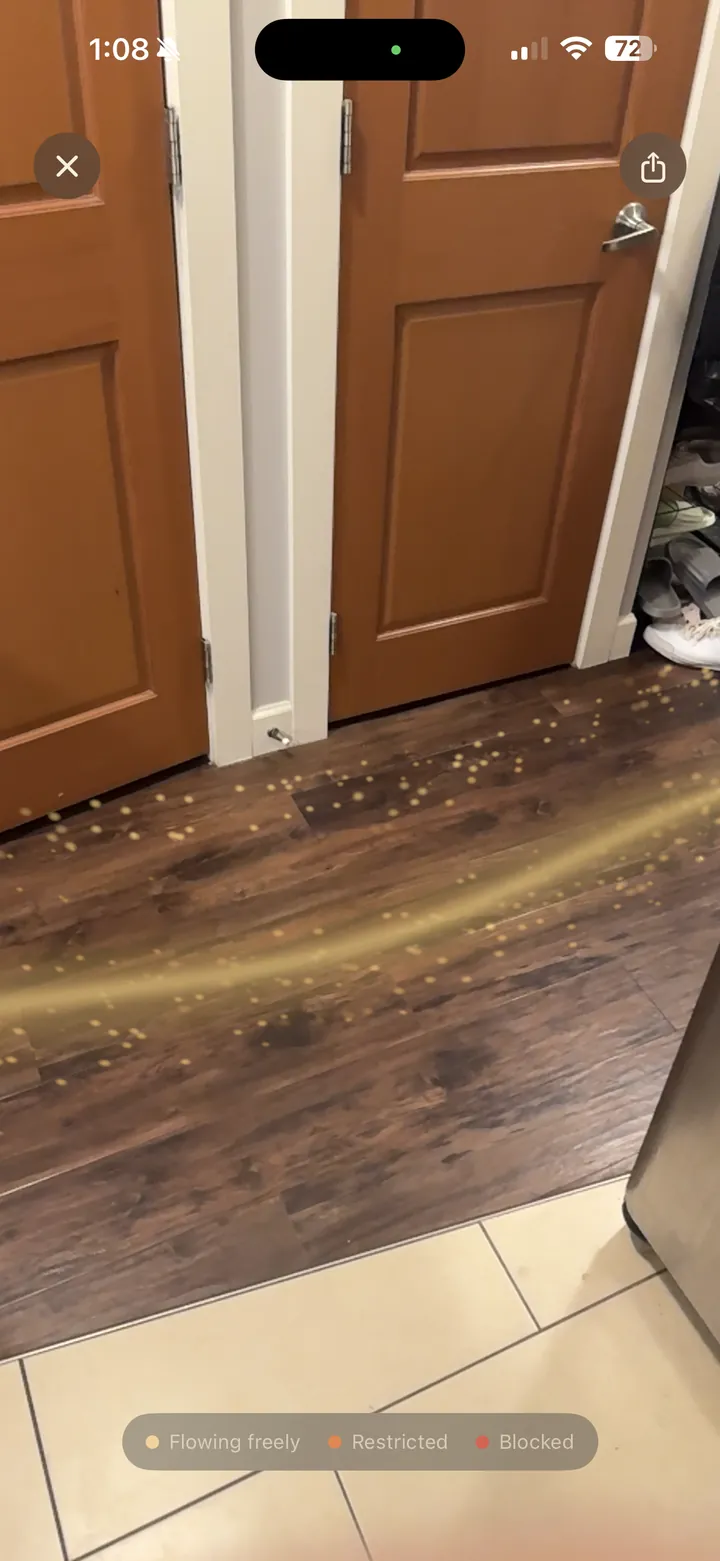
What a scan reads in your hallway
- Dead-end hallways.
- Narrow passages: pinch points on the route the flow takes.
- Furniture along the path that narrows it or cuts it.
- When the corridor runs from the front door: whether the door lines up with a window or exterior door, or looks straight at a bathroom or into a bedroom.
- The flow path itself, drawn through the corridor on your plan and shown as moving light in AR.
- Not read: a hallway’s length by itself. A scan does not mark a corridor as too long, and it does not read runners, pictures or lighting.
Questions
Is a long hallway bad Feng Shui?
Tradition reads a long, straight, bare corridor as speeding the flow up, which is considered unfavorable for the room at the end. It is treated as something to slow down with rugs, pictures and lighting, not as a fault in the home. No school sets a length at which it becomes a problem.
What should I put at the end of a hallway?
Something with colour or light that gives the corridor a destination: a picture, a lamp, or a plant if there is room and daylight. Avoid storage. A mirror on the end wall is suggested by some practitioners and discouraged by others.
Is a bedroom at the end of a long hallway bad Feng Shui?
It is said to receive the corridor's flow directly. The usual advice is to keep the bedroom door closed, especially at night, and to make sure the bed inside is not in line with the door. If the bed is off that line, most practitioners consider the arrangement acceptable.
Can I hang a mirror in a hallway?
On a side wall, generally yes, and it makes a narrow hall look wider. Practitioners are divided about a mirror on the end wall, and most advise against any mirror that directly faces the front door.
How do I fix a narrow hallway in Feng Shui?
Clear the floor first. Move shoe storage and shelving out, hang coats elsewhere, and let the walls and lighting do the work: a runner, pictures staggered from side to side, and light along the length.