 Feng Shui Scan
Why a window behind your head counts against the bed
Form school’s oldest picture is of a site with high ground at its back and open ground in front. Indoors, practitioners apply the same picture to anything you rest in: something solid behind, a clear view ahead. For a bed, the solid thing is the wall the headboard stands against. A window in that wall is read as an opening exactly where the backing should be, and some teachers add that the room’s flow is said to slip out through it over the sleeper’s head. The same reading is applied to a desk chair or a sofa with a window directly behind it, which is why the advice sounds familiar from other rooms.
The practical case is stronger than usual. Glass is the coldest surface in the room. Draughts fall from it onto the pillow, light comes through at dawn, street noise is nearest there, and curtains move. You also cannot sit up and lean back against a sill. None of that requires belief.
How much it matters
Less than the two rules about the door. Most practitioners rank the tests of the command position, set out on the bedroom page, in roughly this order: see the door, stay out of its direct line, then have a solid wall behind. So:
- A bed under a window that sees the door on a diagonal is usually preferred to a bed on a solid wall with its back to the door.
- A bed under a window that is also in line with the door has two things to address, and the door comes first.
Within that, the details change the reading. A large low window on a ground floor facing a street is the full case. A small window above head height, on an upper floor, with a deep headboard below it, is close to a solid wall.
High windows, low windows and half-covered ones
- High windows. If the sill is above the top of the headboard and your head rests against wall, most practitioners treat the window as minor.
- Low or full-height windows. Glazing that comes down behind the pillow is the most exposed version, and a headboard does the most work here.
- A bed half on wall, half on window. Slide it along until the head is on the solid part. The window then sits beside the bed.
- A bay. A bed pushed into a bay has glass on three sides. Pulling it forward so the headboard lines up with the main wall, with a curtain drawn across the bay behind, gives it something closer to a back.
- Shutters. Solid internal shutters closed at night come nearer to a wall than any curtain does.
Beside a window, and between a window and the door
A window beside the bed is fine. Tradition raises no objection to light from the side.
A bed standing between the door and a window is a separate matter. If the door and window face each other and the bed lies across the line between them, form school reads the flow as crossing the bed on its way out. It is the same mechanism, at room scale, as a front door facing a back window. Moving the bed out of that line, or keeping the window covered at night, is the usual answer.
A window opposite the foot of the bed draws no particular comment.
Fixes, in order of effort
Free
- Close the blind or curtain every night. This is the remedy almost every practitioner gives first.
- Slide the bed along the wall so your head is against the solid part.
- Measure the other walls again. People often assume the bed fits only one, and trying the walls one by one in the bed placement tool sometimes shows another worth measuring for.
- In cold weather, keep the window behind the bed shut or on its latch at night. The draught is the part of this you can feel.
Small purchases
- A tall, solid headboard. Wood or upholstered, with no slats or gaps, and high enough to be above your head when you sit up. It stands in for the missing wall.
- A heavier covering. A lined curtain, or a blind with a curtain over it. A sheer does not count as closed.
Rearranging
Give the window wall to something that suits it. A desk often does, since daylight from the front or side is what a desk wants; the desk placement tool checks the door side of that. The bed then takes the wall the desk or wardrobe had, provided it still sees the door and does not end up opposite a mirrored wardrobe. If you follow a compass method, a move is also the moment to look at your favorable directions, though the door still comes first.
When to stop worrying
Once you have a solid headboard, a covering you close at night and a view of the door, you have done what tradition asks of this arrangement. It stays a compromise on paper, and that is all it is.
Rooms where the window wall wins
- An attic room with one full-height wall — The gable wall has the window and the other walls slope. The bed belongs on the gable, with a headboard taller than the sill and a blackout blind.
- A choice between the window wall and the door wall — On the door wall, the door opens beside your head and out of sight. Most practitioners would take the window wall, with the headboard and curtain.
- A wide low window across the whole wall — No part of the wall is solid at pillow height. This is the case for the tallest headboard that fits and a lined curtain behind it.
- A window with a radiator beneath it — A bed pushed against it blocks the heat as well. That is a practical reason to look harder at the other walls before settling.
Common mistakes
- Counting a sheer as a curtain — light and movement come straight through it.
- A slatted or open metal headboard — it marks where the head of the bed is without backing it.
- Escaping the window by turning your back to the door — that swaps the lesser problem for the greater.
- Pulling the bed away from the window — a gap behind the headboard leaves you with neither wall nor window at your back.
Whether your headboard sits under the glass or just beside it, and whether the bed would still see the door from another wall, is easier to judge on a plan than from the doorway. A scan puts the bed, the window and the door on the same drawing.
SCAN YOUR BEDROOM
Map the room with your phone and see where the headboard sits against the window, the wall and the door.
Coming to the App Store · iPhone and iPad · submitted for review
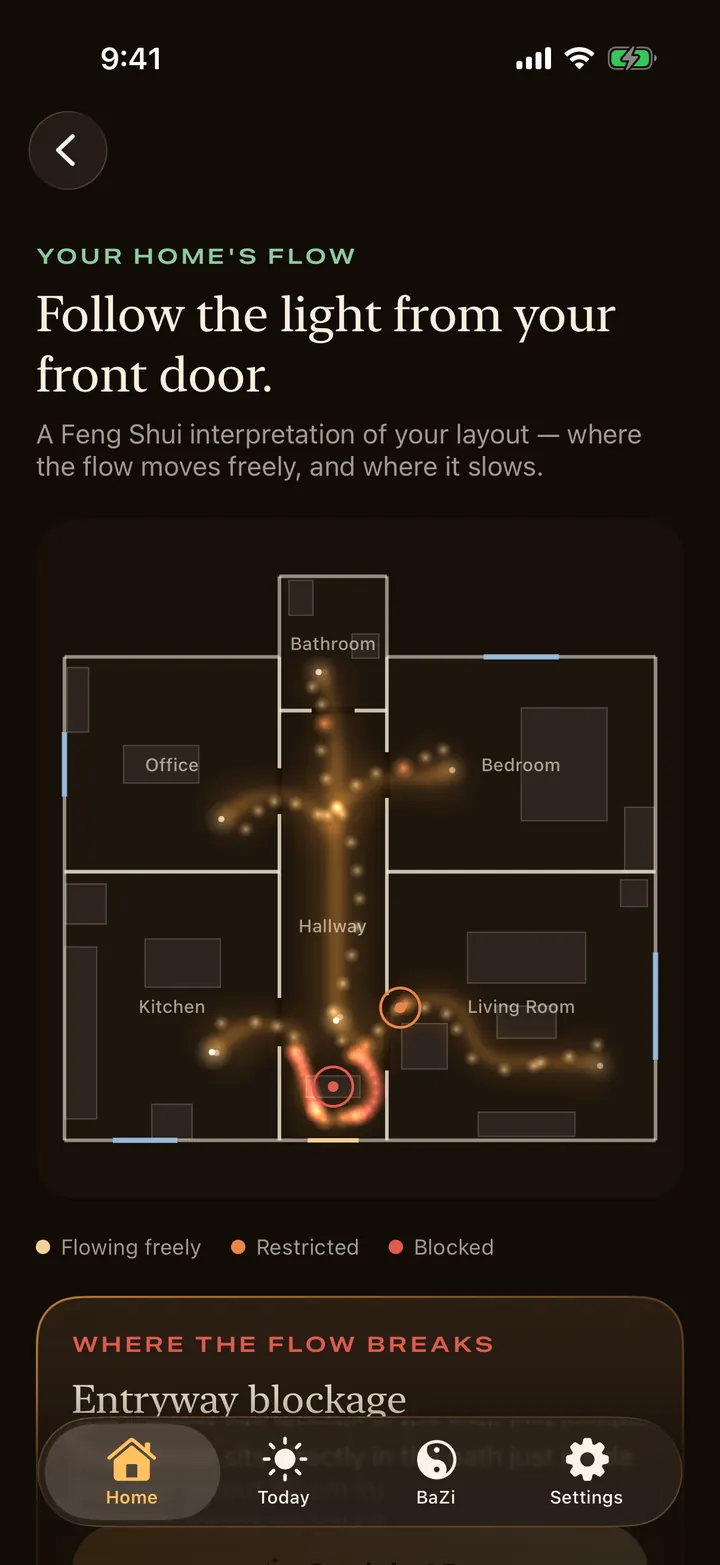
What a scan reads about your bed and the window
- A window behind the headboard, which counts against the bed’s support in the command-position check.
- Whether the headboard stands against a wall at all.
- Whether the bed can see the door, and whether it is directly in line with it.
- Sharp furniture corners aimed at the bed.
- With your BaZi chart and a compass heading: which way your head points and which sector the bed sits in, against your favourable elements.
- Not read: the height or material of the headboard, the height of the sill, or your curtains. Those you check by eye.
Questions
Is it OK to put a bed in front of a window?
It is acceptable when the room offers nothing better. Traditional Feng Shui prefers a solid wall and treats a window behind the headboard as weaker support, but it ranks that below the rules about the door. A solid headboard and a covering closed at night are the usual remedy.
Which is worse, a bed under a window or a bed facing the door?
A bed with its back to the door is generally considered worse than a bed under a window. A bed in line with the door, feet pointing out, is usually also treated as the greater concern, though practitioners weigh the two differently. If both apply, deal with the door first.
Does a headboard fix a bed under a window?
It is the standard remedy, and it needs to be solid and tall, ideally higher than the sill or at least above your head when you sit up. Paired with a curtain or blind closed at night, most practitioners consider the arrangement acceptable.
Is a bed next to a window bad Feng Shui?
No. A window on a side wall beside the bed is not a concern in form-school Feng Shui. The caution is about a window directly behind the head, and about a bed lying on the line between a door and a window.
Does a small high window above the bed count?
Much less. If your head rests against solid wall and the window starts above the headboard, most practitioners treat it as minor. Keeping it covered at night is still the common advice.