 Feng Shui Scan
Rank the compromises
A large room lets a bed meet every rule at once. A small one usually offers one or two positions, and each of them fails something. Traditional practice does not treat all failures as equal. The order most practitioners work to is:
- See the door. From the pillow, the door is in front of you or to the side, not behind your head.
- Stay out of its line. The doorway, continued into the room, should pass beside the bed and not run down the mattress.
- A solid wall behind the headboard. A wall is preferred to a window, and either is preferred to a bed standing free.
- Access from both sides. Wanted for a double bed, and the first thing to give up.
When two positions are possible, compare them from the top of the list. A bed that sees the door from a corner is rated above one with a bedside table on each side and the door behind the pillow. The rules themselves are on the bedroom layout page. This page is about which to let go.
The bed placement tool shows whether any wall in a room like yours passes the first three, and tells you when none does.
Bed in a corner or against a side wall
Pushing the bed against a side wall is the standard way to win floor in a small room, and tradition treats it as a compromise, not a fault. The objection concerns couples: the sleeper on the wall side has to climb over the other, and the bed is read as supported on one side only. For one person it matters little.
If two people share it, give the wall-side sleeper a shelf or a wall light of their own, since they have no bedside table. Where the bed can come out from the wall even thirty or forty centimetres, some practitioners count that as access.
A corner often does well on the rules that rank higher. With the bed in the corner diagonally opposite the door, you see the doorway from the side and the door’s line passes clear of the mattress.
Bed on the same wall as the door
Sometimes the only wall long enough is the one with the door in it. The door then opens beside or behind your head and you cannot see who enters without turning. That is the first rule lost.
Two adjustments are usual. Put the bed as far along the wall from the door as it will go, so the door swings away from the pillow. Then place a small mirror where it shows you the doorway as you lie down. Tradition accepts a reflected view of the door as a substitute for a direct one.
The mirror needs some care, because a mirror reflecting the bed is itself a well-known caution, covered under mirror facing the bed. Keep it small, about the size of a hand mirror, and angle it so that from the pillow you see the door frame and not yourself. The wall opposite, off to one side of the foot of the bed, usually works.
Under the window as the least-bad option
In many small rooms the choice comes down to the door wall or the window wall. Going by the ranking, the window wall usually wins. A bed under the window can still see the door and stay out of its line, and it loses only the third rule.
What it loses can be partly made up. A solid headboard taller than the sill and a blind or lined curtain closed at night are the usual measures, with the bed kept a little clear of any radiator. The options are set out in full under bed under a window. A window on a side wall is generally fine.
Single beds, box rooms and studios
The both-sides rule is about two sleepers, so a single bed against a side wall gives up almost nothing, and its narrower width makes it easier to keep out of the door’s line.
In a box room where the bed fills one end, check that line first. If the doorway points down the mattress, a closed door at night and something solid at the foot are the remedies given on the bed facing the door page.
A studio adds a second door to think about. The bed should see the way into the sleeping area, and the home’s front door should not look straight at the bed. A bookcase, a curtain or a screen between the two does both jobs, provided it stands beside the path from the door and not in it. The entryway guide covers how to make that edge.
Storage and the path from the door
Small rooms run out of storage before they run out of rules.
Under the bed. Many practitioners prefer the space under a bed empty, on the reasoning that the flow should pass beneath the sleeper. Others accept soft things there, such as bedding and out-of-season clothes, and object mainly to shoes, paperwork and anything broken. The practical view is that a small bedroom needs the space, and closed drawers holding linen are a middle course many teachers accept.
Over the bed. Shelves or cupboards fixed above the headboard are widely disliked, as weight hanging over your head. If the shelf has to stay, keep what is on it light, or move it to the wall beside the bed.
The floor. When floor is scarce, the strip from the door to the bed is the part to protect. You should be able to walk from the doorway to your side of the bed without turning sideways. A room with furniture over most of its floor reads as crowded in form-school terms, and taking one piece out does more than rearranging the rest.
Compass direction comes last in a room like this. The page on bed direction explains why position is settled first.
Small rooms with one or two choices
- A narrow room with the door in the corner of a short wall — Put the headboard on the far short wall, in the corner diagonally opposite the door, with one side of the bed against the long wall. You see the door from the side and its line misses the bed. The cost is access from one side.
- The only bed wall is the door wall — Slide the bed to the far end of it. Stand a hand-sized mirror on the chest of drawers opposite and turn it until it shows the door frame from the pillow and nothing of the bed.
- Door wall or window wall, and nothing else — Take the window wall. Fit a headboard higher than the sill and a lined curtain. You have kept the two rules that rank highest.
- A studio where the front door sees the bed — Stand a bookcase at right angles to the wall, beside the door’s path, tall enough to hide the pillow from the threshold. The bed keeps a view of the way in past its end.
Common mistakes
- Centring the bed for symmetry — a bed centred on the wall opposite the door often lies in the door’s line. Off-centre and out of the line ranks higher.
- A mirror big enough to show the bed — the workaround calls for a small mirror aimed at the doorway. A wardrobe mirror facing the bed is a different thing.
- Choosing two bedside tables over a view of the door — access from both sides is the last rule on the list, not the first.
- Shelves over the pillow because the wall was free — the wall beside the bed holds the same books.
- Storage that takes the walkway — the room met the rules when you arranged it, and then a drying rack moved in.
In a small room, the difference between in line with the door and just clear of it can be a few centimetres. That is hard to judge from the pillow and easy to see on a measured plan.
SCAN YOUR BEDROOM
Map the room with your phone and see which rules your bed keeps where it stands, and what a suggested move would change.
Coming to the App Store · iPhone and iPad · submitted for review
What a scan reads in a small bedroom
- Whether the bed is in the command position: can it see the door, is the headboard on a solid wall, and is it out of the door’s direct line.
- A window behind the headboard, which counts against the bed’s support.
- Corners of a wardrobe, desk or chest of drawers pointing at the bed, which is common when furniture stands close.
- Furniture that narrows or cuts the path through the room, any pinch point on it, and how much of the floor is covered.
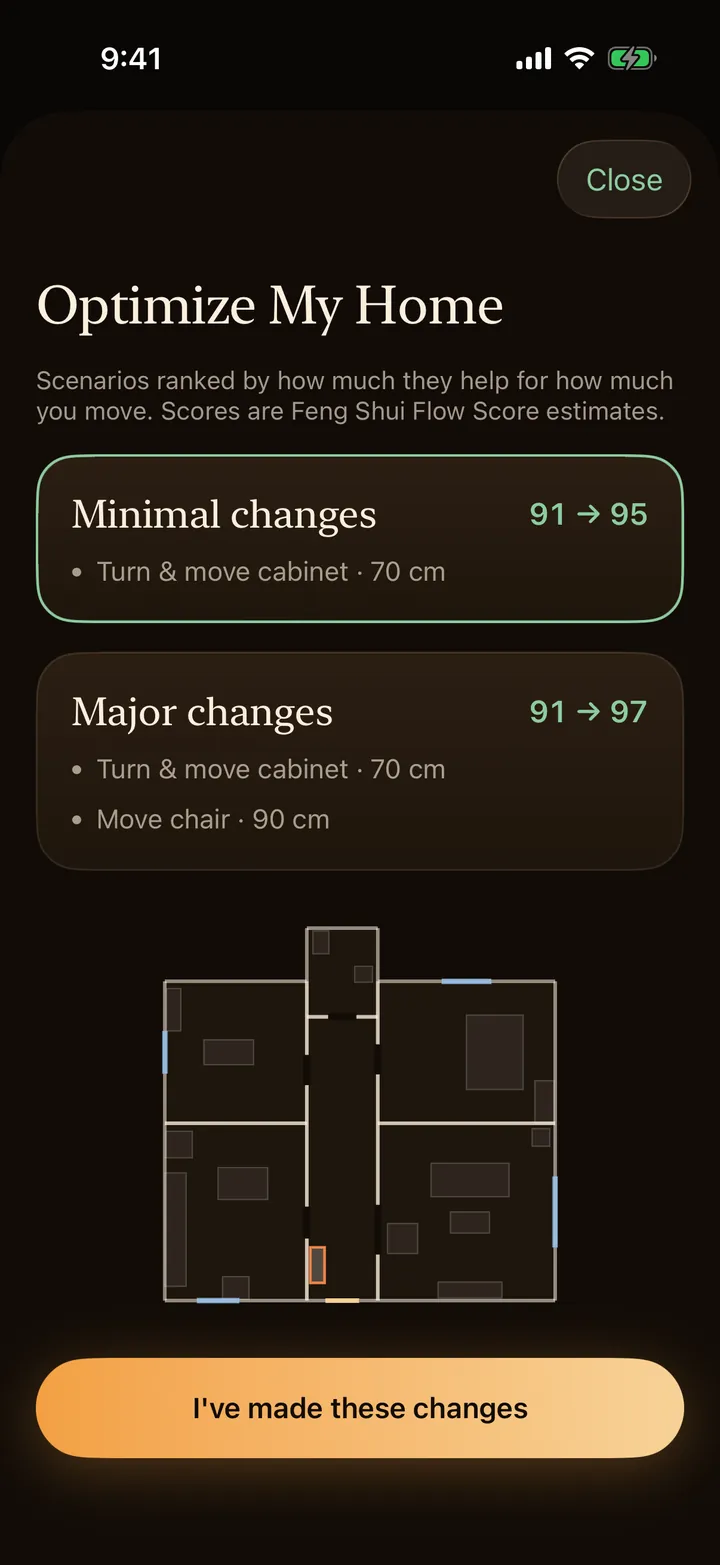
- Suggested furniture moves, which you can preview in AR before lifting anything.
- Not read: mirrors, including a small one placed to show you the door, what is stored under the bed, or shelves above it. Those you check by eye.
Questions
Can a bed be pushed against the wall in Feng Shui?
Yes. A bed with one side against a wall is treated as a compromise, not a fault. The traditional preference for access from both sides concerns two sleepers, so for one person it matters little. Seeing the door and staying out of its line rank higher.
Where should the bed go in a small bedroom?
Where you can see the door from the pillow without lying directly in line with it. After that, prefer a solid wall behind the headboard to a window. Access from both sides is the first rule to give up when the room is tight.
Is it bad to have the bed on the same wall as the door?
It is a weak position because the door opens beside or behind your head. If no other wall fits, move the bed as far from the door as that wall allows and place a small mirror where it shows you the doorway from the pillow.
Is it okay to store things under the bed?
Practitioners differ. Many prefer the space empty. Others accept soft items such as bedding and clothes, and object mainly to shoes, paperwork and broken things. In a small room, closed drawers holding linen are a common middle course.
What if the bed can only go under the window?
Under a window is weaker than a solid wall, but it usually keeps the view of the door, which ranks higher. A solid headboard taller than the sill and a curtain or blind closed at night are the usual remedies.
How do I arrange a bedroom that fits only one layout?
Apply the remedies that suit the rule you have lost: a mirror for a door you cannot see, something solid at the foot for a bed in the door's line, a tall headboard for a window behind. Then keep the path from the door clear and stop there.