 Feng Shui Scan
The reasons teachers give
They vary, and it is better to know that than to be handed one as settled.
- Activity in a room for rest. Mirrors are said to stir up and multiply whatever they reflect. Many teachers treat the bedroom as the room that wants least of that.
- Bouncing the flow. Some describe a mirror opposite the bed as sending the room’s flow back at the sleeper.
- Doubling the bed. Popular writing often claims that a mirror reflecting a couple’s bed invites a third person into the relationship. It is repeated widely and there is no way to test it.
- An older folk explanation. Some sources say a sleeper could be startled by a reflection in the night.
- Not much at all. Some classically trained practitioners regard the rule as household custom more than Feng Shui proper, and say so.
What you can fairly take from this: the caution is widespread, the reasoning is not agreed, and nothing in it predicts anything about your life. A mirror facing the front door is a different rule with its own reasoning, and should not be confused with this one.
The practical reason
A mirror is the one object in a bedroom that moves when you move. In a dim room, a shift in the glass at the edge of your vision registers before you have worked out that it is you. Mirrors also pass on light: a street lamp, headlights crossing the ceiling, a phone screen, the first sun. For a light sleeper those are reason enough, with no tradition involved.
Does it count if you cannot see it from the pillow?
For most teachers, no. The caution is about a mirror that reflects the sleeper or the bed. Test it where it matters:
- Lie down on your side of the bed, head on the pillow.
- Look for yourself, and for any part of the bed, in the glass.
- Sit up and look again.
- Repeat on the other side of the bed.
A mirror on the same wall as the headboard cannot reflect you. A mirror on a side wall may or may not, depending on its angle. A small mirror hung high over a chest of drawers may show only the ceiling. A stricter minority prefers no mirror in the bedroom whatever it shows; most do not go that far.
Mirrored wardrobes, televisions and other glass
Mirrored wardrobe doors are usually the largest mirror in the home, and in many bedrooms they run along the wall beside or opposite the bed. They count. Tradition makes no exception for mirrors that came with the room.
A television opposite the bed is a dark mirror when it is off. Some practitioners treat it exactly like one and others never mention it.
By the same logic, a few surfaces that are not mirrors behave like one at night: high-gloss wardrobe doors, large glazed pictures, and an uncurtained window, which reflects the room as soon as it is dark outside. If the practical reason is the one that persuades you, these belong on the list, and the window is one more reason to keep a window behind the bed covered.
Fixes, in order of effort
Free
- Drape a throw over the mirror at night.
- Tilt or turn a freestanding mirror until it shows wall or ceiling from the pillow.
- Move it to the headboard wall, to a wall the bed cannot see, or out of the room.
- Close the curtains, which deals with the window.
Small purchases
- Fixings to hang the mirror on the inside of a wardrobe door, the remedy most often suggested.
- Frosted or opaque film for mirrored sliding doors. It peels off, which matters in a rented room.
- A curtain on a ceiling track in front of mirrored doors, drawn at night.
- A cloth cover for the television, or a cabinet with doors.
Rearranging
Moving the bed is the last resort, and it has a cost. Do not give up a view of the door or a solid wall to get away from a mirror. The bedroom layout page explains why those come first, and the bed placement tool will check a new position.
When to stop worrying
If you cannot see yourself or the bed from either pillow, most teachers would say you are finished, and you can go back to the rest of the problems list. If you can, and it has never bothered you, you are entitled to treat it as a low priority.
The one bedroom mirror tradition likes
There is an exception. When a bed cannot be placed to see the door, a common remedy is a small mirror positioned so that the doorway is visible in it from the pillow. It restores the view the command position is meant to give.
The two rules fit together once you see what each is about. The first objects to a mirror that shows you the bed. The second wants a mirror that shows you the door. Angle the small one until the doorway is in it and you are not. It sits alongside the other remedies for a bed that cannot face the door properly.
Bedrooms with a mirror question
- A rented room with mirrored sliding wardrobes opposite the bed — The doors cannot be replaced. Removable frosted film on the panels the bed can see, or a curtain on a track, covers them without touching the fittings.
- A dressing table at the foot of the bed — Its mirror faces the pillows. Moving the table to the headboard wall, or along a side wall until the glass shows the room and not the bed, keeps it in use.
- A full-length mirror leaning in the corner — The easiest case. Turn it a few degrees, or move it behind the door.
- A television on the wall opposite — Whether it counts depends on which teacher you ask. A cover costs little if the dark screen bothers you.
Common mistakes
- Checking from the doorway — what matters is the view from the pillow, on both sides of the bed.
- Covering one wardrobe door of three — the uncovered panels still reflect the bed from the other side.
- Moving the bed and losing the door — a bed with its back to the door to avoid a mirror has swapped a disputed rule for an agreed one.
- Removing the useful mirror too — the small mirror that shows you the door is a remedy, not a fault.
This is one question you answer from the pillow, not from a plan: lie down and look. The rest of the bedroom’s reading is harder to do by eye, and that is the part a scan covers: where the bed sits against the door, the wall and the window.
SCAN YOUR BEDROOM
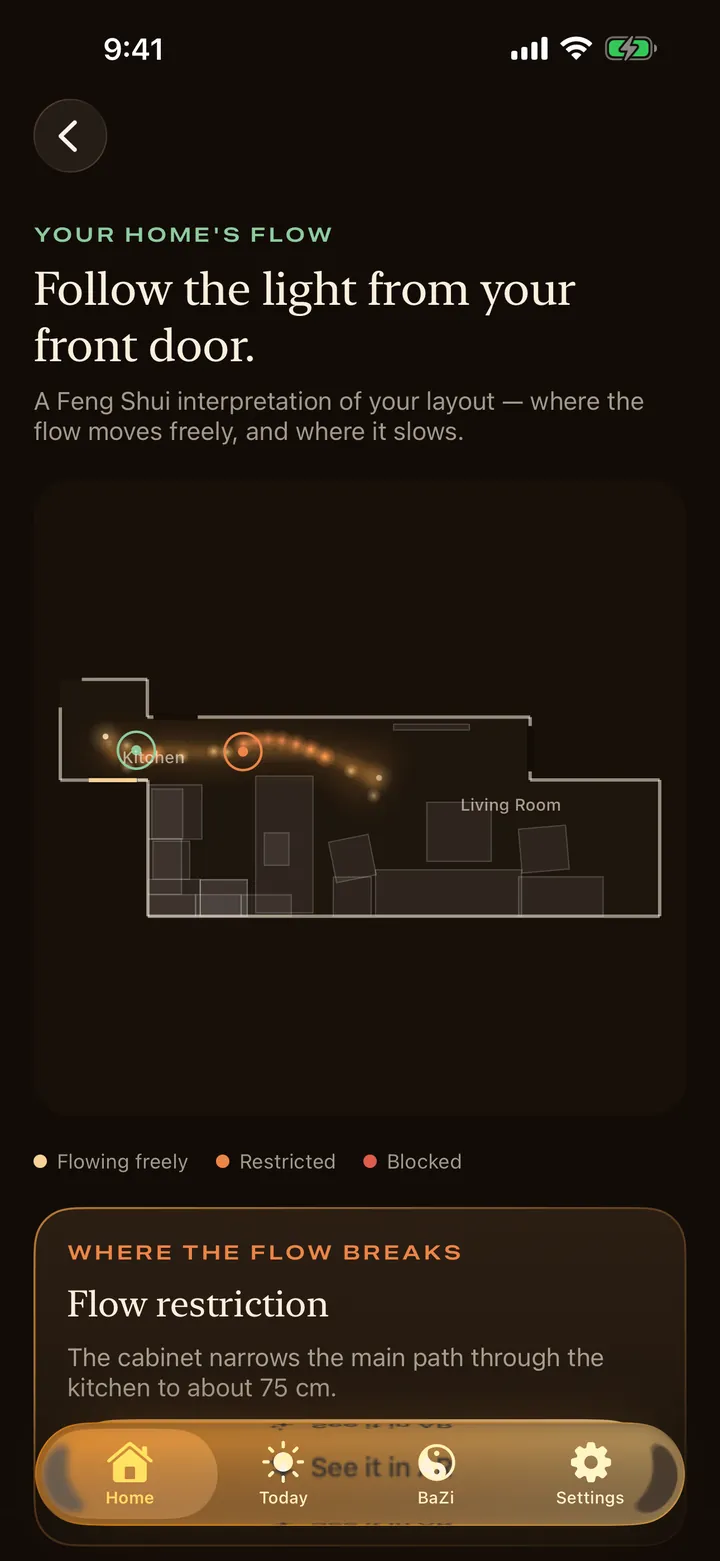
A scan does not read mirrors, but it shows where your bed sits against the door, the wall behind it and the window.
Coming to the App Store · iPhone and iPad · submitted for review
What a scan does and does not read here
- Mirrors facing beds are not part of a scan. The app’s only mirror finding is a mirror straight across from the front door of the home.
- In the bedroom it reads the bed instead: whether it can see the door, whether it is directly in line with it, and whether the headboard is on a solid wall.
- A window behind the headboard.
- Sharp furniture corners aimed at the bed.
- Furniture that narrows the route through the room, and how much of the floor is covered.
- Not read: a mirror, mirrored wardrobe doors, a television or any other reflective surface facing the bed. Check those by lying down and looking.
Questions
Is it bad Feng Shui to have any mirror in the bedroom?
Most teachers object only to a mirror that reflects the bed or the sleeper. A mirror you cannot see from the pillow, or one inside a wardrobe door, is generally accepted. A stricter minority prefers none in the room at all.
Is a mirror beside the bed a problem?
It depends on the angle. If you can see yourself or part of the bed in it while lying down, it falls under the same caution as a mirror opposite. If it shows only the wall or the room beyond the bed, most practitioners do not count it.
Does covering a mirror at night work?
It is one of the standard remedies, and it answers the practical objection completely, since a covered mirror reflects neither movement nor light. A throw, a curtain on a track or removable film are the common ways to do it.
Is a TV facing the bed the same as a mirror?
Some practitioners treat a dark screen as a mirror because it reflects the bed when switched off; others do not raise it. If it bothers you, a cover or a cabinet with doors deals with it.
Does Feng Shui Scan check for mirrors facing the bed?
No. The app flags a mirror only when it is straight across from the front door of the home. A bedroom scan reads the bed's position against the door, the wall behind it and the window, along with sharp corners and how furniture affects the route through the room.