 Feng Shui Scan
Start with the bed, not the decor
Most bedroom advice in Feng Shui is a consequence of bed placement. The form school, which reads a home through its shape and the way people move through it, asks three questions about a bed:
- Can you see the door from it? Lying down, the door should be somewhere in front of you, usually on a diagonal.
- Is there something solid behind your head? A wall, with the headboard against it.
- Are you out of the door’s direct line? If you could draw a straight line from the doorway down the length of the bed, the bed is in line.
A bed that answers yes, yes, yes is said to be in command. There is a plain reason the rule has lasted: people rest more easily when they can see who is coming in and nothing is moving behind their head. You don’t have to accept anything about energy to notice that a bed with its back to the door feels exposed.
If you want to test your own arrangement quickly, the bed placement tool runs these three checks on a simple room you set up.
The bed and the door
The arrangement Feng Shui likes least is the one where your feet point straight out of the door. Practitioners sometimes call it the coffin position; the reasoning given is that the door is where the room’s flow enters and leaves, and a bed lying along that line sits in the busiest part of it. There is a whole page on a bed facing the door, including what to do when the room gives you no choice.
The second-least-liked is a bed on the same wall as the door, so that the door opens behind or beside your head. You can’t see who enters without turning. A diagonal view is the usual fix: put the bed on the wall opposite the door, shifted to one side of it.
Bedrooms with two doors (an en-suite, a walk-in wardrobe) are judged by the main one. Keeping the bathroom door closed at night is the standard advice, and it costs nothing.
Windows
A window directly behind the headboard is treated as missing support: the wall that should be solid has a hole in it. Draughts, light and street noise make the practical case without any help from tradition. If the only wall long enough for the bed has the window in it, a tall, solid headboard and heavy curtains are what most practitioners suggest — see bed under a window for the options.
Windows on a side wall are fine. A bed placed directly between a door and a window, though, sits in the line that Feng Shui reads as the flow rushing through the room, and is worth shifting off that line if you can.
Mirrors, and what is opposite the bed
A mirror that reflects the bed is one of the most repeated bedroom cautions. Different teachers give different reasons — that it doubles the activity in a room meant for rest, or that movement caught in it at night is unsettling. The second is easy to believe. The common remedies are to move the mirror to the inside of a wardrobe door or to a wall the bed can’t see. There is more in mirror facing the bed.
A television opposite the bed is treated much like a mirror by some practitioners, since a dark screen reflects. Others don’t mention it. This is a place where the tradition is not unanimous.
Circulation and furniture
Form-school Feng Shui wants you to be able to walk around the bed. A double bed pushed into a corner leaves one sleeper climbing over the other, and is read as support on one side only; the traditional preference is space and a bedside table on both sides. When the room does not allow it, the small bedroom page ranks which rules to keep.
Beyond the bed:
- Keep the path from the door clear. A chair, a laundry basket or the corner of a chest of drawers in the first step inside the door is the kind of thing that narrows the room’s flow.
- Watch for corners aimed at the bed. The sharp edge of a wardrobe or a desk pointing at where you sleep is called a poison arrow. Turning the piece, or moving it along the wall, takes the point off the bed.
- Don’t fill the floor. A bedroom where furniture covers most of the floor reads as crowded however tidy it is. Taking one piece out often does more than rearranging five.
How the bedroom connects to the rest of the plan matters too: a bedroom the front door looks straight into is considered too exposed to the active part of the house. That is covered under home layout.
Direction: which way should the bed face?
This is where schools part ways. Form school cares about the door and the walls and has little to say about compass points. Compass-based methods do: Eight Mansions assigns each person four good directions from a Kua number, while approaches built on BaZi work from the elements your chart is said to favour and the directions that belong to them.
The two can disagree with each other, and either can disagree with the room; bed direction goes through how each is measured. When they do, most practitioners put the command position first: a bed that faces a favourable direction but has its back to the door is not considered an improvement.
Bedrooms that don't cooperate
- The only free wall is the door wall. Put the bed as far along that wall from the door as it will go, so the door opens away from your head, and hang a small mirror where it shows you the doorway from the pillow. This is the traditional workaround when a diagonal view is impossible.
- A narrow room where the bed must face the door. Shift the bed off-centre so the door’s line runs past it rather than down it, and put something with height at the foot — a bench, a chest, a footboard — to break the line.
- A studio where the bed is in the living space. Treat the bed’s corner as its own room: headboard on a solid wall, and a bookcase, screen or curtain between the bed and the front door so the entrance does not look straight at it.
- A window on every usable wall. Choose the wall with the smallest or highest window, use a solid headboard taller than the sill, and keep that window’s covering closed at night.
Common mistakes
- Chasing a direction and losing the door. Turning the bed to a "lucky" compass point while putting your back to the door trades the rule most schools agree on for one they don’t.
- A headboard that isn’t one. A bed pulled away from the wall, or a slatted or open metal frame, doesn’t give the solid backing the rule is asking for.
- Storage that grows into the walkway. The room met the rules when you arranged it; six months later a drying rack and two boxes are standing in the path from the door.
- Fixing the mirror and ignoring the wardrobe. Mirrored wardrobe doors facing the bed are still a mirror facing the bed.
Reading about Feng Shui bedroom layouts is one thing. Seeing your own bedroom is another. Whether your bed is "in line with the door" depends on a few centimetres either way, and it is hard to judge from the pillow.
SCAN YOUR BEDROOM
Map the room with your phone and see where your bed sits against the door, the windows and the way the flow runs.
Coming to the App Store · iPhone and iPad · submitted for review
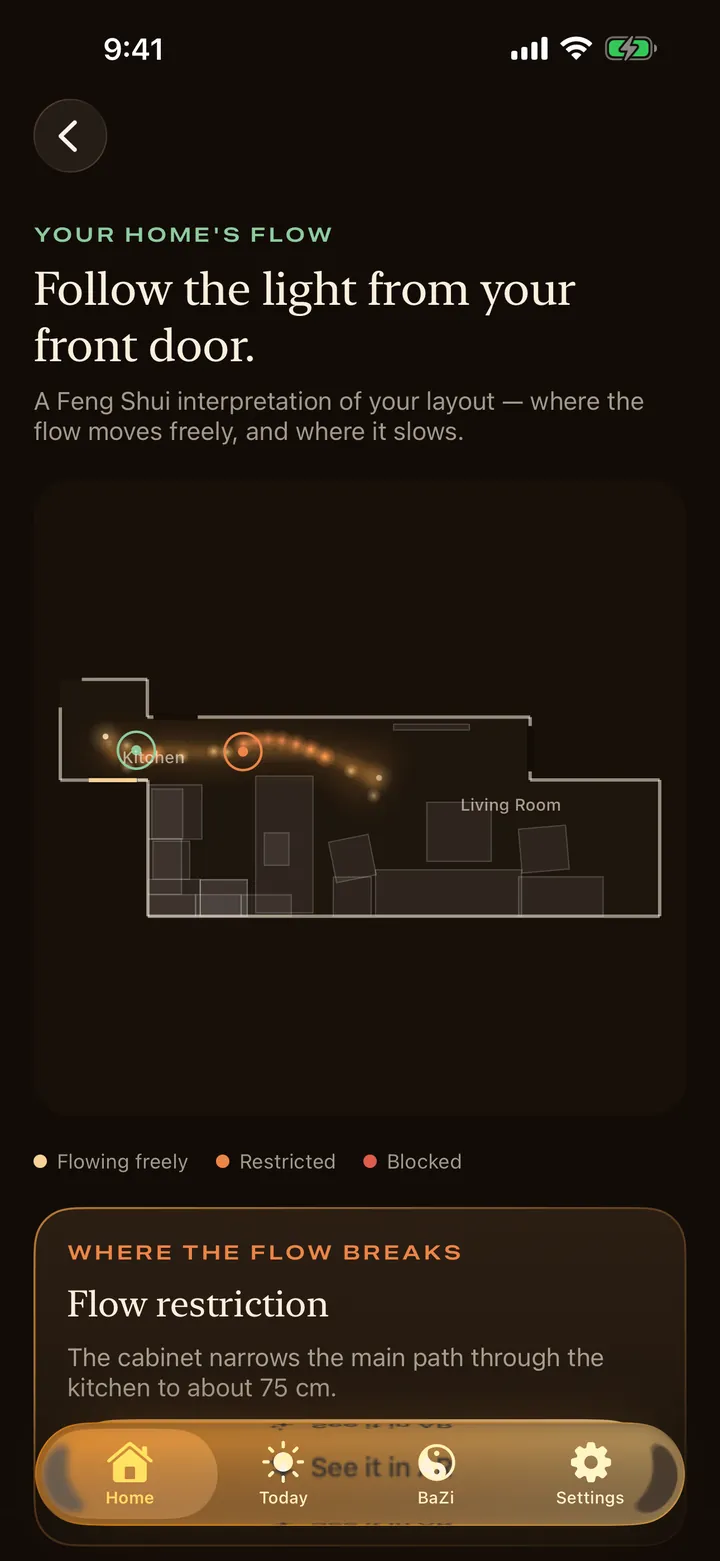
What a scan reads in your bedroom
- Whether the bed is in the command position: can it see the door, is the headboard on a solid wall, and is it out of the door’s direct line.
- A window behind the headboard, which counts against the bed’s support.
- Furniture corners pointing at the bed.
- Furniture that narrows or cuts the path the flow takes through the room, and how much of the floor is covered.
- Whether the front door of the home looks straight into the bedroom.
- With your BaZi chart and a compass heading: the direction your head points and the sector the bed sits in, against your favourable elements.
- Not read: mirrors facing the bed, electronics, or what is stored under it. Those you check by eye.
Questions
What is the best position for a bed in Feng Shui?
The command position: from the bed you can see the door, usually on a diagonal, without lying directly in line with it, and the headboard is against a solid wall with no window behind it. Most schools of Feng Shui agree on this before anything else in the bedroom.
Which direction should my bed face?
Form-school Feng Shui does not prescribe a compass direction; it cares about the door and the wall behind you. Compass methods such as Eight Mansions, and approaches based on BaZi, each suggest personal directions, and they do not always agree. When a favourable direction conflicts with the command position, practitioners generally keep the command position.
Is it bad Feng Shui to have a bed under a window?
It is considered weaker than a solid wall, because the window is read as a gap in the support behind your head. If the room leaves no alternative, a tall solid headboard and a heavy curtain or blind kept closed at night are the usual remedies.
Can a bed go in the corner of the room?
It can, and in a small room it often has to. Traditional Feng Shui prefers access from both sides, so a bed against a side wall is seen as a compromise rather than a fault. For one sleeper it matters little.
Does bedroom Feng Shui work in a rented or shared room?
The core rules are about where furniture stands, not about building work, so they apply to any room where you can move the bed. Where you cannot move it, the traditional workarounds — a mirror to show the door, something solid at the foot of the bed, a closed curtain behind the headboard — need no permission from a landlord.