 Feng Shui Scan
Why tradition objects
The front door is called the mouth of qi, the opening the home’s flow comes in by. Form school wants that flow to slow down just inside and spread into the rooms. A staircase squarely opposite the door is read as a channel that takes it somewhere else at once.
Two versions of the reading are taught:
- Stairs going up. The flow is said to rush to the upper floor and bypass the ground floor, leaving the living rooms short.
- Stairs going down. Where the entrance is on the upper level and the stairs descend from it, the flow is said to run downhill and drain away. Some teachers consider this the stronger of the two.
A further folk reading runs the other way: that what is upstairs rolls down and out of the door. Treat it as a saying, not a forecast.
There are ordinary observations underneath. In a house laid out this way people do tend to go straight upstairs when they come in. With the door open, the draught runs straight up the stairwell. A visitor on the step looks directly up at the landing and the bedroom doors. And the foot of the stairs is where shoes, bags and post pile up, exactly where you least want to trip.
How much it matters in your home
Not all door-and-stair arrangements are read alike. Four things change the weight.
Alignment. The full case is a straight flight whose bottom step faces the door head on. A staircase that starts off to one side, or runs along the wall parallel to the door’s line of travel, is treated as much milder. Many practitioners do not count a staircase you have to turn to reach.
Distance. The closer the first step is to the threshold, the more seriously it is read. Practitioners do not agree on a figure. A reasonable test is whether there is room to stand, close the door behind you and take a few steps before the stairs begin. If there is a proper entryway between the two, most would call the matter minor.
The shape of the flight. A staircase that turns at a landing part-way is read as slowing the flow by its own form. A straight, steep, narrow flight is the firmest case.
What else the door sees. If the hall also opens to a living room beside the stairs, the flow is said to have somewhere else to go. A door that sees nothing but stairs and a closed corridor is the version the tradition has in mind.
Split-level entries and apartments
Split-level or bi-level entries. Some houses open onto a small landing with one short flight up and another down. Teachers who write about this layout describe the flow as divided the moment it enters, with neither level receiving it fully. The landing is usually too small for furniture, so the remedies are light, a rug on the landing, and something on the wall of the upper flight to lead the eye up.
Apartments. Inside most apartments the question does not arise. In a duplex with internal stairs the same reading applies as in a house. A separate question is the building’s staircase outside your own door. Some practitioners read a communal flight descending directly opposite an apartment door as drawing flow away, and others confine the rule to stairs inside the home. Nothing can be done to a shared stairwell beyond a good doormat and a well-lit threshold.
Fixes, in order of effort
The aim is to slow the route and give it a reason to turn, without putting an obstacle in the doorway.
Free
- Clear the bottom steps and the floor at the foot of the stairs. Nothing should be stored there.
- Open the doors to the ground-floor rooms, so the hall has somewhere to lead besides up.
- Switch on the hall light when the door is in use, so the entrance is not the darkest part of the route.
Small purchases
- A rug or runner between the door and the stairs, laid across the line of travel instead of along it. This is the remedy offered most often. A round rug is another common choice.
- A plant at the foot of the stairs, beside the newel post and out of the walking line.
- Lighting. A lamp on a side table in the hall. Many teachers add a light on the landing, so the staircase is not a dark shaft.
- Art on a side wall. A picture, or a row of them, on the wall that leads toward the living room draws the eye sideways. Pictures climbing the stair wall do the opposite.
- A crystal. Black Hat teachers sometimes hang a faceted crystal between the door and the first step. Classical practitioners generally do not use one.
Rearranging
- A round table in the centre of a hall wide enough to take it, so the route curves around it.
- A console or bench on the side wall, which gives the hall a place to stop.
- A screen or open shelf unit between door and stairs, where the hall is deep. Keep clear of the first steps inside the door, or the fix becomes a blocked entryway.
One thing to leave out is a mirror hung to face the door. Tradition reads that as turning the flow back at the threshold, a problem of its own. A mirror on a side wall is fine.
When to stop worrying
- The stairs start to one side of the door, or you have to turn to climb them.
- There is a hall between the door and the first step with room for a rug and a table.
- The flight turns at a landing.
- You rent, and have done the free steps.
This is a common feature of houses, and tradition’s own remedies for it are modest. Where a hall also runs straight on past the stairs, the readings for a long hallway or a door facing a door may apply as well, and one runner serves for all of them. How the entrance sits in the plan as a whole is covered under home layout.
Four entrances
- A terraced house with the first step a stride from the door — There is no room for furniture. Lay a runner crosswise if the door clears it, keep the steps bare, light the hall well, and hang pictures on the wall toward the front room.
- A hall wide enough for a table — A round table with a lamp, set between the door and the stairs but nearer the stairs, makes the route curve. This is the arrangement most often recommended where there is space.
- A split-level entry with flights up and down — A rug on the landing, strong light overhead, and a picture at the head of the upper flight. Keep the door at the bottom of the lower flight closed.
- Stairs along the side wall, starting beyond the living room door — Most practitioners would not count this. Keep the foot of the stairs clear and leave it.
Common mistakes
- A mirror opposite the door to "send it back" — tradition treats a mirror facing the front door as a fault in itself.
- Blocking the foot of the stairs — a large plant or a cabinet on the walking line is a trip hazard on a staircase, which matters more than any reading.
- Putting the remedy in the doorway — furniture in the first steps inside the door trades this problem for a blocked entry.
- Decorating the staircase to make it a feature — a bold runner up the stairs and a gallery wall beside it lead the eye exactly where the tradition does not want it to go.
- Counting every staircase — stairs to the side, or behind a turn, are not the layout the rule describes.
A staircase you can see from the step is easy to judge. The rest of the entrance is not: whether the hall furniture stands in the path, what else the door lines up with, and where the route goes on that floor once it gets past the stairs.
SEE YOUR HOME'S FLOW
Scan from the front door and see how the route runs through that floor. Stairs are not detected, so the staircase itself you judge by eye.
Coming to the App Store · iPhone and iPad · submitted for review
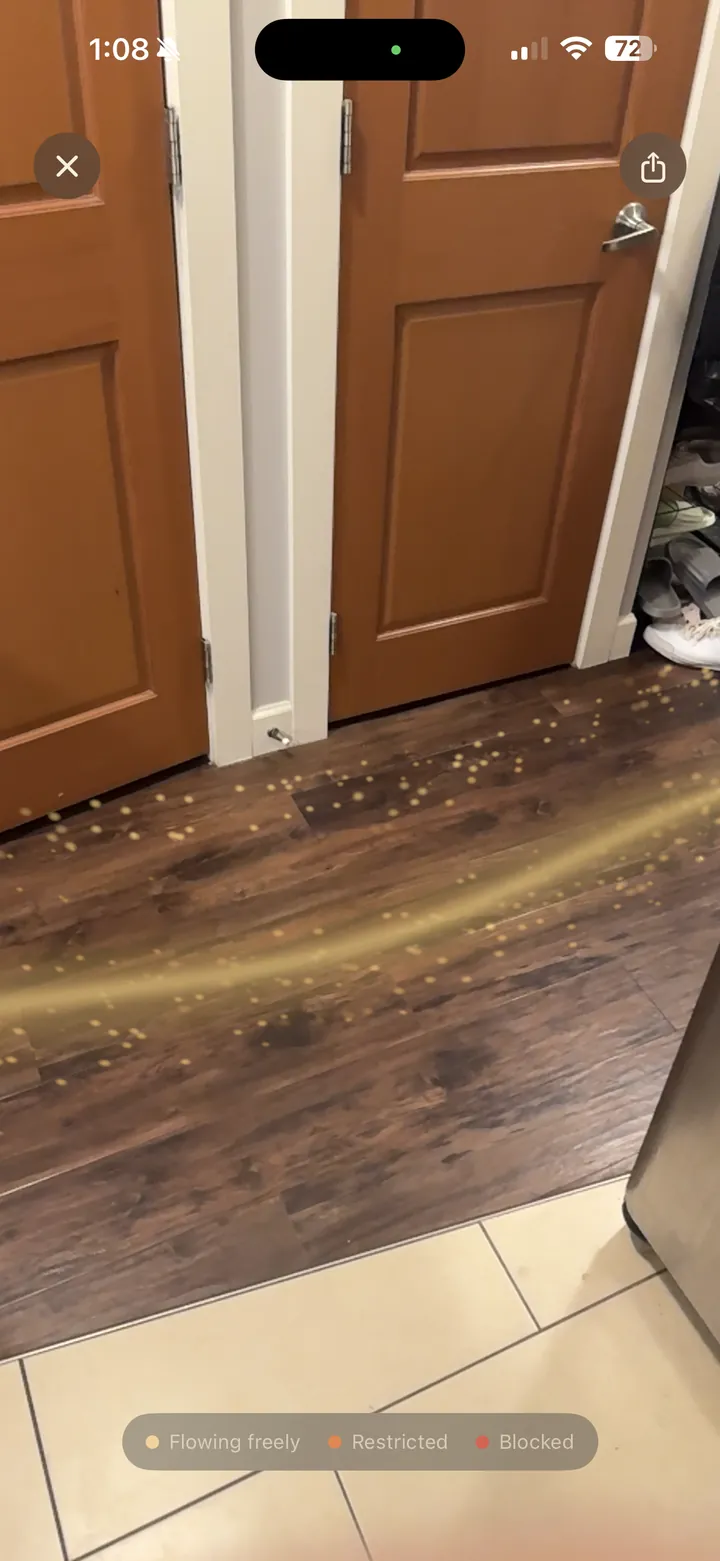
What a scan reads at your entrance, and what it does not
- Not read: staircases. The app does not detect stairs, so a front door facing a staircase will not appear as a finding. That one you check yourself, using this page.
- Entryway blockage: furniture standing in the path just inside the front door, including a remedy placed too close to it.
- Straight line out: the front door lining up with a window or exterior door across the home.
- A straight view from the front door to a bathroom door or into a bedroom.
- A mirror straight across from the front door.
- The flow path from the front door through the rooms on the floor you scanned, so you can see whether the hall leads into them or past them.
Questions
Is it bad Feng Shui to have stairs facing the front door?
Tradition considers it unfavourable, on the reasoning that the flow entering the home runs straight up or down the stairs. Most practitioners treat it as moderate, and milder still when the stairs are set back from the door or off to one side. The standard remedies are a rug, a plant and good light in the hall.
How far should stairs be from the front door?
Practitioners do not agree on a measurement. The closer the first step is to the threshold, the more weight the reading is given. If there is space to come in, close the door and take a few steps before the stairs begin, most would regard it as minor.
What can I put between the front door and the stairs?
A rug or runner laid crosswise is the most common suggestion. In a wider hall, a round table or a plant beside the foot of the stairs is added. Keep the first steps inside the door and the walking line of the stairs clear.
Are stairs going down from the front door worse than stairs going up?
Some teachers think so, since the flow is said to run downhill and away. Others treat the two alike. The remedies are the same in either case.
Should I hang a crystal between the door and the stairs?
Black Hat teachers sometimes recommend a faceted crystal hung between the door and the first step. Classical practitioners generally do not use crystals. It is a matter of which school you follow.
Does it matter if the stairs are to the side of the front door?
Much less. The rule concerns a staircase the door looks straight at. Stairs that begin to one side, run parallel to the hall or sit behind a turn are treated as mild by most practitioners, or not counted at all.