 Feng Shui Scan
What a favorable element is
A BaZi chart is made of eight characters, each belonging to one of the five elements. One of them, the stem of the day pillar, is the Day Master and stands for the person. The reading asks how the Day Master sits among the other seven: supported or outnumbered, fed or drained.
The favorable element is the one that would bring that picture closer to balance. Tradition calls it the useful god. It is not a deity and has nothing to do with worship; "god" is an old translation of a word used for a functional role in the chart.
Two points are often misunderstood. The favorable element is not the element of your Day Master, though in some charts they coincide. And it is not automatically the element you have least of. Both follow from the method below.
The two cycles
Everything depends on how the five elements act on each other.
- Producing: Wood produces Fire, Fire produces Earth, Earth produces Metal, Metal produces Water, Water produces Wood.
- Controlling: Wood controls Earth, Earth controls Water, Water controls Fire, Fire controls Metal, Metal controls Wood.
From any Day Master’s point of view the five elements take five roles: its own element, the one that produces it (its resource), the one it produces (its output), the one it controls (traditionally its wealth), and the one that controls it. For a Fire Day Master these are Fire, Wood, Earth, Metal and Water, in that order.
Step one: how strong is the Day Master?
Strength is a count of how much of the chart is on the Day Master’s side. Two roles count as support: the Day Master’s own element and its resource element.
The count takes in more than the four visible stems. Each branch is said to hold one to three hidden stems, which are added in by conventional weights. The branch of the month pillar is given extra weight, because the month is the season of birth; in the method used here it counts one and a half times.
The season matters in a second way. A Day Master born in a month whose element is its own or its resource is called "in season", and that pushes the judgement toward strong. A Wood Day Master born in spring is the usual example.
The result is one of three verdicts: strong, balanced or weak.
Step two: from strength to favorable elements
Each verdict leads to a different pair of elements.
- Weak Day Master. Said to want support: its resource element and its own element. A weak Wood Day Master is said to favour Water and Wood.
- Strong Day Master. Said to want its energy spent: the element it produces and the element it controls. A strong Wood Day Master is said to favour Fire and Earth.
- Balanced chart. Said to want what is scarce: the element the chart holds least of, together with the Day Master’s output or wealth element.
The elements on the opposite side are usually described as less helpful for that chart. For a weak Day Master those are the ones that drain or control it. Practitioners generally advise not leaning on them, which is different from removing them from your life.
Why two readers can disagree
The method above is often called the support-and-restrain approach. It is the one most introductions teach and the one the app uses. It is not the whole of the tradition.
Professional practitioners weigh things a simple count does not. Stems and branches can combine with each other and are then said to change element. Branches can clash. Some readers adjust for how hot, cold, wet or dry the birth season is. And some charts are treated as special structures, where one element dominates so heavily that the usual rule is said to reverse.
So a practitioner may give you a different favorable element from a calculator, and two practitioners may differ from each other. Treat a calculated result as the standard first reading, and expect a detailed consultation to refine or overturn it.
Using favorable elements at home
Each element has colours, materials and shapes, and this is how a chart reaches a room.
- Wood — greens and teal; living plants, timber, tall columnar shapes.
- Fire — reds, orange and warm pink; warm lighting, candles, triangles and points.
- Earth — yellow, sand and terracotta; ceramics, stone, low square shapes.
- Metal — white, grey, silver and gold; metal objects, round and oval shapes.
- Water — black, navy and deep blue; glass, mirrors, wavy and flowing shapes.
The usual advice is to add your favorable element where you spend long stretches of time: near the bed, on the desk, in the living room. A cushion, a lamp or a plant is the scale intended. Nobody is suggesting a house in one colour.
Each element also has compass directions, covered under favorable directions. How all of this sits alongside the layout of the room is the subject of BaZi and Feng Shui. The short version is that layout comes first: a bedroom is arranged around the bed’s position before any element is added to it.
Three charts, worked through
- A weak Fire Day Master — Little Fire or Wood in the chart, and a birth in winter, when Water is in season. The method gives Wood, the resource, and Fire itself. At home that points to greens, plants, warm lighting and reds.
- A strong Metal Day Master — Plenty of Metal and Earth, born in autumn. The method gives Water, which Metal produces, and Wood, which Metal controls: deep blues and glass, greens and plants.
- A balanced Earth Day Master with almost no Water — Support and opposition are roughly even, so the method looks for what is scarce. Water is the scarcest element here, and it is also the element Earth controls.
- The same birth date without a birth time — The hour pillar is left out and the count is made on three pillars. A borderline chart can move between weak and balanced once the hour is known, so treat the result as provisional.
Common mistakes
- Assuming the missing element is the favorable one — scarcity decides the answer only in a balanced chart. A weak Day Master is given support even if another element is absent entirely.
- Confusing the Day Master with the favorable element — being a Water Day Master does not mean Water is good for you. A strong Water chart is said to favour Wood and Fire.
- Using the year animal’s element — the element attached to your zodiac year is one character of eight and is not the basis of this judgement.
- Treating a calculator’s answer as final — it is the simplified method applied consistently. A chart near a boundary, or one a practitioner would read as a special structure, may be judged differently.
Reading about favorable elements is one thing. Seeing your own chart is another. The count of hidden stems and the weight of the month are slow to do by hand, and a birth near a solar term is easy to place in the wrong month.
SEE YOUR CHART
Enter a birth date, time and place and see the balance of your five elements and the ones your chart is said to favour.
Coming to the App Store · iPhone and iPad · submitted for review
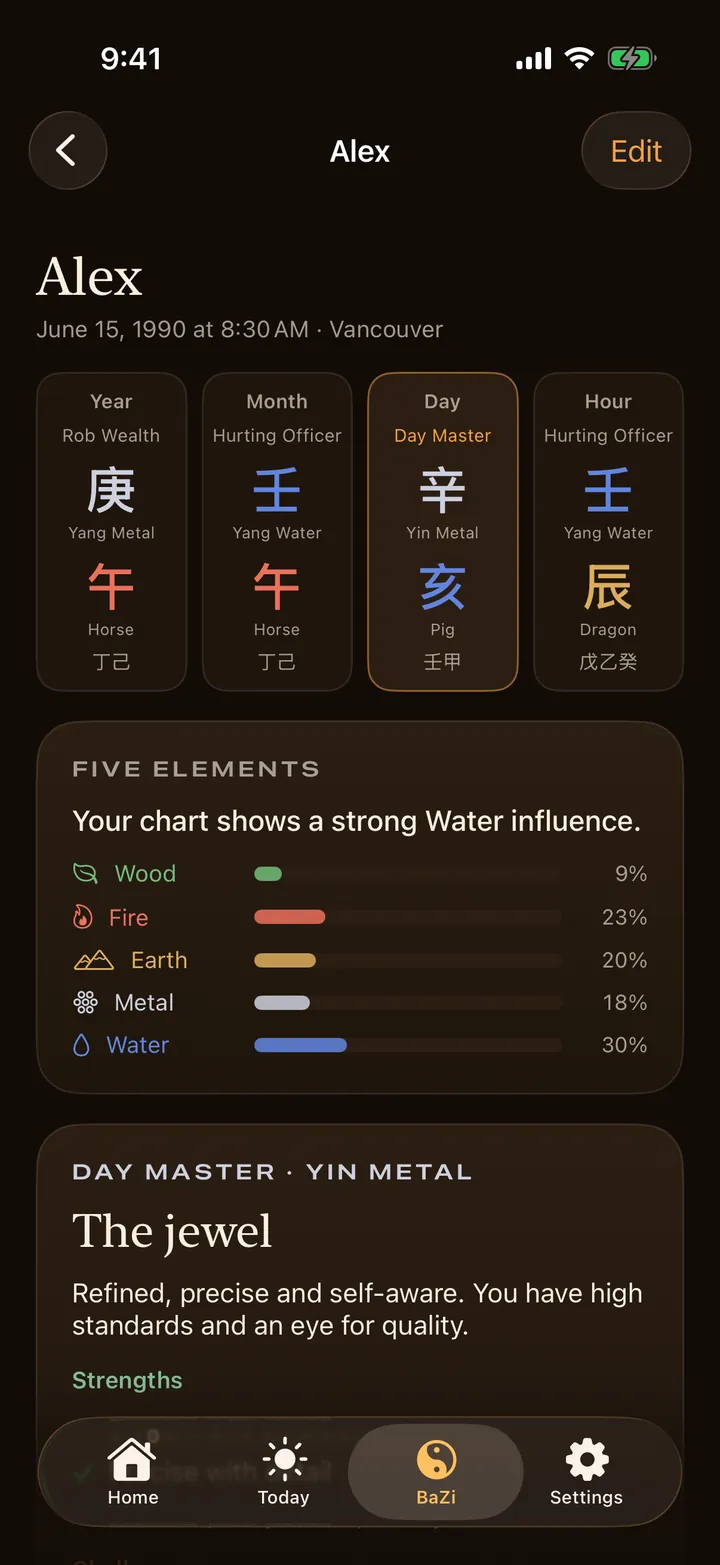
What the app works out from your chart
- The Four Pillars from your birth date, time and place, with the hour pillar left out if you do not know the time.
- The balance of the five elements, counting visible stems and the hidden stems in each branch, with the month branch weighted most.
- Whether the Day Master reads as strong, balanced or weak, and the favourable elements that follow by the method on this page.
- In a scanned home: the colours and materials of those elements as suggestions near each bed and desk, and a note on living rooms, bedrooms and offices that have nothing of them.
- Not read: the colours already on your walls or furnishings. The app also applies one consistent method, so it will not reproduce every school’s judgement of special chart structures.
Questions
What is the useful god in BaZi?
The useful god, yong shen in Chinese, is the element judged to do the most good for a particular chart. In everyday use it means the same as favorable element. The term describes a role in the chart and has no religious meaning.
How do I find my favorable element?
Build the chart, count how much of it supports the Day Master, and decide whether the Day Master is strong, balanced or weak. A weak one is said to favour its own and its resource element, and a strong one the element it produces and the element it controls. A calculator does the counting for you.
Can I have more than one favorable element?
Yes. The common method gives two, and practitioners often rank them as primary and secondary. Some readings also name elements that are neutral for the chart.
Is my favorable element the same as my Day Master's element?
Only sometimes. For a weak Day Master its own element is one of the two favoured. For a strong Day Master it is not, and the favoured elements are the ones that draw its strength off.
Do favorable elements change over time?
The birth chart does not change, so in the simple method the favorable elements stay the same. Practitioners do read each ten-year luck pillar and each year as adding elements of its own, and some adjust their advice for a period on that basis.
Why did a practitioner give me a different element from a calculator?
Most calculators use the support-and-restrain method alone. A practitioner may also consider combinations, clashes, the climate of the birth season and special structures, any of which can change the conclusion.