 Feng Shui Scan
Phases, not substances
The Chinese term is wu xing, and "five elements" is a loose translation. "Five phases" is closer. They are not building blocks in the way the Greek elements were meant to be. They describe kinds of movement: Wood is growth upward and outward, Fire is peak and rising heat, Earth is settling and holding, Metal is contraction and sharpening, Water is sinking and storing.
That is why a colour or a shape can belong to an element. A tall bookcase is not made of anything special, but its upright form is read as Wood. A red cushion is Fire whatever it is stuffed with. Where material and form point different ways, such as a round wooden table, teachers generally say the object carries some of each.
The two cycles
The producing cycle runs Wood, Fire, Earth, Metal, Water and back to Wood. Wood feeds Fire. Fire leaves ash, which is Earth. Earth yields Metal. Metal is said to gather Water. Water grows Wood.
The controlling cycle skips one each time: Wood controls Earth, Earth controls Water, Water controls Fire, Fire controls Metal, and Metal controls Wood. The images are roots breaking soil, a bank holding a river, water on flame, fire melting metal, an axe on timber.
Two working rules follow, and the rest of this page uses both.
- To strengthen an element, add it, or add the one that produces it.
- To temper an element there is too much of, many practitioners prefer the element it produces, which draws it off, over the element that controls it. The controlling element is the firmer measure.
Wood
- Directions: east and southeast.
- Colors: greens and teal.
- Shapes and materials: living plants, wood, tall columnar shapes.
Wood is the element of growth. A room is said to have too much of it when it is all uprights and foliage: floor-to-ceiling shelving, vertical stripes, plants on every surface. Fire draws Wood off, so warm lamps or a little red are the gentler answer. Metal controls it: a round metal tray or white paintwork.
Fire
- Direction: south.
- Colors: reds, orange and warm pink.
- Shapes and materials: warm lighting, candles, triangles and points.
Fire is the most active element and the one tradition uses most sparingly. Too much is described as a room that feels restless or overheated: strong reds on large surfaces, hard lighting, many angular shapes. Earth draws it off, with sand tones, ceramics and low square furniture. Water controls it, through dark blue, glass or a mirror. The kitchen is the room where Fire and Water are most often discussed together, because of the stove and the sink.
Earth
- Directions: northeast, southwest and the centre.
- Colors: yellow, sand and terracotta.
- Shapes and materials: ceramics, stone, low square shapes.
Earth stands for stability. A room heavy with it is the beige-on-beige room: low, wide furniture, thick rugs, stone and pottery, nothing tall. Tradition calls that stagnant. Metal draws Earth off, so white, grey and round shapes lighten it. Wood controls it, and a tall plant is the usual suggestion.
Metal
- Directions: west and northwest.
- Colors: white, grey, silver and gold.
- Shapes and materials: metal, round and oval shapes.
Metal is associated with precision and clearing away. An all-white room with chrome and steel is the standard picture of too much, usually described as cold or stark. Water draws Metal off with dark accents and flowing shapes. Fire controls it, and here the firmer measure is also the pleasant one: warm light and a touch of red or orange.
Water
- Direction: north.
- Colors: black, navy and deep blue.
- Shapes and materials: glass, mirrors, wavy flowing shapes.
Water stands for depth and movement downward. Too much is a dark room with large mirrors and a great deal of glass, said to feel unanchored. Wood draws it off, which is one reason plants are so often suggested for bathrooms. Earth controls it, through terracotta, stone and square forms.
Where the elements sit in a home
The directions above belong to the compass schools: each of the eight directions carries an element, and so does the centre. The Bagua uses the same pairings for its nine areas. Family is Wood and so is Wealth; Fame is Fire; Relationships, Knowledge and the central Health area are Earth; Children and Helpful People are Metal; Career is Water.
This is where the traditional colours for the wealth corner and the love corner come from. It is also where the schools divide. The Black Hat school lays those nine areas out from the front door, so its Wood corner may not be in the east at all. Compass practitioners keep each element to its direction. The Bagua map shows both layouts over one plan.
When your own chart changes the answer
Everything so far treats a room on its own terms. BaZi adds the person. A Four Pillars chart built from a birth date, time and place is read for the balance of its five elements, and from that practitioners name the elements the chart is said to favour. The method is set out under favorable elements, and the BaZi calculator works it out for you.
The two layers can pull apart. A north-facing study is a Water room by direction, while the person who works in it may have a chart said to favour Fire. Practitioners differ on which to follow. A common approach is to leave the room’s layout alone and bring the personal element in through objects near where you sit or sleep. Each element also has directions said to suit a chart.
Eight Mansions uses a different personal number and gives different advice again. These are separate systems, and no agreed rule ranks them.
Using the elements without redecorating
- Take stock first. Go round one room and name what is already there. Most rooms hold plenty of Earth and Wood through sofas, rugs and timber furniture, and little Fire or Water.
- Work on one element at a time. Decide what the room is short of, or heavy with, and change only that.
- Use accents, not walls. A cushion, a lamp, a vase, a plant or a picture frame carries an element as well as a coat of paint does, and can be moved if it looks wrong.
- Count shape and material as well as colour. A round mirror is Metal in shape and Water in substance. A green ceramic pot is partly Wood and partly Earth.
- Stop early. Five elements in every room is not the goal. The goal is a room with a clear character and nothing overwhelming it.
None of this replaces where the furniture stands. Layout is the first question in every school. The elements are a finishing layer.
Four rooms, read by element
- A white kitchen with steel appliances — Heavy Metal, with Fire and Water from the stove and sink. A wooden board, a pot of herbs and a warm bulb over the table add Wood and Fire without changing a cupboard.
- A living room in beige and oatmeal — Nearly all Earth. One tall plant and a single round metal lamp bring in Wood and Metal. Leave the sofa where it is.
- A study with dark blue walls and glass shelves — Water throughout. A terracotta pot or a square stone bookend adds Earth to steady it, and a desk lamp with a warm bulb adds a little Fire.
- A bedroom for someone whose chart is said to favour Metal — White bedding, a round bedside table or a brushed-metal lamp. No need to repaint or to remove the wooden bed.
Common mistakes
- Treating colour as the whole of it — shape and material carry an element too. A room can be painted green and still hold very little Wood.
- Reaching for the controlling element first — Water on a Fire problem is the blunt tool. The element that draws the excess off, here Earth, is the one teachers usually suggest first.
- Adding all five to every room — the result is clutter with a theory attached.
- Mixing the door Bagua and the compass — taking the wealth corner’s Wood from one map and the north’s Water from the other gives contradictory instructions for the same wall.
- Using the zodiac year’s element as "your element" — a BaZi reading works from the whole chart, and the favoured elements often differ from the year’s.
Naming the elements in a room is easy once you know the list. Knowing which of them your own chart is said to favour, and which of your rooms has none of it, takes a chart and a plan side by side.
MAKE YOUR HOME PERSONAL
Add a birth chart to a scanned home and see which elements it is said to favour, and which of your rooms have nothing of them.
Coming to the App Store · iPhone and iPad · submitted for review
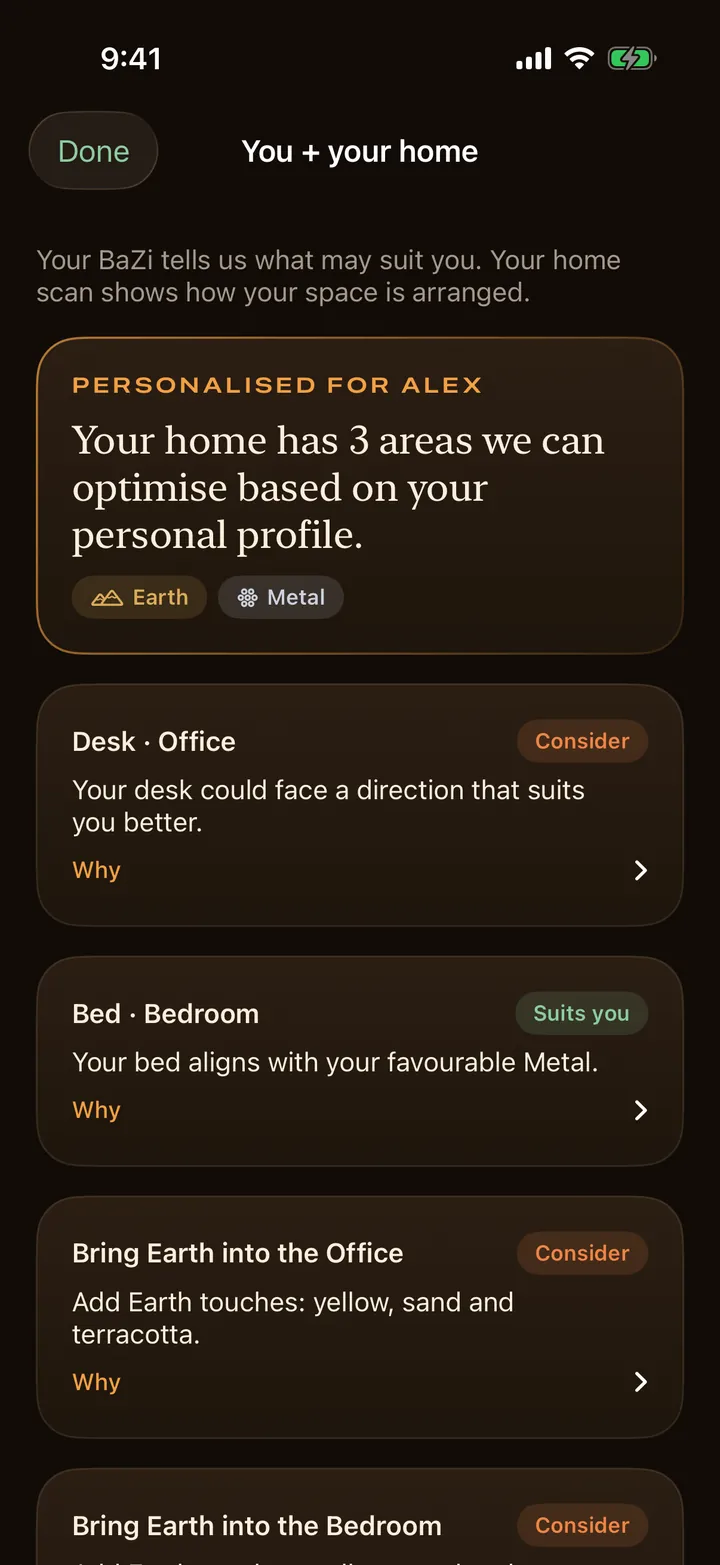
What the app does with the five elements
- Builds a Four Pillars chart from a birth date, time and place, and shows the balance of its five elements and the ones it is said to favour.
- Notes which element common furniture carries in a scanned room: plants and wooden furniture as Wood; lamps, a stove or a fireplace as Fire; rugs and sofas as Earth; mirrors as Metal and Water; sinks and baths as Water.
- With a chart, flags living rooms, bedrooms and offices that have nothing of a favourable element, and suggests colours and materials to add.
- With a compass heading, notes which sector each bed and desk sits in and which way you face, against your favourable elements.
- Lays the Bagua over the plan, by entrance or by compass, so you can see which area each room falls in.
- Not read: the colours already on your walls, floors or furnishings. The app works from the furniture it detects, not from paint or fabric.
Questions
What are the five elements in Feng Shui?
Wood, Fire, Earth, Metal and Water. They are better understood as phases or kinds of movement than as physical substances, and each is linked to particular colors, shapes, materials and compass directions.
What colors go with each Feng Shui element?
Wood takes greens and teal. Fire takes reds, orange and warm pink. Earth takes yellow, sand and terracotta. Metal takes white, grey, silver and gold. Water takes black, navy and deep blue.
Which element is my home missing?
Go through a room and note the colours, shapes and materials in it against the five lists. Most homes have plenty of Earth and Wood from soft furniture and timber, and less Fire or Water. Tradition does not require every room to contain all five.
How do I find my personal element?
In BaZi it comes from a Four Pillars chart built from your birth date, time and place. The chart is read for how its elements balance, and the favoured elements follow from that. Eight Mansions uses a different method based on a Kua number, and the two can give different answers.
What is the difference between the producing and controlling cycles?
In the producing cycle each element feeds the next: Wood, Fire, Earth, Metal, Water, then Wood again. In the controlling cycle each restrains another: Wood controls Earth, Earth controls Water, Water controls Fire, Fire controls Metal and Metal controls Wood.
Can two elements clash in one room?
Tradition reads elements next to each other in the controlling cycle, such as Fire and Water, as a clash when they are placed side by side. The usual remedy is to put the element that lies between them in the producing cycle in the gap, which for Fire and Water is Wood.