 Feng Shui Scan
Why Feng Shui is wary of bathrooms
In Feng Shui water is associated with wealth and with the movement of a home’s flow. A bathroom is full of drains, and each is read as a point where that flow runs out of the building. A room whose purpose is to carry things away is treated with caution wherever it sits.
A sceptic can find ordinary reasons under the symbolism. Bathrooms are damp, they smell, and they are noisy at night, and none of that is welcome next to where you eat or sleep. The traditional rules line up closely with what a careful architect would do anyway.
Modern practitioners tend to read the rules as being about containment. A bathroom that is clean, dry, ventilated and behind a closed door is considered dealt with. The rest of this page is the detail of that.
The bathroom door
Most bathroom Feng Shui is about the door, because the door decides what the room is connected to.
- Keep it closed. This is the one piece of advice nearly every teacher gives. An open bathroom door is said to let the home’s flow drain into the room.
- Facing the front door. A bathroom door in a straight line of sight from the front door is considered one of the more serious layout faults: the flow is said to enter and go directly down the drain. Keeping the door shut is the first remedy. A screen, a curtain or a piece of furniture that breaks the line is the second.
- Facing a bed. A bathroom door, en-suite or otherwise, that opens toward the bed is disliked, and the advice is the same as for the bedroom door itself. The bedroom page covers where the bed should stand in relation to doors.
- Facing the kitchen. A bathroom opposite the stove or the kitchen door sets drains against the place food is prepared. See the kitchen page; again, a closed door is the answer.
- Facing another door. Two doors directly opposite each other across a hall is its own topic, covered under door facing door.
The toilet
The toilet is the largest drain in the home and gets the most attention. Two rules are common to almost every teacher.
Keep the lid down. It is the smallest remedy in Feng Shui and probably the most widely repeated. It is also good hygiene.
Keep it out of the doorway’s line of sight. A toilet that is the first thing you see when the bathroom door opens is considered the weakest arrangement. Tucked behind the door’s swing or beside the basin is preferred. Since a toilet cannot be moved without a plumber, the practical answers are a door that stays closed, a shower curtain or screen drawn across the view, or a half-height partition if you are renovating anyway.
Many practitioners also dislike a toilet on the other side of the wall from a headboard. If that describes your bedroom and the bed can go on another wall, that is the suggested move. If not, a solid headboard is the usual advice.
Mirrors
Every bathroom has a mirror, and the tradition does not ask you to remove it. The guidance is about what it reflects. A mirror that shows the toilet is avoided by many teachers, on the reasoning that a mirror doubles what it sees. One over the basin, reflecting light or a window, is not considered a problem.
One remedy divides the schools. Black Hat teachers often recommend a full-length mirror on the outside of the bathroom door, to turn the home’s flow away from the room. Classical practitioners generally do not use it, and some object that it puts a mirror facing a hallway, another door or a bed. If you try it, check what that mirror ends up reflecting.
En-suites, and a bathroom at the centre
An en-suite puts a bathroom inside the bedroom, which older homes never did. The advice is unchanged but matters more: close the en-suite door at night, keep the lid down, and place the bed so it does not look into the bathroom.
The location the tradition likes least is a bathroom in the middle of the home. On the Bagua map the centre is associated with the health of the household and with the Earth element, and a room of drains there is said to weaken it. Nothing short of rebuilding moves it, so practitioners turn to the elements. Earth is the element that controls Water, so the suggested counterweights are Earth materials and colours: stone, ceramics, sand and terracotta tones.
In a house with more than one floor, some teachers also caution against a bathroom directly above the front door or the stove. That is a matter of how the home was built, covered under home layout.
Plants, Earth and a small bathroom
Two elements are used to balance a bathroom’s Water. Wood draws on Water, so living plants are a frequent suggestion, provided the room has enough light to keep them alive. Earth holds Water back, which is why stone, tile and earthy colours are recommended. The schools agree on these more than on most things. If you follow BaZi, your own favorable elements may shift the choice of colour.
A small bathroom needs the same things any small room does:
- A door that opens fully. Nothing stored behind it, nothing hanging on it that stops it.
- A clear floor. A laundry basket, scales and a bin can take up most of the standing room.
- Dry and aired. Use the window or the fan, and fix a dripping tap. The tradition reads a drip as a slow loss, and the water bill agrees.
Bathrooms you can't move
- The bathroom door is the first thing the front door shows — Keep that door closed as a habit, and add a self-closing hinge if people forget. If the hall is wide enough, a narrow console or a plant on the line between the two doors breaks the view.
- An en-suite whose door faces the bed — Close it every night. If the door is glass or missing, hang a curtain across the opening, and place the bed off the door’s line where the room allows.
- A bathroom with no window in the middle of a flat — Lean on Earth: stone or ceramic accessories, towels in sand or terracotta tones. Use the fan, leave the light on a short timer, and choose a plant that tolerates low light or skip plants altogether.
- A toilet directly opposite the bathroom door — Keep the lid down and the door shut. If a shower curtain or screen can be drawn so that it hides the toilet from the doorway, use it.
Common mistakes
- Buying remedies and leaving the door open — crystals and plants are secondary. A closed door and a closed lid are the remedies nearly all teachers agree on.
- A plant in a room with no daylight — a dying plant is considered worse than none. Use Earth materials there instead.
- A mirror on the outside of the door without checking what it faces — it may now reflect the front door or a bed, which trades one caution for another.
- Storing things in the hall outside the bathroom — a laundry basket or shelf unit beside the door narrows the passage everyone uses.
Reading about Feng Shui bathroom layouts is one thing. Seeing your own home is another. Whether your front door has a straight view to the bathroom door depends on exactly where the two openings sit, and that is easier to see on a plan than from the doormat.
SCAN YOUR HOME
Walk your home from the front door and see whether the entrance looks straight at a bathroom, and how the flow passes it.
Coming to the App Store · iPhone and iPad · submitted for review
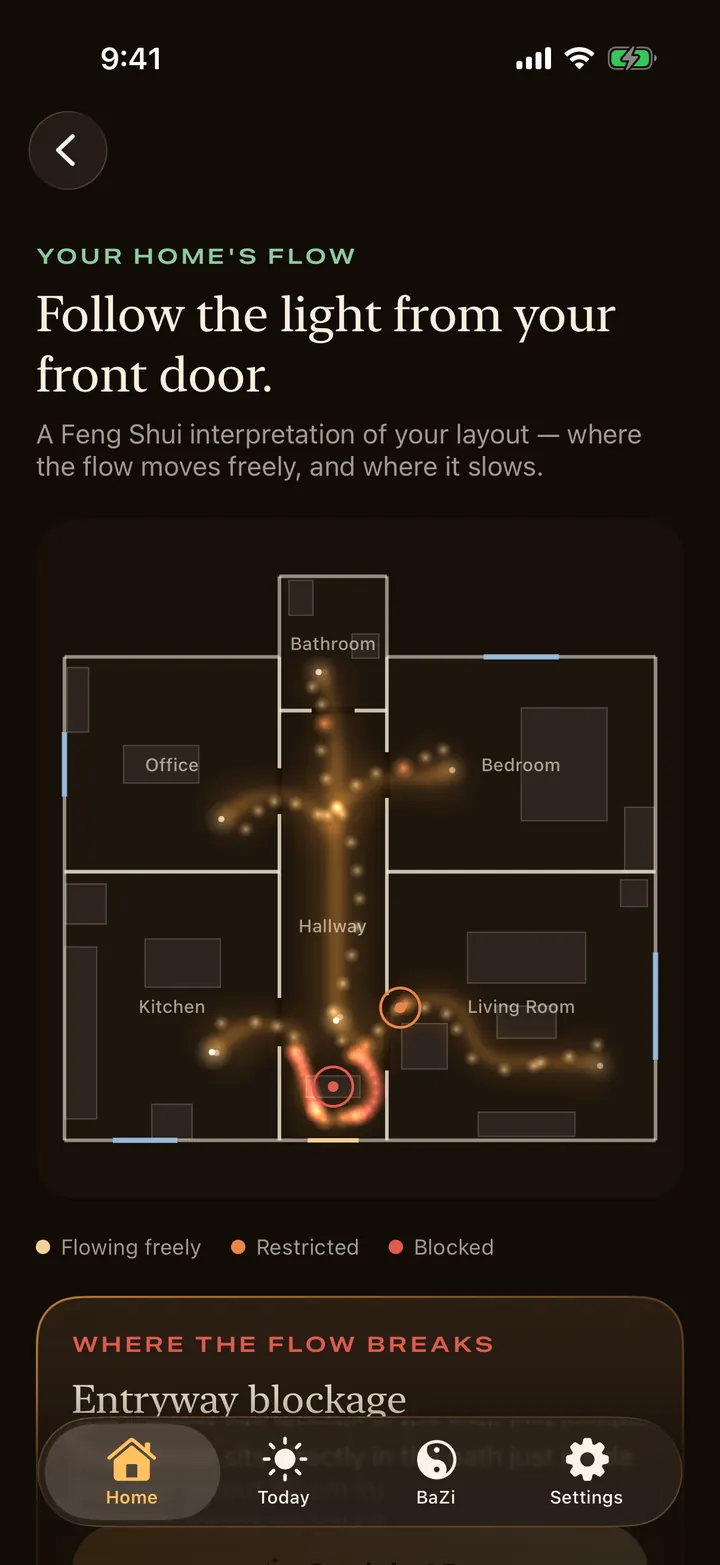
What a scan reads about your bathroom
- Whether the front door has a straight view to a bathroom door. This is raised as its own finding.
- The path the flow takes from the front door through the home, so you can see whether it runs toward the bathroom or past it.
- Narrow passages and furniture blocking the route outside the bathroom.
- Whether the bathroom is connected to the rest of the plan.
- With the Bagua map laid over your floor plan: which area the bathroom falls in.
- Not read: where the toilet sits inside the bathroom, the lid, mirrors in or on the bathroom, or whether a bathroom door faces a bed or the kitchen. Only the front door’s view of a bathroom door is checked.
Questions
Is it bad Feng Shui if the bathroom faces the front door?
It is considered one of the less favourable layouts, because the flow entering the home is said to run straight to the drains. The remedy is to keep the bathroom door closed and, if there is room, to put something between the two doors that breaks the line of sight.
Should the bathroom door always be closed?
That is the advice nearly every teacher gives. It is the main remedy for almost every bathroom concern, along with keeping the toilet lid down.
Where should the toilet be in a Feng Shui bathroom?
Out of the direct view from the bathroom doorway, ideally behind the door's swing or to one side. In an existing bathroom where it cannot move, a closed door and a curtain or screen that hides it are the usual substitutes.
Is a mirror facing the bathroom door a problem?
Opinions differ. Many teachers prefer a bathroom mirror not to face the door or reflect the toilet. Black Hat practitioners sometimes place a mirror on the outside of the door, which classical practitioners do not recommend.
What can I do about a bathroom in the centre of the home?
The traditional counterweight is the Earth element: stone, ceramics and earthy colours such as sand and terracotta. Keep the room clean, dry and ventilated, and the door closed.
Are plants good in a bathroom?
They are a common suggestion, since the Wood element is said to draw on the room's Water. They only help if they are healthy, so in a bathroom without daylight most practitioners suggest Earth materials instead.