 Feng Shui Scan
How to use it
Imagine your floor plan with the front door wall at the bottom. In door mode, say whether the door is on the left, centre or right of that wall; the highlighted square is the one you walk in through. In compass mode, say which way the front door faces. Tap any square to read what the area is associated with, its element, its traditional colours, and the usual advice for it.
The front-door method
This is the layout taught in the Black Hat school, the form of Feng Shui most widely known in the West. The plan is divided into a three-by-three grid, stretched to fit the home’s outline. The row along the front door wall is, left to right, Knowledge, Career, and Helpful People and Travel. The middle row is Family, Health, Children and Creativity. The far row is Wealth, Fame and Reputation, Love and Relationships.
So the wealth corner in this method is always the far left corner from the front door, and the love corner is the far right. It takes no compass and works the same in any building, which is much of its appeal.
The compass method
Older, classical practice assigns each of the eight outer areas to a direction: Career to the north, Knowledge to the northeast, Family to the east, Wealth to the southeast, Fame to the south, Relationships to the southwest, Children to the west, Helpful People to the northwest, with Health at the centre. Here the wealth area is the southeast part of the home wherever the door happens to be.
The two methods agree only when the front door faces north. Otherwise they give different maps of the same home. Practitioners of each school consider their own correct, and there is no neutral way to settle it. Choose one and use it consistently; mixing them produces a map that follows neither.
What to do with the map
Tradition’s advice for each area is modest: keep it clear, light it well, and put there the things that belong to it. A plant in the wealth area, books in the knowledge area, pairs of objects in the relationships area. What matters more in practice is whether an area is missing, in a home with an L-shaped plan, or occupied by a bathroom or a storeroom, which is discussed under reading a floor plan.
The Bagua is a way of assigning meaning to parts of a home. It does not replace the form-school questions about the layout itself: whether the entrance is clear and whether the path through the rooms is open.
A square grid is easy to draw over a square. Real homes have notches, extensions and rooms that straddle two areas.
SEE IT ON YOUR FLOOR PLAN
Scan your home and the app lays the Bagua over your real plan, room by room.
Coming to the App Store · iPhone and iPad · submitted for review
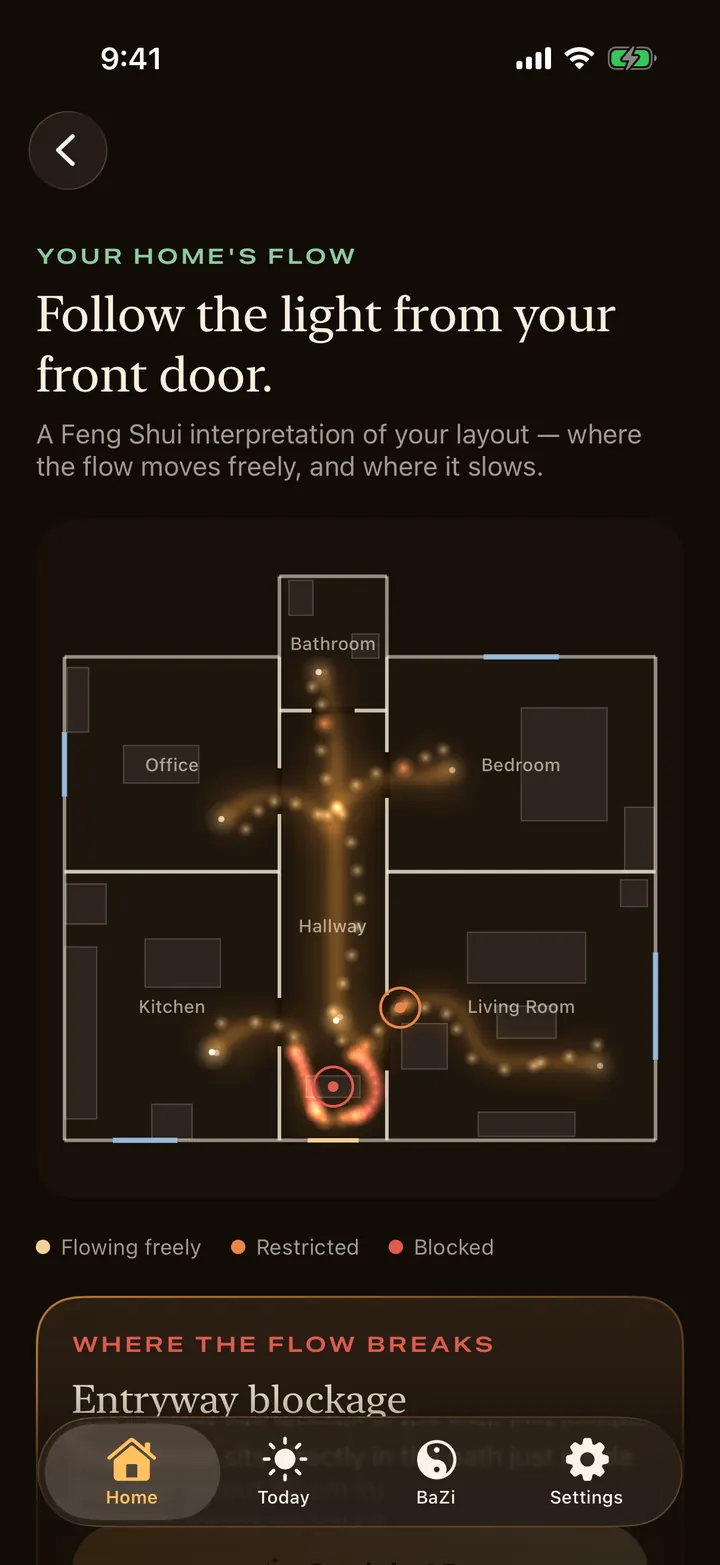
What the app does with the Bagua
- Lays the grid over the floor plan you scanned, stretched to its real outline.
- Offers both methods: by entrance, and by compass, using the heading recorded during the scan.
- Shows which rooms fall mostly in which area.
- Marks an area as missing when less than half of its cell is floor.
- Not read: the app does not judge what you have placed in an area or how it is decorated.
Questions
Where is the wealth corner of my home?
By the front-door method, it is the far left corner as you stand at the front door looking in. By the compass method, it is the southeast part of the home. The two only coincide when the door faces north.
Which Bagua method is correct?
They belong to different schools, and each school holds to its own. The front-door method is simpler and needs no compass. The compass method is older. Pick one and apply it consistently.
Do I apply the Bagua to the whole home or to each room?
Both are taught. Most people start with the whole home, aligned to the front door, and then apply the same grid to a single room from that room's door if they want more detail.
What does a missing area mean?
In an L-shaped or notched plan, one square of the grid falls partly or wholly outside the home. Black Hat teaching treats that as a weakness in the corresponding part of life and suggests remedies such as a light or a plant to fill the corner. It is a traditional reading, not a prediction.