 Feng Shui Scan
The sofa: a wall behind, the entrance in view
The form school applies the same idea to seating that it applies to a bed or a desk. The person sitting should have something solid behind them and should be able to see who comes in. For a living room that means the largest sofa stands against a wall, not a window or an open walkway, and faces or half-faces the room’s entrance.
There is an ordinary reason behind it. People settle less easily in a seat where others pass behind their head, and a sofa with its back to the doorway makes everyone on it turn around when someone walks in.
Two cases come up constantly:
- The sofa has to float. In a large or open room the sofa often sits in the middle to divide the space. The usual remedy is to give it a back of its own: a console table, a low bookcase or a row of tall plants directly behind it.
- The only wall for the sofa is under the window. A window is read as weaker support than a wall. A sofa with a high, solid back and a blind or curtain you can close in the evening is the common answer.
Both cases, and L-shaped sofas, are taken further on the sofa placement page.
Seats that face each other
A living room is where a household talks, and Feng Shui reads the seating as a picture of that. Seats placed in a row facing a screen are treated as a room for watching. Seats in a loose circle or U, each able to see the others, are treated as a room for people.
In practice: put a chair or a second sofa at a right angle to the main one or opposite it, close enough that nobody has to raise their voice. Avoid leaving one seat stranded across the room, and avoid a single chair with its back to the doorway if it can be turned.
Seats do not have to match or be symmetrical. The point is that no one is left out of the group and no one has their back to the entrance without something behind them.
The coffee table and corners aimed at seats
Sharp corners pointing at a place where someone sits are called poison arrows. In a living room the usual sources are the corner of a square coffee table, the edge of a shelving unit, a projecting wall corner, or a sideboard standing at an angle.
Round and oval coffee tables are often recommended for this reason, and for a second one that needs no tradition: people stop walking into them. A rectangular table is not a fault. Check where its corners point when the seats are occupied, leave enough room to walk between table and sofa without turning sideways, and keep the table lower than the seat cushions so it does not form a barrier in the middle of the group.
For a corner that cannot move, such as a structural pillar, practitioners usually suggest softening it with a tall plant or a piece of furniture placed in front.
Walkways through the room
Most living rooms are also corridors. People cross them to reach the kitchen, the balcony or the bedrooms, and form-school Feng Shui reads the route they take as the path the home’s flow follows. That path should curve through the room without squeezing between two pieces of furniture or stopping at the back of a chair.
Walk the routes you use every day. If you turn your shoulders to pass the armchair, or step around the end of the sofa to reach a door, the furniture is cutting the path. Moving one piece along the wall usually does more than buying a smaller one. The floor plan self-check asks about this among its twelve questions, and home layout covers how the living room should connect to the rooms around it.
A living room with furniture over most of its floor reads as crowded however good each piece is. Taking one out is the standard advice.
The TV, mirrors and plants
The TV. The classical texts were written long before television, so there is no traditional rule for it. Modern practitioners differ: some treat a dark screen like a mirror, some advise not making it the focus of the seating, and many say nothing. A sensible reading is to choose where the sofa goes first and fit the screen to it, not the other way round.
Mirrors. A mirror is said to double whatever it reflects, so the question is what it shows. One reflecting a window with a view or the dining table is usually liked. One reflecting a cluttered corner is not, and one straight across from the front door is said to send the flow back out before it has entered the home.
Plants. Living plants stand for the Wood element and are a common suggestion for empty corners and for softening sharp edges. Some practitioners advise keeping spiky plants away from seats. A plant that is dying is better replaced than kept. If you follow a BaZi approach, whether Wood suits you personally depends on your favorable elements.
When the front door opens into the living room
Many flats have no hall: the front door opens straight into the living space. Traditional Feng Shui prefers a pause between the door and the room, and the usual way to make one is with furniture. A rug inside the door, a console against the side wall, or a bookcase or screen standing at right angles to the door all mark out an entryway where the plan does not provide one.
Two things to avoid. Do not put the back of the sofa hard up against the door’s swing, where it becomes a blocked entryway. And look at what the front door lines up with: a balcony door or large window directly opposite is read as the flow running straight through the room and out again. A piece of furniture, a plant or a curtain placed on that line is the usual remedy.
Living rooms that don't cooperate
- A long, narrow room with doors at both ends — Put the sofa on one long wall and keep the walkway along the other, so the route runs past the seating instead of through it. A chair at right angles to the sofa closes the group without closing the path.
- The sofa can only go under the window — Choose a sofa with a high solid back, hang a curtain or blind you close at night, and place an armchair against a solid wall so at least one seat has full backing.
- An open-plan room where the sofa divides living from dining — Stand a console or low bookcase behind the sofa to act as its wall, and angle the seating so it sees the front door.
- A square coffee table whose corners meet both sofas — Turn the table forty-five degrees and check again from each seat, or swap it for a round one. Either takes the points off the people sitting down.
Common mistakes
- Arranging the room around the screen — every seat faces the TV and none faces another. Fix the seating for people first, then find the wall the screen fits on.
- Pushing everything against the walls — it gives each seat backing but leaves people too far apart to talk. Bring the secondary seats in and let only the main sofa keep the wall.
- A mirror opposite the front door — hung there to make a small room look bigger. A side wall gives the same effect without facing the door.
- Blocking the walkway to keep the sofa symmetrical — a centred sofa that makes everyone squeeze past its arm is worse than one a little off-centre.
Reading about Feng Shui living room layouts is one thing. Seeing your own living room is another. Whether the armchair narrows the way to the balcony, or which seat the table’s corner points at, is hard to judge from the sofa you sit on every day.
SCAN YOUR LIVING ROOM
Map the room with your phone and see where the flow from the front door runs, where furniture cuts it, and which corners point at your seats.
Coming to the App Store · iPhone and iPad · submitted for review
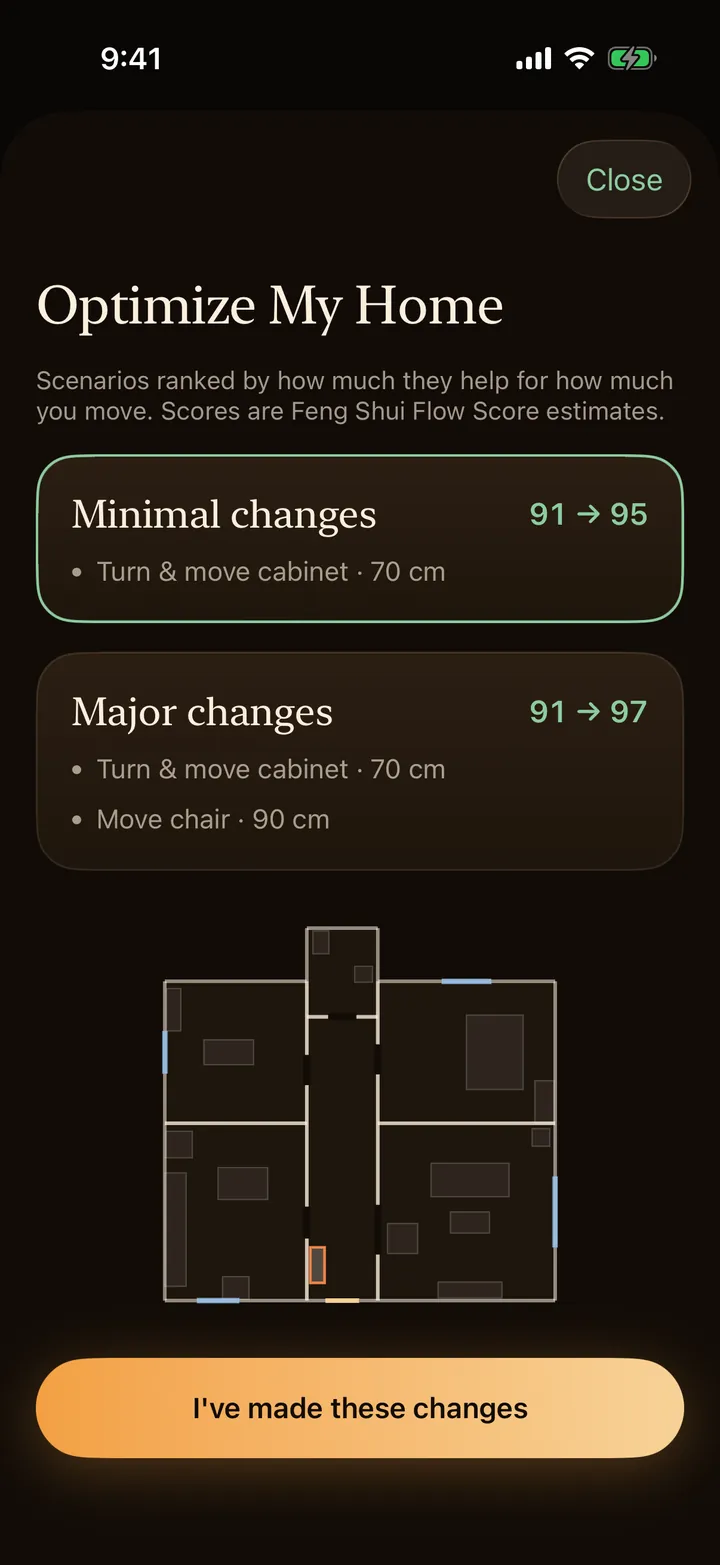
What a scan reads in your living room
- Furniture that narrows or cuts the path the flow takes through the room, and any pinch point along it.
- How much of the floor is covered by furniture, which is what makes a room read as crowded.
- Sharp corners of furniture aimed at a sofa.
- When the front door opens into the room: furniture standing just inside it, a mirror straight across from it, and whether the door lines up with a window or outside door opposite.
- Suggested furniture moves, which you can preview in AR before lifting anything.
- With your BaZi chart: a note if the room has nothing of your favourable elements in it.
- Not read: whether the sofa has a wall behind it or sees the entrance (that check is made for beds and desks), where the TV is, what a mirror elsewhere in the room reflects, or your plants.
Questions
Where should a sofa go in Feng Shui?
Against a solid wall, in a spot where the people sitting on it can see the room's entrance. If the sofa has to stand in the middle of the room, a console table or low bookcase behind it is the usual substitute for a wall.
Is it bad Feng Shui to have a sofa with its back to the door?
It is considered a weak position, because the people on it cannot see who comes in. Turning the sofa is the first choice. If the room does not allow it, a piece of furniture behind the sofa and a mirror on a side wall that shows the doorway are the common workarounds.
Where should the TV go in a Feng Shui living room?
Traditional Feng Shui has no rule for televisions. Modern practitioners disagree: some treat a dark screen like a mirror and some do not mention it. The practical approach is to place the seating first and then put the screen where it can be seen without turning the seats away from each other.
Is a round coffee table better than a square one?
Round and oval tables are often recommended because they have no corners to point at the people sitting around them. A square or rectangular table is acceptable if its corners are not aimed at a seat and there is room to walk past it.
Should a living room mirror face the window?
A mirror reflecting a pleasant view or daylight is generally liked. The position most teachers warn against is straight across from the front door. Beyond that, the usual advice is simply to check what the mirror shows.