 Feng Shui Scan
Head or feet: what "bed direction" means
"Which way does the bed face" can be read two ways, and they are exact opposites. Most teachers of compass Feng Shui measure the direction the crown of your head points when you lie down, which is the wall the headboard stands against. Some measure where the feet point instead. Everyday speech tends to follow the second: a bed "facing the window" has its foot towards the window.
This page uses the head. A bed with its headboard on the east wall has an east direction here, whatever is at its foot. The app uses the same convention.
Before following any chart, check which one it means. Advice written for the feet and applied to the head turns the bed the wrong way round.
Bed direction is also not the same as where the bedroom is. A room in the north of the home is in the north sector whichever way the bed points, and BaZi favorable directions explains how each reading is used.
Form school gives no direction
The form school reads shape and movement, not compass points. For a bed it asks three things: can you see the door, is the headboard on a solid wall with no window behind it, and are you out of the door’s direct line. A bed that passes all three is in the command position, set out in the bedroom layout guide.
Nothing in that depends on north. A form-school practitioner asked which direction a bed should face will answer with the door, and there is an everyday reason for it: a bed that sees the door is easier to settle in than one with the door behind your head. If the form school is all you follow, check the position with the bed placement tool and stop here.
Eight Mansions and BaZi: two compass answers
Compass schools add a personal direction on top of the form rules. Two methods are in common use, and they start from different information.
Eight Mansions works out a Kua number from your birth year and sex. Each number belongs to an East or a West group and has four directions said to suit it and four said not to. For a bed, the usual application is to point the head toward one of the four good ones. The Kua number calculator gives yours.
BaZi reads the full birth chart, with year, month, day and hour, and from it the elements the chart is said to favour. Each element belongs to compass directions: east and southeast to Wood, south to Fire, northeast and southwest to Earth, west and northwest to Metal, north to Water. The head points toward a direction that belongs to a favourable element. How those elements are found is covered under favorable elements.
Because one method uses the year alone and the other the whole chart, they can give different directions for the same person. The practical course is to choose one method and stay with it, not to average the two.
The folk rules about north and the door
A third group of rules travels without any calculation: never sleep with your head to the north, always sleep with it to the south or the east, never sleep with your feet toward the door.
These do not come from one tradition. An aversion to the head pointing north is well known in Japanese custom and in Indian Vastu, which is a separate system from Chinese Feng Shui. In the compass methods above, north is simply one of eight directions. It is among the four good ones for an East-group Kua number and it belongs to Water in BaZi, so it is recommended to some people and not to others.
"Feet to the door" has nothing to do with the compass. It is the form-school caution about a bed lying in line with the doorway, explained under bed facing the door.
If a rule arrives with no method behind it, treat it as custom. Keep it if it matters to you or your family.
How to measure your bed’s direction
A phone compass is enough.
- Stand beside the bed at the pillow end, a step away from the frame.
- Hold the phone flat and turn until its top edge points the way the top of your head points when you lie down, which is straight at the headboard wall.
- Read the heading in degrees.
- Repeat from the other side of the bed, and again from the middle of the room.
Metal pulls a compass off. A steel bed frame, a sprung mattress, a radiator or a magnetic phone case can each shift a reading, which is why you stand clear of the bed. If the three readings agree within a few degrees, use them.
Each of the eight directions covers forty-five degrees. North runs from 337.5 to 22.5, northeast from 22.5 to 67.5, and so on. A reading within a few degrees of a boundary is uncertain.
Check also whether your compass shows true north or magnetic north. A traditional luopan reads magnetic north, and in some places the two are far enough apart to matter near a boundary.
When partners differ, or the room says no
Two people share one bed and it has one direction. Compass methods have no single answer to this. Common approaches are to favour the person whose rest is the greater concern, or to give one partner the bed and the other the direction they face at a desk.
More often the limit is the room. The favoured wall has the door in it, or the window, or the wardrobe. Here most practitioners agree on a priority: the command position beats direction. A bed turned to a favourable heading with the door behind the pillow is not considered an improvement.
When the direction cannot be had, BaZi-based practice brings the element in through colour and material near the bed instead. If moving the bed to the next wall gains a favoured direction and keeps the door in view, do it. In a room with one possible position, as on the small bedroom page, direction is the first thing to let go.
Directions in real bedrooms
- Headboard on the north wall, Kua number in the West group — North is not one of the four good directions for that group. If the west wall can take the headboard and still shows you the door, use it. If it cannot, leave the bed where it is and apply the direction at a desk.
- Two partners, one East group and one West — No wall suits both. Decide whose direction the bed takes, and let the other person have theirs at the desk or the chair they use most.
- Favourable element Fire, and the south wall is all window — The head would point south only with the headboard under glass. Keep the solid wall, and bring Fire in through colour near the bed, such as a red or orange throw.
- Readings of 20 and 26 degrees at the same bed — They fall either side of the line between north and northeast. Take another reading outdoors, along the wall the headboard stands on. If it still sits on the line, treat the direction as undecided.
Common mistakes
- Mixing head and feet conventions — a chart that names bed direction by the feet gives the opposite answer. Find out which it uses before you move anything.
- Reading the compass on the mattress — springs and a metal frame sit directly under the phone. Stand clear of the bed and take three readings.
- Running every method until one agrees — Kua, then BaZi, then a folk rule, until something approves the wall you already wanted. Pick one method first.
- Giving up the door for a direction — the rule most schools share is traded for one that depends on which school you ask.
- Treating "never north" as Feng Shui — it is a custom from other traditions. Compass Feng Shui recommends north to some people.
A direction on a chart is only useful once you know which way your own bed points, and whether the wall you would turn it to still shows you the door. Most people guess the first and have not checked the second.
SCAN YOUR BEDROOM
Scan the room and see which way your head points in bed, which sector the bed sits in, and whether it still sees the door.
Coming to the App Store · iPhone and iPad · submitted for review
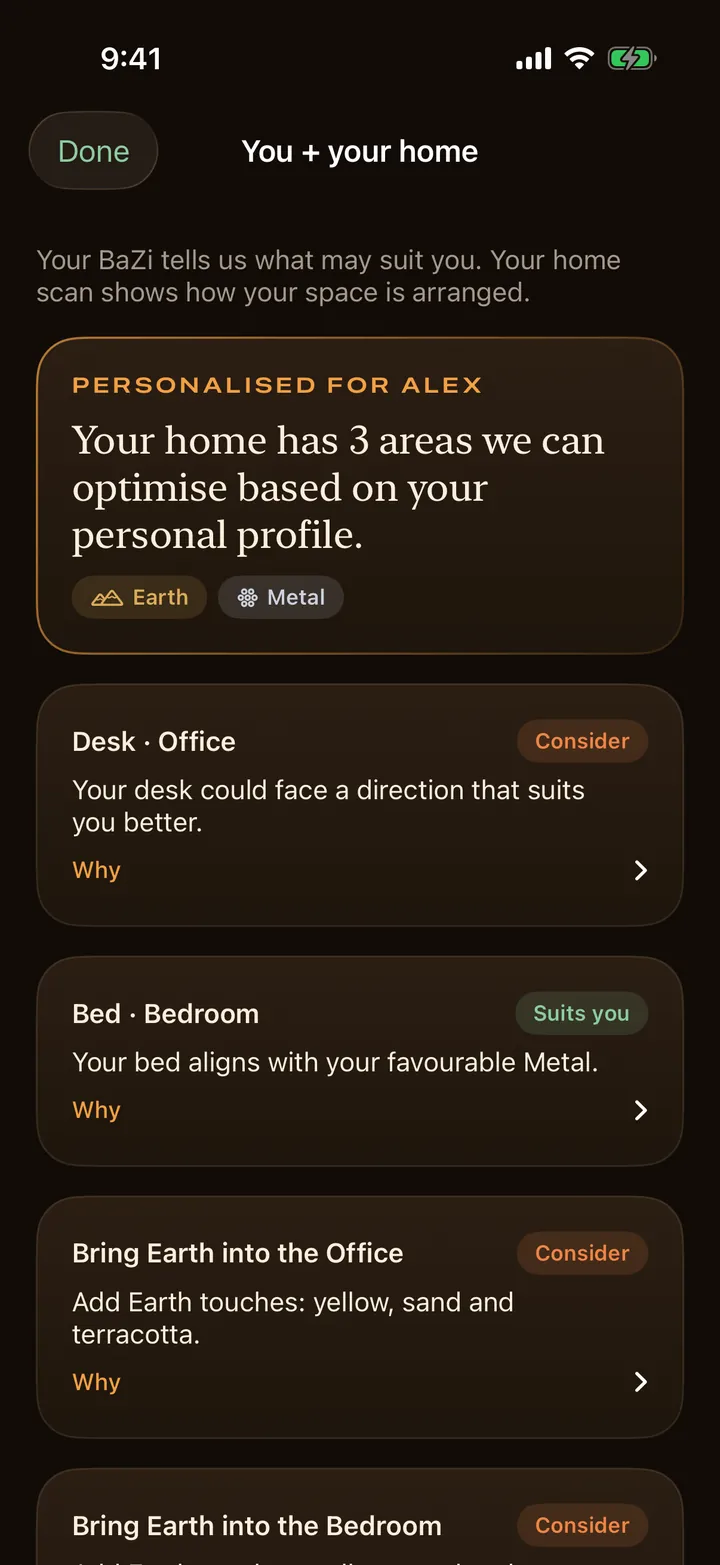
What a scan reads about your bed's direction
- A compass heading is recorded as you scan, so each bed on the plan has a bearing without a separate measurement.
- The direction your head points in each bed, and the sector of the home the bed sits in.
- With your BaZi chart: how both compare with your favourable elements, with a suggestion to face a favourable direction or to add that element’s colours and materials.
- Whether the bed is in the command position: door in view, headboard on a solid wall with no window behind it, and out of the door’s direct line.
- Not read: Kua numbers, Eight Mansions directions or folk rules about north. A heading taken close to large metal objects can also be off, so compare it with a reading of your own.
Questions
What is the best direction to sleep in Feng Shui?
There is no single best direction for everyone. Form-school Feng Shui names none and places the bed by the door and the wall. Eight Mansions gives four personal directions from a Kua number, and BaZi gives the directions that belong to your favourable elements. The two can differ for the same person.
Is it bad Feng Shui to sleep with your head to the north?
Not as a general rule. The idea is well known from Japanese custom and from Indian Vastu, which are separate traditions. In compass Feng Shui, north suits some people and not others, depending on the Kua number or the BaZi chart.
Is bed direction measured from the head or the feet?
Most teachers of compass Feng Shui use the direction the top of the head points, which is the headboard wall, and that is the convention used here and in the app. Some use the feet, which gives the opposite direction. Always check which one a chart or article means.
My partner and I have different lucky directions. Which do we use?
The tradition has no single answer. Common approaches are to favour the person whose rest is the greater concern, or to give one partner the bed direction and the other the direction they face at a desk. Most teachers put the command position ahead of either.
Does direction matter more than where the bed is in the room?
No. Most practitioners place position first: the bed should see the door, have a solid wall behind the headboard and stay out of the door's direct line. A favourable direction is added only if it does not cost any of those.
Can I measure bed direction with my phone?
Yes. Stand beside the pillow end, a step away from the bed, and point the phone the way your head points when lying down. Take three readings in different spots, because metal bed frames, radiators and magnetic phone cases pull a compass off.